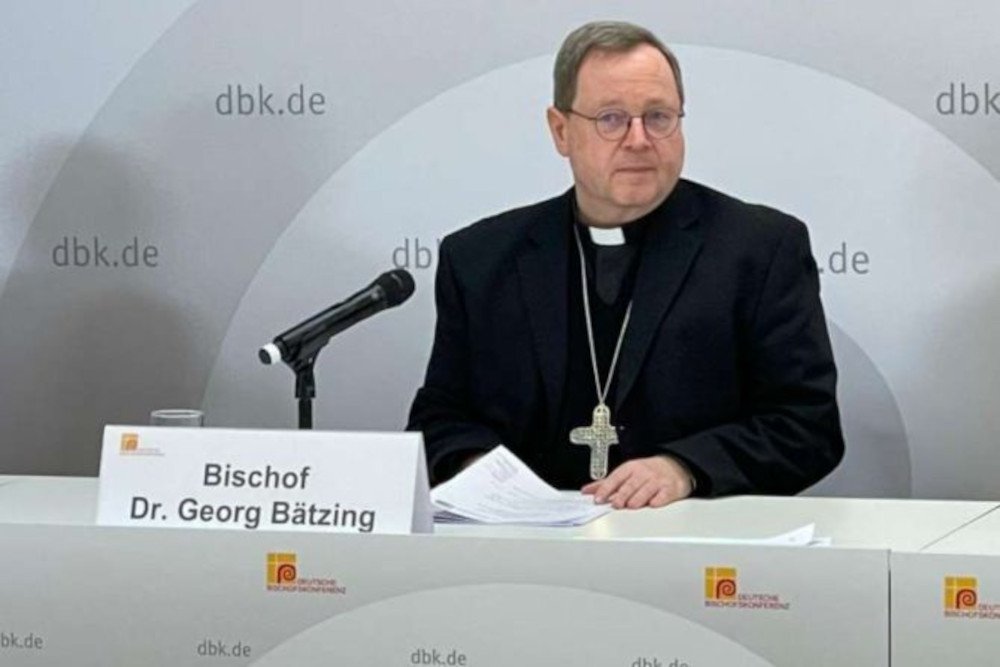
Despite repeated warnings from the Vatican, a letter by the president of the German Bishops’ Conference published Wednesday confirms that plans for a German synodal council are progressing.
In the letter— dated Feb. 23 and published March 1 — Bishop Georg Bätzing writes that the German bishops take the Vatican’s “concerns” about a German synodal council seriously.
The message is addressed to Secretary of State Cardinal Pietro Parolin and to the prefects of the Dicastery for the Doctrine of the Faith, Jesuit Cardinal Luis Ladaria, and the Dicastery for Bishops, Cardinal Marc Ouellet, PSS.
The German bishop tells the cardinals a German “synodal committee” would prepare a synodal council over three years. This move, Bätzing writes, is “a sign that there is still a great need for clarification regarding future synodal cooperation.”
In a four-page letter in January, the Vatican wrote “that neither the Synodal Way nor a body appointed by it nor a bishops’ conference have the competence to establish the ‘synodal council’ at the national, diocesan, or parish level.”
Bätzing’s response says that the German side now wants to delve into the theological issues raised by Rome.
“Therefore, I ask for your understanding if I do not address individual aspects of your remarks in this letter, but gladly and gratefully take up the offer of conversation you have proposed.”
The conversation, Bätzing adds, should continue in Rome “as soon as possible” — but after the final meeting of the German Synodal Way in Frankfurt.
The German bishops are meeting this week in the East German town of Dresden for their plenary assembly.
At the outset of this meeting, the papal nuncio to Germany, Archbishop Nikola Eterović, said he had been “commissioned ex officio” to “specify that, according to a correct interpretation of the content of this letter, not even a diocesan bishop can establish a synodal council at the diocesan or parish level.”
The nuncio also stated, CNA Deutsch reported, that synodality did not mean creating “new institutions with the risk of a further increase in bureaucracy.”
Instead, he warned the German bishops, “what is needed is to revitalize the already existing diocesan bodies in a synodal spirit.”
Synodality was “more a question of spirit and style than of structures,” he said.
Pope Francis and other Church leaders have expressed serious concerns about plans to create a permanent synodal council for the German Church.
Such a body would function “as a consultative and decision-making body on essential developments in the Church and society,” according to a Synodal Way proposal.
More importantly, it would “make fundamental decisions of supra-diocesan significance on pastoral planning, questions of the future, and budgetary matters of the Church that are not decided at the diocesan level.”
In response to warnings from Rome about taking such a step, Bätzing in January already suggested he would pursue a “fallback option.”
“We in Germany are looking for a way of truly deliberating and deciding together without overriding the canonical regulations that affect the authority of the bishop,” the German prelate said.
As to the objections raised at the meetings in the Vatican — and confirmed in a letter approved by Pope Francis — Bätzing in January repeated his public dismissal of these concerns — and vowed the Synodal Way would continue pursuing its controversial agenda in the face of them.
Concerns by German bishops
The bishops of Cologne, Regensburg, Passau, Eichstätt, and Augsburg wrote to the Vatican on Dec. 21, 2022. They raised what Bätzing acknowledged were “justified and necessary questions” — particularly whether bishops could be compelled to abide by such a council’s authority.
This was not the case, the Vatican’s letter noted. The message, written in German, reminded Bätzing that according to Lumen Gentium, the Second Vatican Council teaches “that episcopal consecration, together with the office of sanctifying, also confers the office of teaching and of governing, which, however, of its very nature, can be exercised only in hierarchical communion with the head and the members of the college.”
Running to four pages, the latest Vatican letter to Germany said it was approved by Pope Francis. It was signed by the Vatican secretary of state, Cardinal Pietro Parolin; the prefect of the Dicastery for the Doctrine of the Faith, Cardinal Luis Ladaria; and the former prefect of the Dicastery for Bishops, Cardinal Marc Ouellet.
Warning of a threat of a new schism from Germany, the Vatican already intervened in July 2022 against a German synodal council.