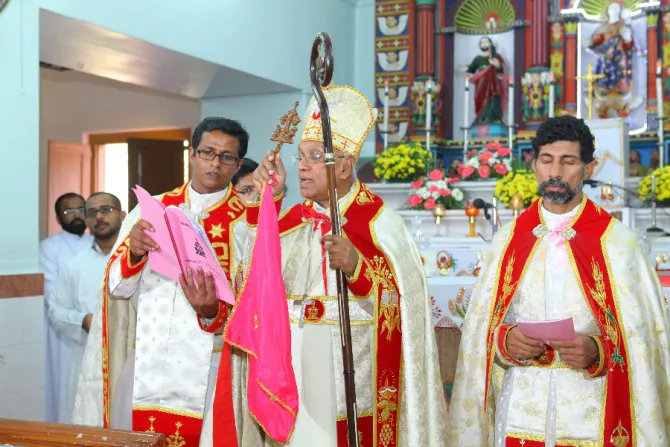
Tensions are rising within the Syro-Malabar Church in the Indian state of Kerala as the Vatican’s Dec. 25 deadline for priests to implement a “universal” liturgy or face possible excommunication fast approaches.
Ahead of the deadline, a number of priests have publicly protested a mandate to institute a uniform Mass and have urged the Vatican to take into account the way they have celebrated the liturgy for the past 60 years.
“We are not against the pope or the Synod [of Bishops] but our request is only to do justice to our archdiocese with 650,000 faithful, 464 priests, and thousands of religious,” Father Kuriakose Mundadan of the Ernakulam Archdiocese told CNA.
Facing the people vs. facing East
The Syro-Malabar Church is one of the 23 autonomous Eastern Catholic Churches in full communion with Rome. The Eucharistic liturgy of the Syro-Malabar Church, known as the Holy Qurbana, has been the subject of a long, complex dispute over which direction the priest should face when celebrating the liturgy.
The Church has been divided, with priests from the Archeparchy of Ernakulam-Angamaly celebrating the Mass “ad populum” (facing the people) in the style of the post-Vatican II Western Church. Others continue to celebrate the Eucharistic liturgy “ad orientem” (facing the East/altar).
The Synod of Bishops of the Eastern Catholic Church based in India approved the introduction of a uniform liturgy in 2021, mandating that priests face the altar rather than the pews.
In July 2021, Pope Francis weighed in on the side of the synod’s mandate, exhorting “all the clergy, religious and lay faithful to proceed to a prompt implementation of the uniform mode of celebrating the Holy Qurbana, for the greater good and unity of your Church.”
A Christmas deadline
After several eparchies failed to abide by the mandate, the pope issued an ultimatum in a Dec. 7 video message calling on the Church to adopt the ad orientem liturgy approved by the synod by Dec. 25.
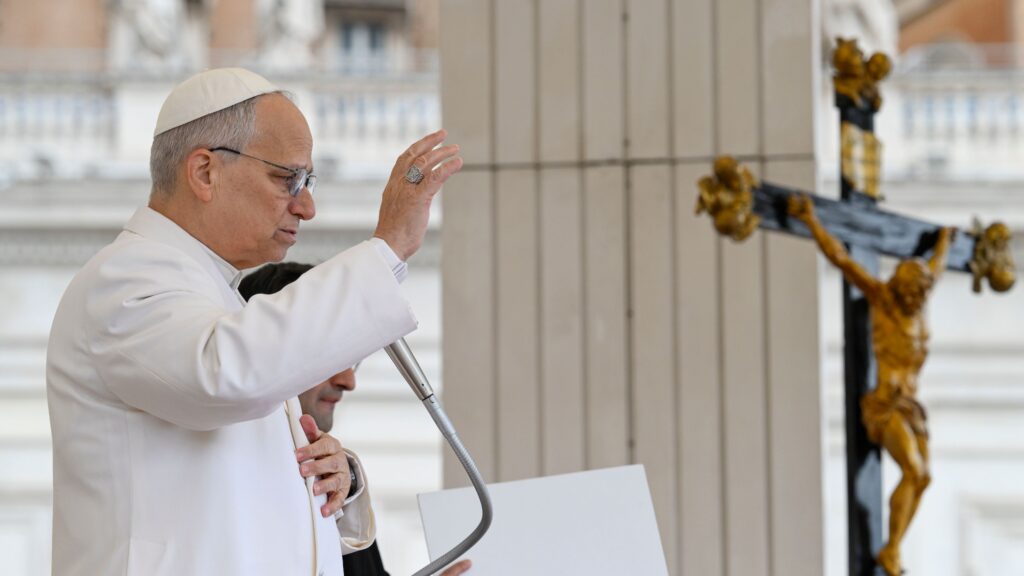
“By Christmas, in the Archeparchy of Ernakulam-Angamaly, as throughout the Syro-Malabar Church, may Qurbana [holy Mass] be celebrated in communion according to the directions of the synod,” Pope Francis exhorted.
“Please do not continue to wound the body of Christ! Do not separate yourselves from it! And even though there have been some grievances against you, forgive them with generosity. May the Eucharist be the model of your unity. Do not shatter the body of Christ which is the Church, so as not to eat and drink judgment upon yourselves (cf. 1 Cor 11:29),” Pope Francis urged in his message to “Brothers and Sisters of the Archeparchy of Ernakulam-Angamaly.”
“I examined closely and attentively the reasons that have been used for years to convince you,” the pope said in his message, adding: “I know there are reasons for opposition that have nothing to do with celebrating the Eucharist or the liturgy. They are worldly reasons. They do not come from the Holy Spirit. If they do not come from the Holy Spirit, then they come from somewhere else.”
Following criticism of the pope’s video message from priests and lay leaders, the Syro Malabar Church (SMC) released a statement on Dec. 11 urging the Church to abide by the pope’s wishes.
“The message of the Holy Father in the video is unambiguous,” the statement read.
“This statement is being issued because of the propagation of a message that the Holy Father might have made a mistake in the subject of the unified mode of celebration of the Qurbana and has been misinformed about it and that there are factual errors in his video message,” said Father Antony Vadakkekara, spokesperson for the SMC.
“This propaganda that the Holy Father was misinformed is a futile camouflage that tries subtly to justify their disobedience of the Holy Father,” Vadakkekara, a Vincentian priest, said.
On Dec. 7, the Vatican accepted the resignations of Major Archbishop Cardinal George Alencherry of the Syro-Malabar Catholic Church and of Archbishop Andrews Thazhath as apostolic administrator. The move was viewed favorably by dissenting priests in the days before the release of the pope’s video.
Dissent from more than 300 priests
In response to the pope’s video message, more than 300 priests of the Ernakulam Archdiocese held an emergency meeting on Dec. 13 and demanded that a “thorough investigation must be conducted into the content of the video message of Pope Francis.”
In a statement released to the press they said that Thazhath, who had days before been relieved of his duties as apostolic administrator, was responsible for the pope’s video message.
“The source of the video message, which is replete with factual errors and ambiguities, is a by-product of Archbishop Andrews Thazhath and the Dicastery for Oriental Churches, which enforces the pope to sing to its tune without verifying the facts,” alleged the statement issued by the Archdiocesan Protection Council (APC).
“When the pope remarks that only a few priests are against the synod [uniform] Mass and the faithful should not listen to them on this matter, it obviously is not the language of Pope Francis who consistently and repeatedly speaks about synodality. In fact, out of the 464 priests, barring 10-12 priests, the remaining 452 vouch for the Mass versus populum (facing the people),” the APC statement said.
The Syro Malabar Church, however, told CNA that all members of the Church are duty-bound to obey the pope’s wishes.
“The papal message needs no clarification,” Vadakkekara told CNA when asked for reaction to the controversy making headlines in the secular and Catholic media.
“When the Holy Father has clearly stated that he has ‘examined closely and attentively’ the subject, how can we [the SMC] react to it?” he said.
Thazhath told CNA that criticism of the pope’s video message was an act of disobedience.
“Am I greater than the pope to dictate anything to him?” Thazhath said. “They are trying to find excuses to disobey the pope,” he added.
Nevertheless, a number of priests have continued to express dissenting views, challenging the pope’s call for liturgical unity.
“The Holy Father would have not made such a message if he had been briefed about the reality here,”Mundadan, the priests’ council secretary of the Ernakulam Archdiocese, told CNA.
“Based on the Second Vatican Council,” Mundadan said, “all the parishes under Ernakulam Archdiocese have been saying the Mass facing the people for 60 years while some dioceses have been doing it facing the altar.”
“The real issue is the liturgy itself, but some have misguided the pope on this to say there are ‘worldly reasons,’” Mundadan said.
Mundadan told CNA that the 2021 online synodal meeting did not follow correct procedure when it decided that the entire Church would adopt a uniform liturgy.
Archbishop Cyril Vasil, appointed by Pope Francis in July to help find a resolution to the crisis splitting the Syro-Malabar Church, traveled to Kerala on Dec. 12.
“I explained this in detail during today’s [Dec. 18] meeting with Archbishop Cyril Vasil. We are not against the pope or the synod but our request is only to do justice to our archdiocese with 650,000 faithful, 464 priests, and thousands of religious,” Mundadan said.
“Serious discussions are going on with the papal delegate and Bishop Bosco Puthur, [new administrator of Ernakulam] to sort out the issues,” Father Jose Vailikodath, APC spokesperson, told CNA.
Meanwhile, priests from the neighboring Irinjalakkuda Diocese have also protested the “uniform Mass” mandate.
Seven senior priests from the diocese met with Vasil in Kochi on Dec. 19 and presented him with a memorandum calling for the restoration of the Mass facing the people.
“The bishop and the representatives of the priests from the Eparchy of Irinjalakuda had reported the discord in the diocese [that] arose after the announcement of the synod’s controversial decision,” the memorandum pointed out.
“Any move to impose uniformity, falsely citing dissension among priests, will end up leaving the currently vibrant Church lifeless and inactive,” cautioned the memorandum signed by 127 of the 220 priests now serving in the diocese.
“Though officially the synodal Mass was launched in the diocese, Mass facing the people throughout is followed in several parishes,” Father Jose Kavalakat, coordinator of the Liturgical Action Committee of Irinjalakkuda who led the delegation, told CNA.
This article was originally published on Catholic News Agency.