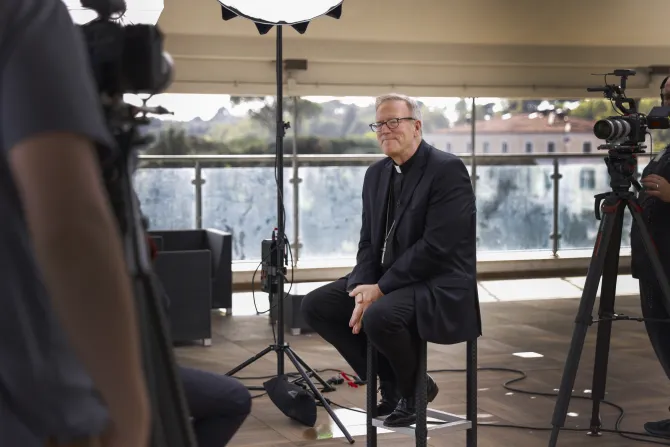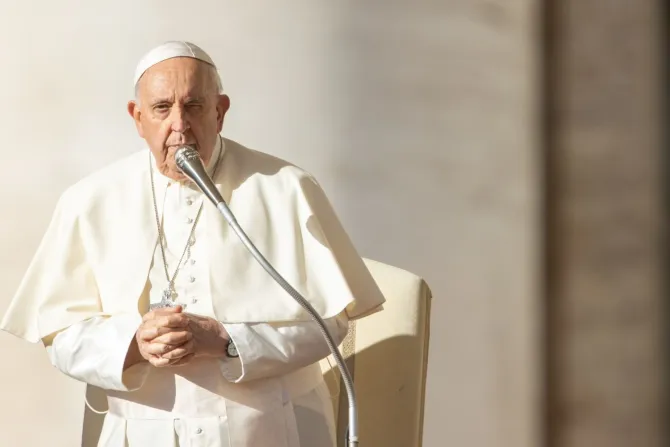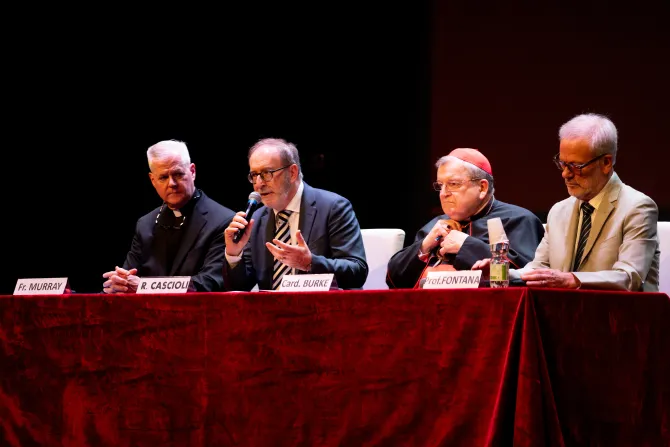
Cardinal Raymond Burke has spoken out on the reactions raised by the “dubia” he and four other cardinals submitted to Pope Francis on the eve of the opening of the plenary assembly of the Synod on Synodality, asserting that the move was aimed neither at the pope’s person nor his agenda, but merely at safeguarding the Church’s perennial doctrine.
The cardinal was speaking at a conference organized in Rome on Oct. 3 by the Italian Catholic newspaper Nuova Bussola Quotidiana on the theme “the synodal Babel,” designed to discuss the main points of contention raised by the synod, which opened at the Vatican on Oct. 4.
The work of this first session convened by the pope, titled “For a Synodal Church: Communion, Participation, and Mission,” will run until Oct. 29. A second session of the Synod on Synodality is expected in October 2024 to “continue discernment.”
In his address at the Ghione Theater, located less than a mile from St. Peter’s Square, the prefect emeritus of the Apostolic Signatura reaffirmed his concern over the “philosophical, canonical, and theological errors that are widespread today regarding the Synod of Bishops and its [first] session.”
The main stumbling blocks cited by the cardinal and his fellow cardinals in the questions addressed to the Holy Father in August and made public on Oct. 2 concern doctrinal development, the blessing of same-sex unions, the authority of the Synod on Synodality, women’s ordination, and sacramental absolution.
“It is unfortunately very clear that the invocation of the Holy Spirit by some has for its purpose the advancement of an agenda that is more political and human than ecclesial and divine,” he stated before an audience of about 200 people, largely made up of journalists and ecclesiastics, including Guinean Cardinal Robert Sarah, co-signatory of the dubia along with Cardinals Walter Brandmüller, Zen Ze-Kiun, and Juan Sandoval Íñiguez.
Highlighting that “many brothers in the episcopate and even the College of Cardinals support this initiative, although they are not on the official list of signatories,” the American cardinal specified that it did not concern the Holy Father as a person.
He was reacting to a comment made by a synod father, quoted anonymously by Il Giornale after the contents of the dubia were published in the press, accusing the five cardinals of wanting “only to strike at Pope Francis” and of seeking to dictate their agenda at the risk of threatening the unity of the Church.
“These comments reveal the state of confusion, error, and division that permeates the session of the Synod of Bishops,” he continued. “The five dubia deal exclusively with the perennial doctrine and discipline of the Church, not a pope’s agenda.”
According to him, that statement was influenced by the words of the new prefect of the Dicastery for the Doctrine of the Faith, Cardinal Víctor Manuel Fernández, who in a recent interview with the National Catholic Register accused those who criticize the “doctrine of the Holy Father” of being on the road to “heresy and schism.”
“The Church has never taught that the Roman pontiff has a special power to constitute his own doctrine. The Holy Father is the first master of the deposit of faith, which is in itself always alive and dynamic,” he said.
Burke then challenged the very concept of synodality, the theme of the current synod. Indeed, he believes that the “abstract” term of synodality, which he describes as “a neologism in Church doctrine,” is intended to “artificially link” this concept to an Eastern practice, which has nevertheless “all the characteristics of a recent invention, especially with regard to the laity.”
These remarks echoed those of canon lawyer Father Gerald E. Murray, who introduced the conference by expressing his doubts about the validity of the current synodal session, due to the introduction of non-bishop electors to the assembly.
“Those who are not shepherds in the Church are being given a role that pertains by nature only to the shepherds,” he said, concluding that “the assembly is not a Synod of Bishops any longer.”
“By analogy, would we say that the election of a pope at a conclave made up of cardinals and also of non-cardinals would still be an act of the College of Cardinals? Clearly, we could not say that,” he said.
The lack of a metaphysical aspect in the understanding of the notion of synodality was also pointed out by Stefano Fontana, director of the Van Thuân Observatory for the Social Doctrine of the Church, who noted that the concepts and key words developed around this notion in recent years, especially in the Instrumentum Laboris, have been influenced by currents such as existentialism, Marxism, and, more generally, historicism, which postulates that a society’s values depend on a historical context.
As a result, Fontana said, the “change of doctrine through the new synodality is not entrusted to doctrine but to practice; it is practice that decides what we do.”
“Being and ought-to-be are the same thing,” he said. “How can one not see in all this the influence of the more classical strands of philosophical and theological modernism that the new notion of synodality transposes with great fidelity? Truly, the new synodality comes from far away.”
This article was originally published on CNA.