Skip to content

Exploring the Holy Relics of the Passion of Christ in Rome’s Basilica of the Holy Cross in Jerusalem

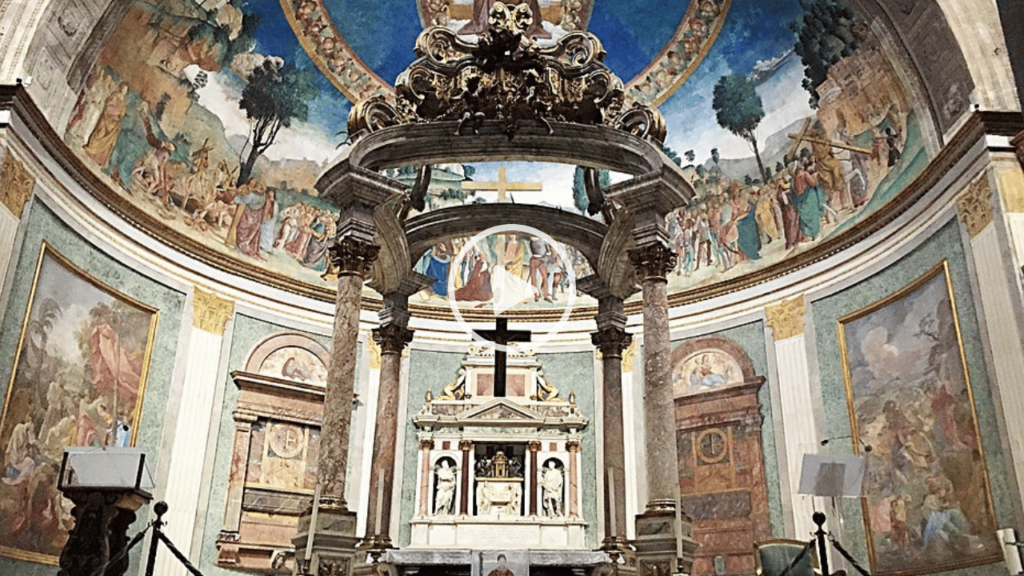
Welcome to our latest video tour of the Basilica of the Holy Cross in Jerusalem! In this video, we take you on a journey through the chapel of the relics, where the most important and symbolic relics of the passion of Jesus Christ are kept. 

For centuries, the popes would walk barefoot to pay homage to these relics on Good Friday, and today, people from all over the world come to kneel and pray in front of them. 

In the small chapel of the relics, you can find the precious reliquaries that house the holy relics, including a fragment of the true cross on which Jesus was condemned to death. You can also see two thorns from the crown placed on Christ’s head, a nail used for Jesus’ crucifixion, fragments from the grotto of the nativity and the holy sepulchre, and the phalanx of Saint Thomas’s finger. 

In addition, you can see the titulus crucis, the tablet written in Hebrew, Greek, and Latin characters placed on the cross of Jesus, which states the reason for his death sentence. This tablet was found in the 15th century walled up inside the abscidal arch of the basilica. 

The frescoes in the apse of the basilica tell the story of the legend of the true cross, starting with Saint Helena’s search for the cross in Jerusalem and ending with her division of the cross into three parts. 

While we can never be certain that these relics are genuine, they are incredibly symbolic and important in the devotion to the tomb that lay empty 2,000 years ago. Join us on this special Vatican tour and explore the history and significance of these relics for yourself.


Receive the most important news from EWTN Vatican via WhatsApp. It has become increasingly difficult to see Catholic news on social media. Subscribe to our free channel today

Share

Would you like to receive the latest updates on the Pope and the Vatican

Receive articles and updates from our EWTN Newsletter.

I agree that EWTN will keep me informed about news, faith stories and how to best support their work. You will never receive e-mails from us that you do not want to receive. You can unsubscribe any time. For more information on how to unsubscribe, our privacy practices, and how we are committed to protecting and respecting your privacy, please review our Privacy Policy.

More news related to this article

EWTN SUMMER ACADEMY: How to Become a Digital Missionary

The EWTN Summer Academy took place in Rome for the fourth year in a row. 40 journalists studied, collaborated on scripts, and worked in teams to produce, shoot, and edit videos, all while taking a deeper dive into their faith.

Pope speaks with Israeli and Ukrainian presidents amid conflicts in Holy Land, Ukraine

The pontiff discussed the ongoing wars and exchanged Easter greetings with the two presidents. Pope Leo XIV spoke

Pope John Paul II declared Divine Mercy Sunday a feast 25 years ago

On April 30, 2000, Pope John Paul II canonized Maria Faustina Kowalska and declared the second Sunday of Easter as Divine Mercy Sunday. This year, we celebrate the feast on April 27.

Pope Leo praises Christian archaeology, capable of ‘bringing to light anonymous holiness’

On the centenary of the founding of the Pontifical Institute of Christian Archaeology, Pope Leo XIV published a

Message from Pope Francis for the World Day of Migrants and Refugees 2023

Pope Francis emphasizes the importance of freedom in migration decisions in his message for the 109th World Day of Migrants and Refugees

Archives of a Political Laboratory: Rome 1943-1944 Reveals the Role of the Holy See in Liberation

On April 26th, Rome's Catholic LUMSA University hosted an event that shed light on the actions and role of the Holy See during the liberation of Rome from Nazi-Fascism in 1944, thanks to the opening of archives from the pontificate of Pius XII.

LIVE
FROM THE VATICAN

Be present live on EWTNVatican.com