Msgr. Alberto José González Chaves, a Spanish priest of the Archdiocese of Toledo and former Vatican official, reflected on the importance of Eucharist adoration for Benedict XVI.
In an interview with EWTN News, Bishop Gonzalez explained that for Benedict XVI, “adoration is life because his life was an adoration.”
The Spanish priest recalled that the late Pontiff first placed “the primacy and absolute protagonism of God” and the need for men to turn to Him.
Bishop Gonzalez, appointed Chaplain to His Holiness in 2011, remembered how Benedict XVI considered adoration to be “a transformation with the One with whom we merge” through Holy Communion in the Holy Mass.
For this reason, the Doctor of Spiritual Theology also highlighted the care with which the Pontiff officiated the Eucharist.
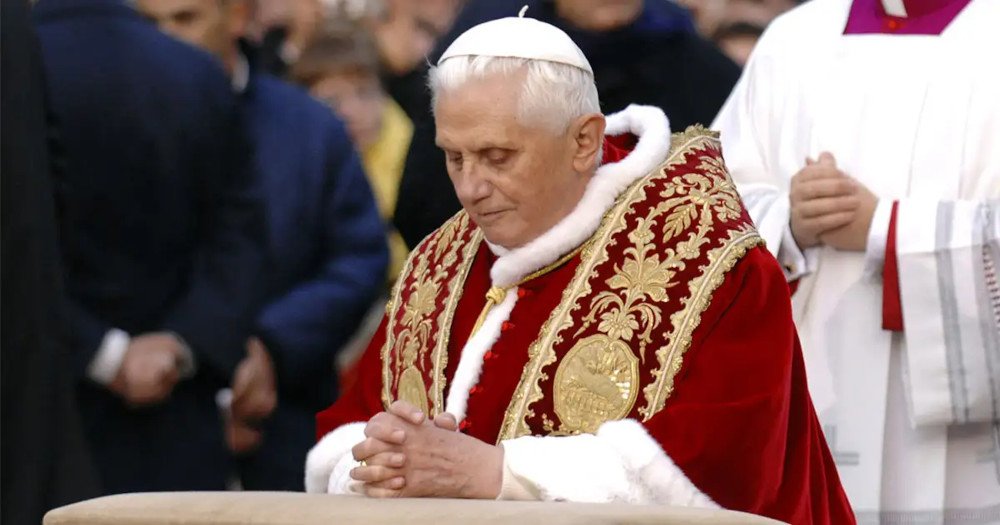
“It was necessary to see him celebrate the Holy Mass. With how much unction, delicacy, and visible zeal he did the genuflections at more than 80 years of age,” he said.
He also emphasized the importance he gave to receiving Communion on his knees and in his mouth as a way of confronting “the desacralization, or even Protestantization of the Eucharist, ” which St. John Paul II spoke in his encyclical Ecclesia de Eucharistia.”
The priest, author of spiritual books such as “Jesus in the Eucharist: Do you understand what I have done with you?”, explained that Benedict XVI “inaugurated a new format for World Youth Day” in which the protagonist is not the Pope or the young people, but Jesus.
This protagonism was reflected in an anecdote during WYD in Madrid, Spain when the Pope’s program was suspended for a few minutes due to an intense “hurricane” that blew over Cuatro Vientos. In this place, the closing Mass of the event was being celebrated.
“He preferred to omit the speech he had prepared for the young people not to suppress the Eucharistic adoration. And he was there for another half hour, prostrate before the magnificent monstrance of Arfe of the Cathedral of Toledo,” he recalled.
Bishop Gonzalez also explained that the monstrance “was moved on that occasion to make visible and better present the sovereign importance of the Eucharist, for which man has made not an object of clay or wood, but of gold and precious stones.”
The Spanish priest, who worked in the Congregation for Bishops at the Vatican from 2006 to 2013, stressed that with this custody, the Church, without abandoning the poor, wanted to give God the best it had.
“All this was of great interest to Benedict XVI. [He wanted] to visualize it,” indicated Msgr. Gonzalez. “But [it was] not as a nostalgic or aesthetic staging, but to put at the center of the Church the one who is truly its center”, that is, “Jesus, crucified and risen, alive with a beating heart, present in the Eucharist that asks for our adoration.”
“This is why I say that in Benedict’s adoration, more than a teaching or a commitment, is life,” he concluded.
This story was first published by ACI Prensa, the Spanish-language sister service of EWTN News.