In the run up to Christmas, the Holy See has pushed for an end to the European war, ramping up its involvement in the work for peace in Ukraine. Yesterday, Secretary of State, Cardinal Pietro Parolin, offered the Vatican as “adequate space” to bring together the conflicting parties and for starting a dialogue between Russia and Ukraine.
Today, President Sergio Mattarella was due to meet with Cardinal Parolin to discuss possible routes towards peace through diplomacy. However, the Italian head of state tested positive for Covid over the weekend and was not able to participate. The conference still took place and focused on the Helsinki Accords from 1975, an agreement signed by 35 countries at the height of the Cold War, affirming their respect for fundamental human rights and freedoms.
Italy and the Vatican seemingly want to join forces in moving towards an end of the war in Ukraine, and it is not insignificant that Pope Francis and Cardinal Parolin have referenced the Helsinki Accords quite often in the past few months.
During his apostolic trip to Kazakhstan, the Holy Father called for leaders who promote “mutual understanding and dialogue”. They need to “give birth to a new ‘spirit of Helsinki’,” he said.
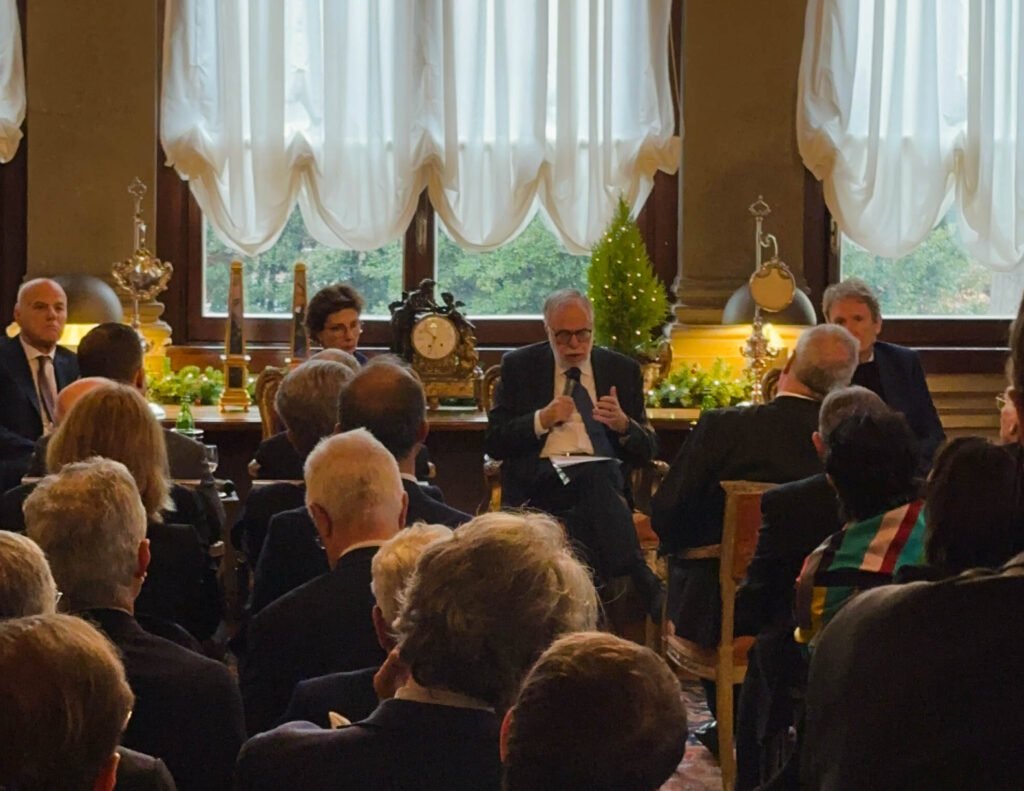
This “spirit of Helsinki” was evoked in today’s conference in Rome frequently and fervently. The high-level panel discussion of that took place today mirrored the current political debate in Europe surrounding the Russian invasion of Ukraine. While some suggested that peace at all costs needs to be achieved, others insisted that lasting peace requires justice. Among the panellists were Lucio Caracciolo from the Italian magazine Limes, Andrea Riccardi, founder of the Sant’Egidio community, Claudio Descalzi, a representative of the global oil and gas company ENI, and Monica Lugato, a professor from the Libera Università Maria SS. Assunta (LUMSA).
Many attended the discussion, including ambassadors and journalists. Afterwards, some voiced their surprise that the panel had partially urged the West to back out of the conflict and accept new borders in Ukraine.
In his keynote speech, Cardinal Parolin called for more courage to make peace possible, asking why everyone does not work together towards “a new grand European conference dedicated to peace”.
The Holy See is “ready to do everything possible,” but they favour a course of dialogue and cooperation. The Secretary of State would like to see an end to the ongoing “barbaric fratricide” in the region.
The only business representative in the panel discussion, speaking on behalf of the energy giant, ENI, brought an interesting angle to the conversation. He reminded the audience that Europe has to do more to achieve peace, as it is dependent on Russia and, thus, at a great disadvantage to China or the United States. He also spoke about Africa, and how the continent is currently suffering as a result of the war in Europe as well.
The rest of the panellists generally agreed that human rights ought to be respected and steps towards a peaceful future should be taken.
Helsinki not only lent its name to the conference but served as a reference point throughout the discussion.
Notably, no one in attendance suggested a more hawkish approach to the conflict. Nobody advocated defeating Russia in Ukraine to limit any further expansion. No one mentioned that countries such as Germany have already taken large steps towards harnessing alternative energy sources and becoming more independent from Russian energy as a result. There was a general consensus that it is time to return to the table, just as it was at Helsinki in 1975.
As well as prayer, the strength of the Holy See is diplomacy. The Secretariat of State has an impressive track record in diplomatic talks, a field where even the smallest state can become the most valuable player by convening the right parties. Cardinal Parolin strongly suggested inviting civil society institutions, such as NGOs and think tanks, to the table to facilitate peace talks.
The Vatican also seeks to join ranks with Italy and may have found an ally in the country’s president, even though the real political power is held by Prime Minister Georgia Meloni. Today she affirmed her strong support for Ukraine and announced that Italy, a NATO member, will send more weapons to push back the Russian invasion.