By Gia Chacón
COMMENTARY: When technology serves power instead of the person, the result is not progress but oppression.
SIGN UP FOR OUR NEWSLETTER HERE
Artificial intelligence is giving governments and hostile actors the ability to identify, monitor and silence Christians in ways that are quieter, faster, and harder to expose. What once required vast manpower can now be done instantly, at scale and with precision that human surveillance could never match.
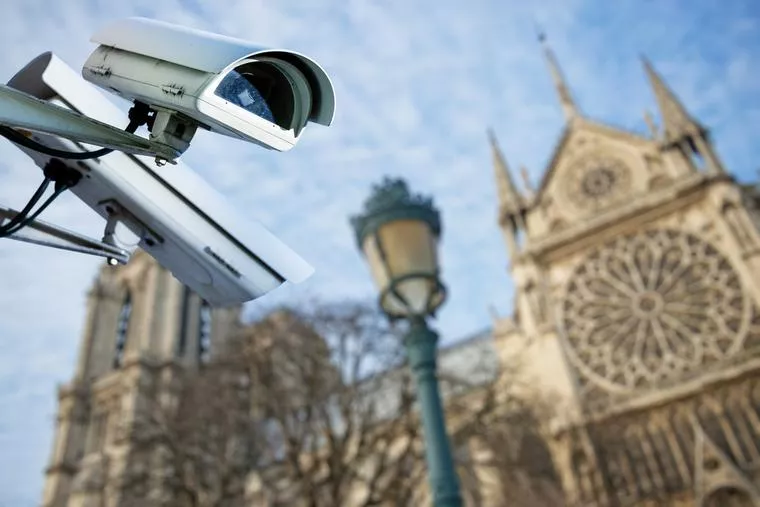
In China, authorities have installed cameras at the entrances of churches and, in some cases, inside sanctuaries. These cameras are tied to facial recognition systems that can identify worshippers and feed that information into state databases. Incredibly, Church attendance can quietly damage a person’s career, block university admission, or limit travel. A national policing platform known as the Integrated Joint Operations System aggregates biometric data, travel history and communications to flag “suspicious” individuals. First deployed against Uyghur Muslims, the same system has been used to monitor Christian communities.
This surveillance extends online. In one documented case, members of a Christian book group tried to recommend The Imitation of Christ by Thomas à Kempis on WeChat, China’s dominant social media and messaging app, used by more than a billion people. The moment they typed the word “Christ,” the platform flagged it as a violation and blocked the post, classifying the term alongside pornography and “incitement.” They were only able to share the title by replacing a letter with a number. This is AI-driven censorship in practice: real-time scanning and suppression of Christian content before it ever reaches an audience.
Persecution of Christians is not a thing of the past. It is growing and changing. Around the world, believers still face brutal violence: Villages are attacked in Nigeria, pastors are jailed in India, and mob assaults in Pakistan result after false blasphemy accusations. But alongside these visible attacks, a new form of repression is advancing.
Iran’s methods look different but rest on the same principle: total visibility. Drones, fixed cameras and facial recognition software scan public spaces, with images tied to government records.
Officially, the system enforces Islamic dress codes, but the same infrastructure can be, and in authoritarian contexts inevitably will be, used to track Christian converts and underground churches. United Nations investigators have documented how these tools are already embedded in universities, workplaces, and transportation hubs.
Between June 2023 and May 2024, governments in at least 41 countries blocked websites that hosted political, social or religious content. For Christians in restrictive environments, digital communication is not optional, it is the only way to receive teaching, join in worship, or hear from their pastors. When algorithms automatically remove sermons, throttle livestreams, or hide faith-based content, the result is the same as locking church doors.
Another weapon is deepfake fabrication. With only a short audio clip or a few photographs, AI tools can create convincing fake videos or recordings. Criminal networks already use these for extortion.
In countries where blasphemy accusations can lead to imprisonment or violence, a fabricated statement from a Christian leader could be deadly. Even in free societies, such attacks can ruin reputations and divide communities before the truth is known.
Pope Leo XIV has already warned that “artificial intelligence requires proper ethical management and regulatory frameworks centered on the human person, and which goes beyond the mere criteria of utility or efficiency.” When technology serves power instead of the person, the result is not progress but oppression. His call for a “moral architecture” for AI is not an abstraction, it is a blueprint the Church must now put into practice.
For the Catholic Church, that means setting its own standards for safeguarding the faithful: requiring secure communication in dioceses and ministries, training clergy in digital risk, and ensuring that no Catholic institution becomes a source of data that can be exploited against believers. It means using the Holy See’s moral authority to press governments and corporations for enforceable protections.
And for Catholics in nations with freedom, it means acting as advocates for those who have none. Laws, trade policy, and technology standards can either protect the persecuted or arm their persecutors.
For the Church, the task is clear: Stop the flow of tools that enable persecution before they reach the hands of oppressors. The United States Commission on International Religious Freedom has identified export controls on AI-driven surveillance, facial recognition, and biometric tracking systems as one of the most effective defenses.
If Pope Leo’s call is taken seriously, the Church will lead in ensuring that the tools of the age are not turned against the body of Christ. If it is ignored, we will have surrendered that responsibility, and the silence will be our own.
This article was originally published by NCRegister.