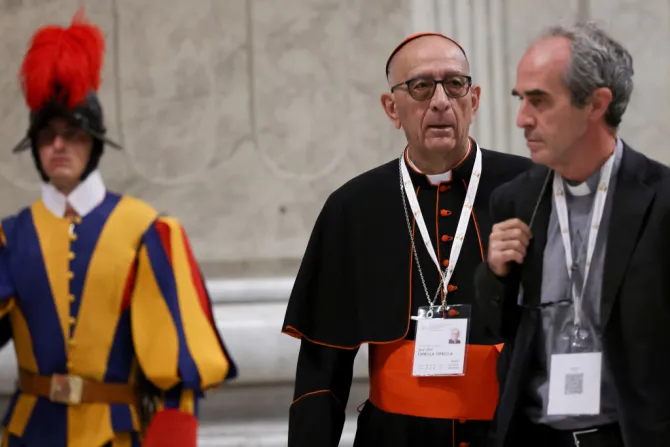
Archbishop Gabriele Caccia, the Holy See’s permanent observer to the United Nations, laid out the economic reasons surrogacy exists, the harm it does, and why it is wrong.
The Holy See has reaffirmed its position against surrogacy in a statement to the United Nations, urging the complete eradication of the practice and calling for the protection of women and children from exploitation.
Archbishop Gabriele Caccia, apostolic nuncio and permanent observer of the Holy See to the U.N., highlighted the urgency and sensitivity of the issue, lamenting that “technology and practice have run laps around the law and ethics.”
Although he acknowledged that many view surrogacy “as a compassionate solution for those wishing to be parents,” he urged the adoption of measures that respect the dignity and rights of women and children.
Women choose it due to financial need
Caccia lamented that because of financial need, many women agree to carry a child in their womb and subsequently hand the child over to others for money. This situation could be remedied through the development of “social protection, education, and economic opportunities,” he said.
The statement asked whether the surrogacy industry could survive if poverty were eradicated. It warned that the demand for this practice “already exceeds the supply” and that many women who do not wish to participate may find themselves pressured or even coerced into doing so by family members.
The text also addressed the rights of children, who are reduced to an item to be ordered “within an industrial and dehumanized logic.” The statement from the Holy See also denounced the commodification of babies and the fact that many are considered “a defective product” when they have a disability.
This attitude “runs contrary to a just society in which children can grow and flourish. Children, in fact, possess rights and interests that must be respected, beginning with “a moral right to be created in an act of love,” as well as the right “to know their parents and to be cared for by them,” according to the statement.
Although the Holy See acknowledged the “very real and understandable desire to have children,” it maintained that these issues cannot simply be resolved through the regulation of surrogacy.
The Permanent Mission of the Holy See to the U.N. commended the decision of the Hague Conference on Private International Law not to proceed with the drafting of a convention on legal parentage in cases of surrogacy.
Caccia also recalled the words of Pope Leo XIV, who affirmed that, by transforming gestation into a negotiable service, one “violates the dignity both of the child, who is reduced to a ‘product,’ and of the mother, exploiting her body and the generative process, and distorting the original relational calling of the family.”
The Holy See urged that new steps be taken “toward ending this practice in all its forms and at all levels,” with the aim of protecting women and children “from exploitation and violence.”
This story was first published by ACI Prensa, the Spanish-language sister service of EWTN News. It has been translated and adapted by EWTN News English.