How to communicate with hope in today’s Europe? That is the question a group of Church communicators and journalists tackled during a June 3–5 meeting in Prague organized by the Council of Bishops’ Conferences of Europe.
Within the framework of the Jubilee of Hope, experts from 18 European Union countries gathered to reflect on communication that “restores meaning” to people’s lives; that is, communication that speaks of God.
Daniel Arasa, consultor to the Dicastery for Communication and dean of the faculty of institutional social communication at the Pontifical University of the Holy Cross in Rome, opened the meeting with a presentation titled “The Service of Ecclesial Communicators to the Church in the Current Context.”
In a conversation with ACI Prensa, CNA’s Spanish-language news partner, Arasa addressed one of the main problems facing institutional communicators: the lack of trust in institutions. In light of this, he emphasized the importance of renewal focused on three lines of action.
A call for ‘cultural reforestation’
First, he called for “cultural reforestation,” a metaphor that refers to the replanting of core values in society “that give meaning and unity to coexistence.”
He specified that the loss of these values has not only been due to religious ignorance or de-Christianization but also the process that began in the 1960s “with gender theories, radical feminism, the exacerbation of individualism, and relativism.”
Arasa explained that these phenomena have emptied concepts such as man, woman, family, and love of anthropological content. Such concepts “until recently were shared worldwide and allowed for dialogue and social coexistence. Now they have been emptied of content,” he pointed out.
When these “trees” are removed, the communications expert added, “the mountain collapses.” Therefore, he emphasized the responsibility of ecclesial communicators to “culturally reforest society.”
In his presentation, Arasa also emphasized the need to foster creativity and empathy in communication.
Finally, he cited four qualities that a religious communicator must possess: “a desire for ongoing formation, service, unity with the Holy Father, good humor, and joy.”
In the face of wars and secularization in Europe, he clarified that giving hope is not only about communicating good news but also “being able to talk about negative things in a context of faith; that is, of hope.”
He also emphasized that people “want to hear stories,” so institutions are best presented through stories.
Italian Alessandro Gisotti, deputy director of the editorial department of the Dicastery for Communication and former Vatican spokesperson during the pontificate of Pope Francis, reflected on the topic of “Communication from Pope Francis to Pope Leo.” He said that to understand Pope Leo, “you have to know St. Augustine.”
The final session addressed the topic “Journalists and Vatican Communication,” with talks by Javier Martínez Brocal, Vatican expert and correspondent for the Spanish newspaper ABC, and Josef Pazderka, editor-in-chief of Český rozhlas Plus, a Czech radio station.
Brocal emphasized that those who have lost the sense of meaning in life or who are despairing find that answer in the Church, even if they are not directly seeking it.
Arasa echoed Martínez-Brocal’s words, emphasizing that “the Church is one of the few, if not the only, institution that can give meaning to many of these questions.” In this regard, he emphasized that the same people who tend toward “Orientalism, mindfulness, etc., were very attentive to what was happening during the conclave.”
“The very beauty of the rites, the prayers, the sense of joy that permeated the people, in the squares… these are things that show there is a spiritual dimension behind it; it is what truly fills people with meaning,” he added.
In this context, he recalled that Leo XIV seeks to “recover the primacy of Christ,” a theme on which Francis also insisted greatly. “People need answers, and only God is the answer, and we must not be afraid to present it in a very positive, non-imposing way. It’s about giving a message of joy,” Arasa indicated.
Witness of life and consistency
Finally, he insisted on the importance of consistency: “We cannot speak of Christ and present Christ without giving testimony with our lives. Everything we say must have that evangelizing spirit, something the pope constantly emphasizes.”
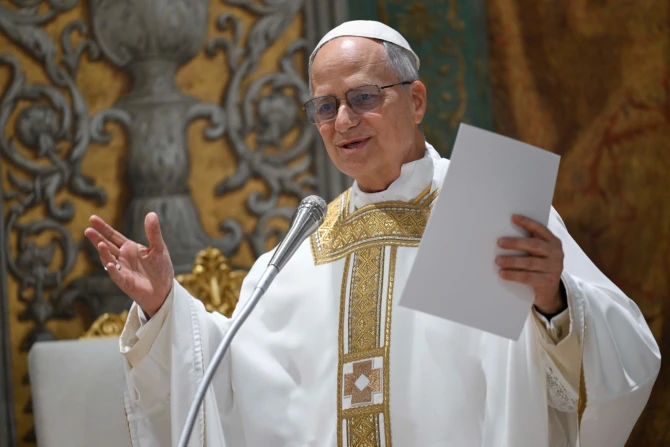
The meeting also included various cultural activities, including a Mass in the St. Wenceslas Chapel of Prague Cathedral, presided over by Bishop Josef Nuzík, president of the Czech Bishops’ Conference.
SIGN UP FOR OUR NEWSLETTER HERE
This story was first published by ACI Prensa, CNA’s Spanish-language news partner. It has been translated and adapted by CNA.