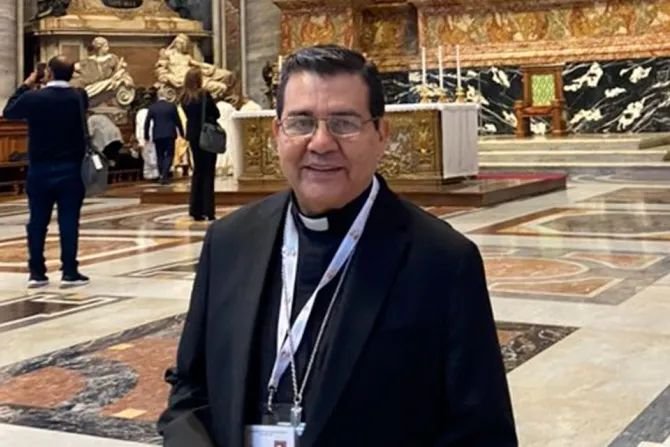
The archbishop of Durango, Mexico, Faustino Armendáriz, commented that “it’s a challenge to seek the will of God” at the Synod on Synodality, where he is a participating member. The synod is taking place at the Vatican through Oct. 29 and for the first time laypeople, including 54 women, will have the right to vote.
The Synod of Synodality was announced in October 2021 with the theme “For a synodal Church: communion, participation and mission.” Hundreds of people, including bishops, priests, and laypeople, are taking part in this year’s session, which will be followed by a second session in October 2024.
“Here it is a challenge to seek God’s will, not ours,” Armendáriz noted. “Many voices are heard saying ‘this is going to happen,’ ‘this is going to change,’ ‘that is going to be removed.’ No. What is the will of God? That is what we want to discover,” the prelate said in an interview with ACI Prensa, CNA’s Spanish-language news partner.
Armendáriz considered that the many proposals and experiences shared will enlighten the participants to help them “see with more hope this path of the Church” in which there are some voices that “are very far from imagining what we really want.”
“What we want,” he emphasized, “is not to remove what already exists but to strengthen it with the desire for our churches to be living churches.”
Synodality and the Holy Spirit
The Mexican archbishop acknowledged that for everyone to be “in synodality is not easy” since there are people “with very different ideas” and who come from different cultures.
“I had to be a relator in one of the small circles, and putting together a document where we all agree is quite a challenge, but it can be done. I say this from my testimony of having achieved it and being able to present it to the synthesis commission,” he continued.
The working method of the synod establishes that each small circle or working group presents its report to the commission in charge of preparing the summary document of the first session, which will include both the topics on which there is both convergence and divergence.
The archbishop encouraged Catholics to “look with great hope that indeed many fruits will come out [of the synod]. I think we should trust the Holy Spirit and say — every time we start a project or a session — that we do it in the name of God.”
When asked what synodality is, Armendáriz said that “synodality, literally and etymologically, means ‘walking together,’ although the fact of being together does not mean that we are in synodality, but rather it is a whole lifestyle that we have to learn.”
The archbishop of Durango then highlighted that “in the synod, before each meeting, the presence of the Holy Spirit is invoked, there are pauses to meditate in the light of the Spirit, the topic is taken up again and at the end, after a day or more, we can agree on this, looking at the good of the Church.”
“Here it doesn’t matter what we say but what the Holy Spirit inspires in each of the participants in the synod,” he noted.
If what is done in the synod, he continued, is done “in the name of God, I believe that we don’t have the risk of being calculating, but we can simply share.”
In that regard, he noted that in the Masses the Lord and the Virgin are asked to guide the delegates. “We invoke the Holy Spirit and believe that he is with us,” the prelate stressed.
“At the end of the day,” Armendáriz said, “with the methodology of conversation in the Spirit we draw out what we believe is good for the Church.”
The organizers of the synod and Pope Francis have explained that the method to follow in this session is “spiritual conversation” in which there must be attentive listening to the Holy Spirit so that he is the protagonist.
In the small circle stage there are four minutes of silence for every two or three interventions, and one minute between each intervention, a new methodology in the history of synods.
German Synodal Path
When asked about the document on the German Synodal Way that the bishops of that country delivered to the delegates, the archbishop of Durango replied that “their way of thinking is respected, but in no way does it affect the spiritual tone that we are going with in this synod.”
The Mexican prelate encouraged waiting “with peace, with serenity” for good results from the Synod on Synodality and encouraged bishops and not only those of Germany and others in the world who may have expressed their opinion on the matter to do so.
The German Synodal Way began in 2019. In March it approved measures to incorporate gender ideology into Catholic teaching, the ordination of women as deaconesses, the blessing of homosexual unions, and a request for the Vatican to “reexamine” the discipline of priestly celibacy.
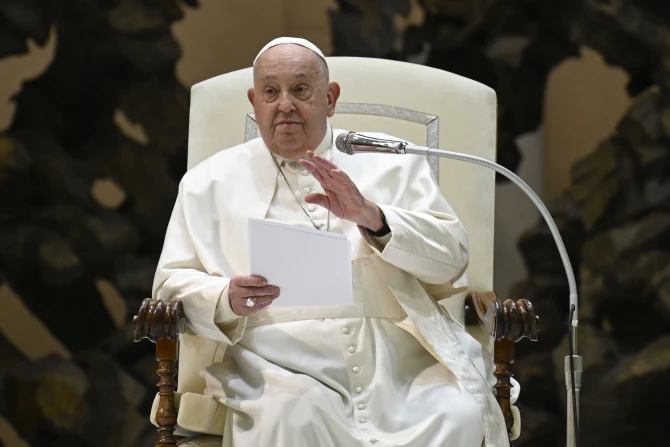
Armendáriz noted that at the Synod on Synodality “the pope encourages us every day and tells us that he is with us to move forward, as it is undoubtedly the light of the Spirit that we are experiencing in the assembly and in the synodal hall.”
This story was first published by ACI Prensa, CNA’s Spanish-language news partner. It has been translated and adapted by CNA. Only later it was published here.