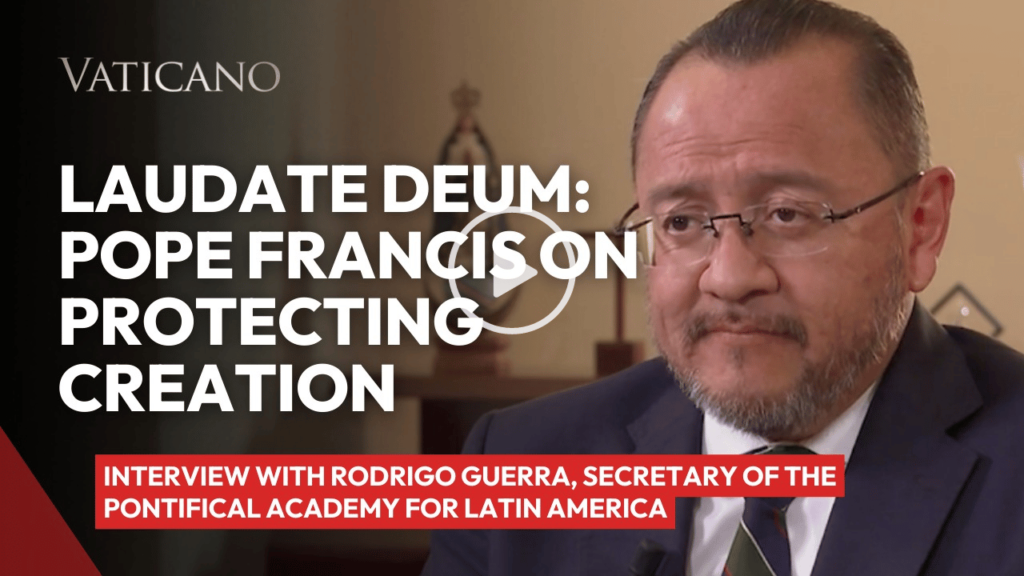
The Vatican released on October 4 the feast of Saint Francis of Assisi, Pope Francis’ apostolic exhortation titled Laudate Deum, addressing climate change. Immediately after the release of the apostolic exhortation, a press conference was held, which saw the participation of young writers, intellectuals, activists, and even Nobel Laureate Giorgio Parisi, who deemed this document “indispensable.” To delve deeper into this exhortation, Ary Ramos of the EWTN Vatican Bureau spoke with Dr. Rodrigo Guerra, professor and Secretary of the Pontifical Academy for Latin America, an expert on this pontificate.
Well, how does Pope Francis interpret the connection between climate change and the damage that our human actions, by human responsibility, are causing to everything related to the environment?
Since the preparation of Laudato sì, Pope Francis became aware that there is a significant scientific, political, and cultural controversy surrounding climate change. Some people believe that the changes we are currently witnessing in global climate, which we all bear witness to, are simply the result of the Earth’s natural cycles that occur over a certain number of centuries. Therefore, they argue that we should not attribute this enormous climatic transformation to pollution or human intervention. However, this controversy has slowly generated a series of consensuses in the scientific community, not absolute but quite strong. We can say that the most widely accepted hypothesis in the scientific community today, from an interdisciplinary perspective, is that climate change has a significant anthropogenic component. In other words, its origins are, to a large extent, due to the unfortunate interventions that humans have made in our environment and nature.
In fact, the Pope tells us that we are not reacting sufficiently to this phenomenon. He says the world is falling apart. It’s almost as if it’s a somewhat apocalyptic view, but after eight years since the publication of Laudato sì, the Pope wants to convey something new to us.
And today, this new encyclical, which should be interpreted in light of what was already said in Laudato sì, essentially tells us that the future that seemed distant is becoming our nearest present. Why? Because environmental deterioration trends indicate that the Earth may soon enter a global systemic crisis, we need global actions without exception.
With just one country, for example, neglecting the emission of greenhouse gases, we cannot truly correct the global phenomenon. We all have to act synergetically and cooperatively.
The Pope also speaks about climate change deniers and says that we should not mock them but rather support the so-called activists who speak about global warming, which cannot be denied.
That’s right. In this world of post-truth, conspiracy theories, and the presence of opinions that sometimes compete with science, often based on pseudo-science and prejudices, there is a culture of denial that has been growing and gaining adherents, often motivated by strong economic interests that would like to expand at the expense of certain natural areas in different parts of the Earth. Pope Francis, aware that there are groups that discourage information simply to expand their business interests, makes strong statements about the denial of the anthropogenic origin of climate change. We need to open our eyes, not just from a naive standpoint but by paying attention to the best science of our time.
In fact, in the last part of the encyclical, the Pope invites us again to praise God through creation and integral ecology.
What the Pope really does is much like what Saint Francis of Assisi did: help us understand that there is a secret and mysterious presence of God in everything and everyone that we need to learn to recognize, even in a topic like the environment. By looking closely at the creation, the environment, and the nature that God has given us, we can more fully praise God and become more like brothers and sisters. Praising God, being responsible for the environment, and living as brothers and sisters are things that are synergistic in the perspective of Francis of Assisi and also in the teaching of Pope Francis today.
Well, praising God, being brothers and sisters, and living in harmony with our surroundings. Thank you very much.
Thank you, Ary Ramos, and thank you to EWTN for your interest in these important themes of contemporary Pontifical teaching.
(Adapted by Jacob Stein)