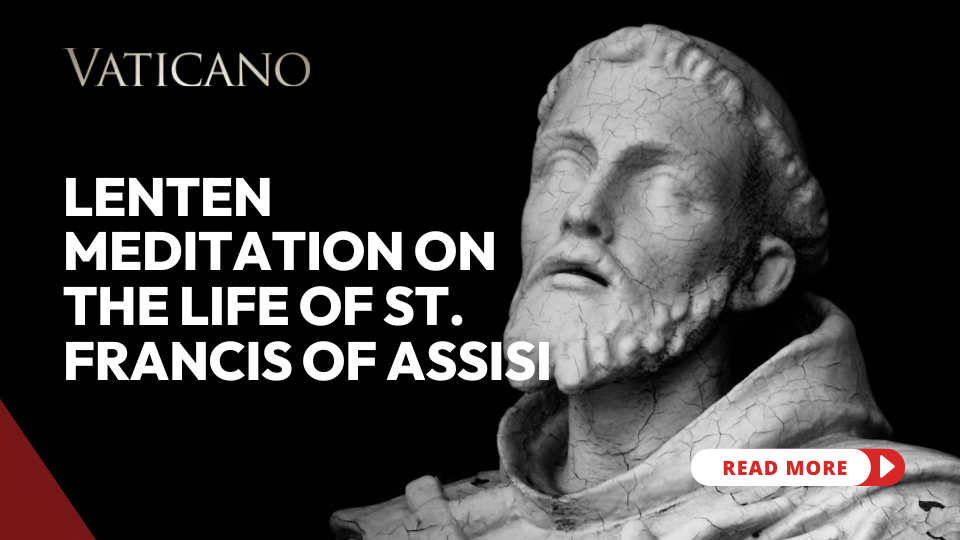
A man of the Gospel, simplicity, and dialogue, St. Francis has inspired countless generations across religions and cultures.
In this Vaticano segment, EWTN Vatican explores the Basilica of Saint Francis of Assisi. Construction began in 1288, two years after the Saint’s death, to mark the location of St. Francis’s tomb, welcome pilgrims, and create a space for encounters.
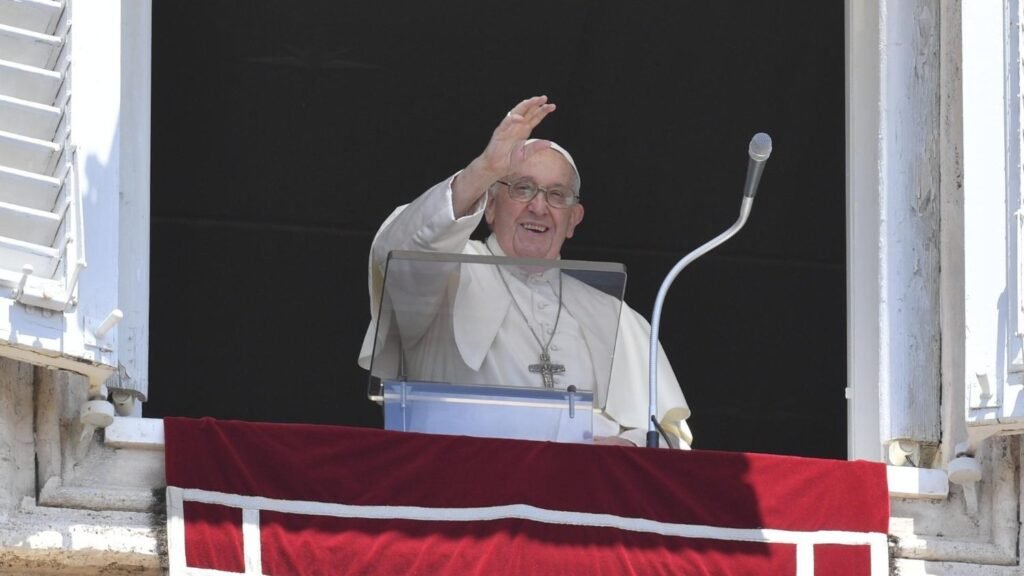
Pope Francis has made multiple trips to Assisi since his election in 2013. In 2020, before the Saint’s tomb, he celebrated Holy Mass and signed his encyclical “Fratelli tutti,” We are all Brothers, in which the Holy Father calls us to love all our neighbors regardless of location, upbringing, or differences.
Fr. Marco Moroni, Custodian of the Sacred Convent of Assisi, meets us in the Upper Basilica. He shares his hopes for today’s Interreligious Dialogue with St. Francis as his guide.
Fr. Moroni said, “I think all religions can dialogue and pray for peace. And since that time, Assisi has developed this further sensitivity in the name of Francis of Assisi, who was a man of dialogue.”
He continued, “There are so many places and so many situations, so many organizations also that find there the possibility of expressing themselves.”
Fr. Moroni welcomed Rabbi Goshen of the Jewish Community of Assisi and Mustafa Ceric, Grand Mufti of Bosnia. Together, they discussed and admired the Basilica’s frescoes.
That which shows St. Francis in the Holy Land offering to walk through fire as a sign of faith before Sultan Al-Kamil during the Fifth Crusade inspired much of their dialogue.
Fr. Moroni highlighted the evolving perspective on this reality, saying, “It was not an obvious and normal thing during the crusades, while everybody is armed while everybody is trying to defend or reconquer, he goes as an unarmed man, and I think that is a key element. The dialogue is always done in an unarmed way, presenting himself as he is, in simplicity.”
At the end of the 13th century, the early Italian Renaissance artist Giotto and his assistants painted the cycle of 28 frescoes in the Upper Basilica, depicting the life of St. Francis of Assisi. As some of the most iconic works in Western medieval art, they act like motion pictures; each painting captures a frame or key moment in the life of the Saint.
Some of the frescoes illustrate his relationship with the papacy. These include the Dream of Innocent III of St. Francis holding up the church, the Confirmation of the Rule of the Franciscans, his preaching before Honorius III, and the Dream of Pope Gregory IX, where he witnesses and confirms St. Francis’s stigmata.
Nearly 800 years ago, on September 14th, 1224, the Feast of the Exaltation of the Cross, St. Francis received the stigmata while on retreat in the nearby mountains of La Verna. He was praying and asking how he could best please God when a seraph visited and gave him the same wounds that Jesus received during the Passion.
And lest we forget that St. Francis was a man of simplicity who loved nature and creation, the iconic fresco of St. Francis’s Sermon to the Birds is also found in the Upper Basilica.
Rabbi Goshen said, “Assisi is the city that goes under the title of Saint Francis, the man who himself was an emblem of friendship and an emblem of the spiritual life in prayer. And in this day and age, what we need is a deepening of the spiritual encounter.”
With this fraternal spirit, Rabbi Goshen brings his own chair, as he frequently does, to honor and pay his respects to St. Francis.
And in that dream for peace embodied by the Saint’s life and etched into the papal encyclical “Fratelli Tutti,” may each person come to realize that as brothers and sisters, we are all children of God.
Adapted by Jacob Stein