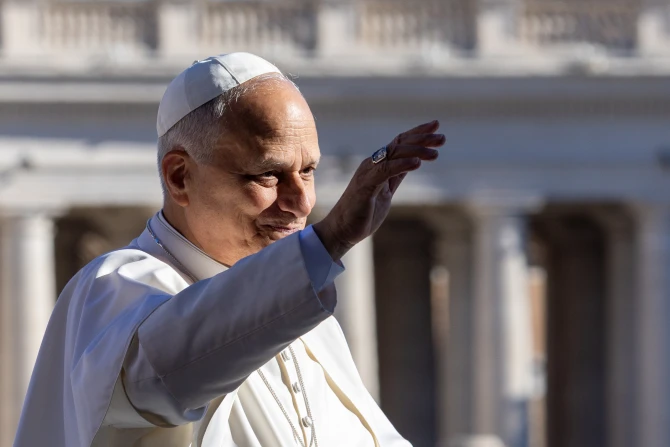
Pope Leo XIV invited Indigenous groups to forgive as he recognized both “the light and the wounds” in the history of the evangelization of their peoples.
“The long history of evangelization that our Indigenous peoples have known, as the bishops of Latin America and the Caribbean have so often taught, is laden with light and shadows,” the pontiff said in an Oct. 16 message sent to the Networks of Indigenous Peoples and the Network of Indian Theology Theologians.
Leo invited members of the network to “forgive our brothers and sisters from the heart, to reconcile ourselves with our own history, and to thank God for his mercy toward us.”
He also encouraged them to recognize “both the light and the wounds of our past,” to understand “that we can only be a people if we truly abandon ourselves to the power of God, to his action in us.”
“It is from this truth,” he added, “that we must reread our history and our reality, to face the future with the hope to which the holy year calls us, despite the hardships and tribulations.”
Leo XIV explained that, through dialogue and encounter, “we learn from different ways of seeing the world, we value what is unique and original to each culture, and together we discover the abundant life that Christ offers to all peoples.”
“This new life is given to us precisely because we share the fragility of the human condition marked by original sin, and because we have been reached by the grace of Christ,” he affirmed.
He recalled that the Lord is the origin and goal of the universe as well as “the primary source of all that is good, including our peoples.” This, he emphasized, “is the goal of our hope; it is not only for some but for all, even those once considered enemies, the great occupying powers.”
Jubilee of Hope
In his message, the pontiff also emphasized the universality of the Church, “which welcomes, engages in dialogue with, and is enriched by the diversity of peoples,” particularly Indigenous peoples, “whose history, spirituality, and hope constitute an irreplaceable voice within ecclesial communion.”
The pope invited the network to experience the Jubilee of Hope as “a moment of living and personal encounter with the Lord” as well as an occasion for “reconciliation, grateful memory, and shared hope, more than a mere external celebration.”
Passing through the Holy Door of St. Peter’s Basilica, he explained, means entering, through faith, “into the very source of divine love, the open side of the Crucified One,” which makes us a “people of brothers.”
This story was first published by ACI Prensa, CNA’s Spanish-language news partner. It has been translated and adapted by CNA.