Pope Leo XIV on Friday stated that authentic peace “takes shape from the ground up” when the differences and conflicts they entail “are not set aside but acknowledged, understood, and surmounted.”
FIND THE POPE’S BIOGRAPHY HERE
Pope Leo began his address to members of various peace movements, whom he received May 30 at the Vatican, with the same words he greeted the faithful when he was elected on May 8: “Dear brothers and sisters, peace be with you!”
The pontiff thanked them for launching the “Arena of Peace” meeting in Verona in May 2024. The event was chaired by Pope Francis and attended by some 300 delegates representing associations and movements that participated in the event.
Among the groups and movements present in the Clementine Hall on Friday were Mediterranea Saving Humans, Libera, the Italian Network for Peace and Disarmament, Catholic Action leaders, Doctors Without Borders, and the Focolare Movement.
The Holy Father recalled that, on that occasion a year ago, Pope Francis reiterated that building peace begins by “standing alongside victims, seeing things from their point of view.”
This approach, according to Leo XIV, “is essential for disarming hearts, approaches, and mentalities, and for denouncing the injustices of a system that kills and is based on the throwaway culture.”
Path to peace requires hearts and minds trained in concern for others
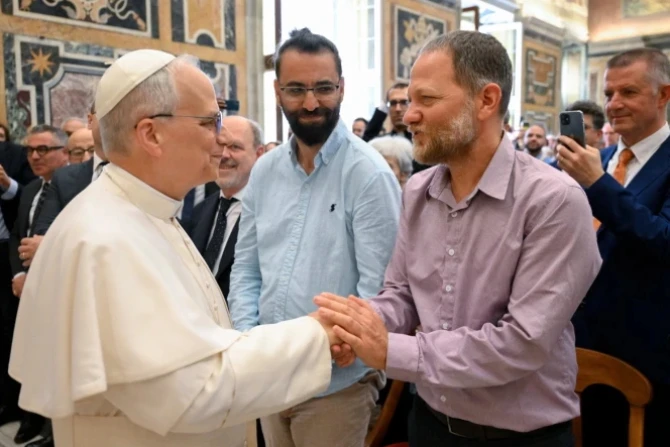
He particularly noted “the courageous embrace” between Israeli Maoz Inon, whose parents were killed by Hamas, and Palestinian Aziz Sarah, whose brother was killed by the Israeli army. Both were present at today’s audience.
“That gesture remains as a testimony and sign of hope,” he added.
“The path to peace demands hearts and minds trained in concern for others and capable of perceiving the common good in today’s world,” the pope continued.
He pointed out that the path to peace involves everyone and that it “leads to the fostering of right relationships between all living beings.”
In an age like our own, “marked by speed and immediacy,” Leo XIV emphasized the need to “recover the patience required for this process to occur.”
In this context, he explained that “authentic peace takes shape from the ground up, beginning with places, communities, and local institutions, and by listening to what they have to tell us. In this way, we come to realize that peace is possible when disagreements and the conflicts they entail are not set aside but acknowledged, understood, and surmounted.”
The pope therefore urged the peace movement members to promote dialogue with all and to maintain “the creativity and ingenuity born of a culture of peace,” with projects that simultaneously inspire hope.
Nonviolence must characterize our decisions
The Holy Father lamented that “all too much violence exists in the world,” reiterating that, in the face of wars, terrorism, human trafficking, and widespread aggression, “our children and young people need to be able to experience the culture of life, dialogue, and mutual respect.”
“Above all,” the pontiff continued, they need the witness of men and women “who embody a different and nonviolent way of living.” He therefore noted that victims who reject revenge become “the most credible agents of nonviolent peacebuilding processes.”
“Nonviolence, as a method and a style, must distinguish our decisions, our relationships, and our actions,” he added.
He also proposed the Gospel and the Church’s social doctrine as the “constant source of support for Christians in this effort” and also as a “compass for everyone.”
“Because it is, in fact, a task entrusted to all, believers and nonbelievers, who must develop and carry it out through reflection and practice inspired by the dignity of the person and the common good,” Pope Leo emphasized.
In this way, he emphasized that peace rests in the hands of all institutions and therefore invited them to be present “within history as a leaven of unity, communion, and fraternity.”
“Fraternity needs to be recovered, loved, experienced, proclaimed, and witnessed,” the pontiff emphasized before encouraging members of the peace movements to act “with patient perseverance.”
SIGN UP FOR OUR NEWSLETTER HERE
This story was first published by ACI Prensa, CNA’s Spanish-language news partner. It has been translated and adapted by CNA.