The Catholic Church celebrates the birth of the Blessed Virgin Mary on Sept. 8, nine months after the Dec. 8 celebration of her immaculate conception.
The Catholic Church celebrates the birth of the Blessed Virgin Mary on its traditional fixed date of Sept. 8, nine months after the Dec. 8 celebration of her immaculate conception as the child of Sts. Joachim and Anne.
The circumstances of the Virgin Mary’s infancy and early life are not directly recorded in the Bible, but other documents, legends, and traditions describing the circumstances of her birth are cited by some of the earliest Christian writers from the first centuries of the Church.
These accounts are not included in the canon of Scripture and thus lack authority, but they do reflect some of the Church’s traditional beliefs about the birth of Mary.
One such non-Scriptural source is the early second century “Protoevangelium of James,” an infancy gospel offering pious legends about Mary that nevertheless affirms some of the earliest teachings of the Church on the Blessed Mother.
The Protoevangelium describes Mary’s father, Joachim, as a wealthy member of one of the 12 tribes of Israel. Joachim was deeply grieved, along with his wife, Anne, by their childlessness. “He called to mind Abraham,” the early Christian writing says, “that in the last day God gave him a son, Isaac.”
Joachim and Anne began to devote themselves extensively and rigorously to prayer and fasting, initially wondering whether their inability to conceive a child might signify God’s displeasure with them.
As it turned out, however, the couple was to be blessed even more abundantly than Abraham and Sarah, as an angel revealed to Anne when he appeared to her and prophesied that all generations would honor their future child: “The Lord has heard your prayer, and you shall conceive, and shall bring forth; and your seed shall be spoken of in all the world.”
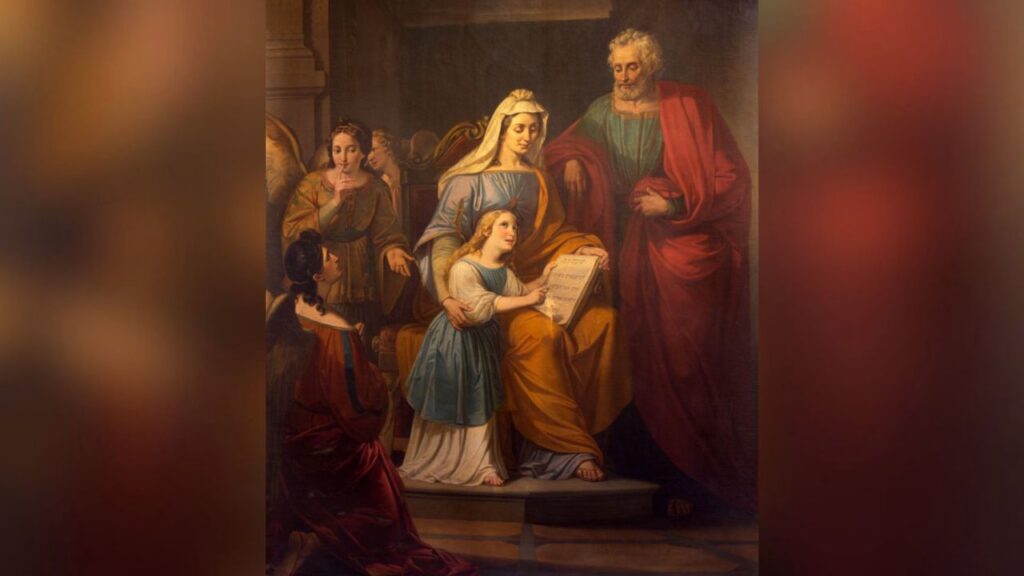
After Mary’s birth, according to the “Protoevangelium of James,” Anne “made a sanctuary” in the infant girl’s room and “allowed nothing common or unclean” on account of the special holiness of the child. The same writing records that when she was a year old, her father “made a great feast and invited the priests, and the scribes, and the elders, and all the people of Israel.”
“And Joachim brought the child to the priests,” the account continues, “and they blessed her, saying: ‘O God of our fathers, bless this child, and give her an everlasting name to be named in all generations’ … And he brought her to the chief priests; and they blessed her, saying: ‘O God most high, look upon this child, and bless her with the utmost blessing, which shall be for ever.’”
The protoevangelium goes on to describe how Mary’s parents, along with the Temple priests, subsequently decided that she would be offered to God as a consecrated virgin for the rest of her life and enter a chaste marriage with the carpenter Joseph.
St. Augustine described the birth of the Blessed Virgin Mary as an event of cosmic and historic significance and an appropriate prelude to the birth of Jesus Christ. “She is the flower of the field from whom bloomed the precious lily of the valley,” he said.
The fourth-century bishop, whose theology profoundly shaped the Western Church’s understanding of sin and human nature, affirmed that “through her birth, the nature inherited from our first parents is changed.”
This story was first published on Sept. 5, 2010, and has been updated by EWTN News English.