Skip to content

Pope Leo XIV promulgates new statutes for Pontifical Academy for Life

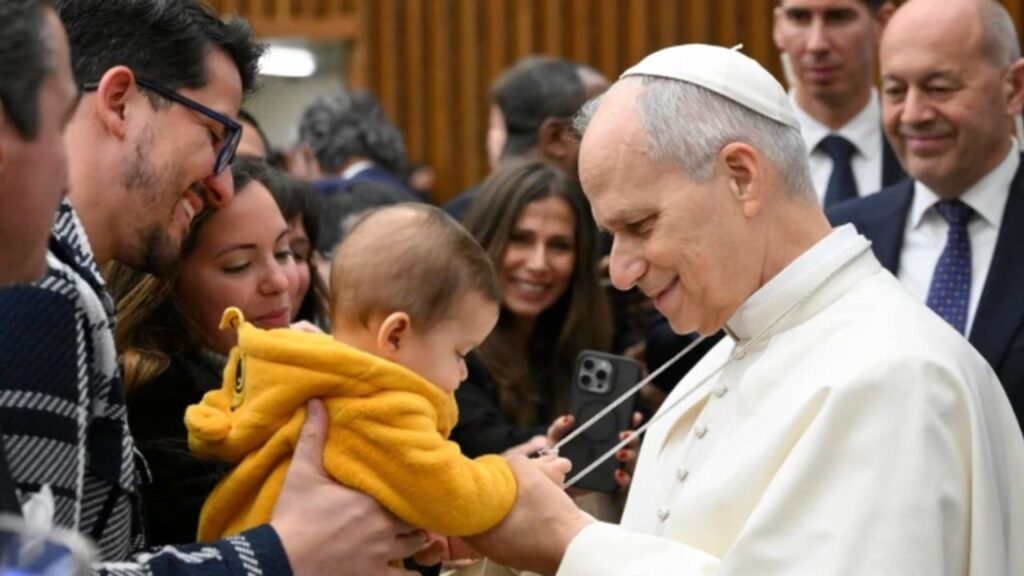
Pope Leo XIV greets a baby during a general audience at the Vatican. | Credit: Vatican Media

The new statues introduce the new role of “supporters” who, while not academics, identify with the academy’s mission and “contribute to the advancement of its academic activities.”

Pope Leo XIV promulgated new statutes for the Pontifical Academy for Life, recalling that its objective is “the defense and promotion of the value of human life and the dignity of the person.”

The new statutes, which introduce the role of “supporters,” according to Vatican News, the Vatican’s official media outlet, were signed by the Holy Father on Feb. 27 and were released in Italian by the Vatican Press Office on Feb. 28.

“Supporters, subject to approval from the Secretariat of State, are appointed by the board of directors for a three-year term and may be confirmed, upon resolution of the same body, for a maximum of two further consecutive terms,” the new statutes state.

Supporters “are individuals who, identifying with the academy’s institutional purposes, contribute to the advancement of its academic activities. They are persons who do not possess an academic profile but who wish to sustain the objectives promoted by the academy,” the new statutes explain.

The Pontifical Academy for Life was established by Pope John Paul II in 1994 with his motu proprio Vitae Mysterium. In that document, the Polish saint emphasized that “the mystery of life, and of human life in particular, is attracting the increased attention of experts who are drawn by the extraordinary opportunities for investigation that scientific and technological advances offer their research today.”

“This new situation opens up fascinating horizons for intervention at the sources of life itself; it also gives rise to a variety of new moral questions that man cannot ignore without the risk of taking steps that could prove irreversible,” John Paul II warned.

The work on drafting the new document, which updates the statutes approved by Pope Francis in 2016, began “more than a year ago,” the Vatican news outlet added.

This story was first published by ACI Prensa, the Spanish-language sister service of EWTN News. It has been translated and adapted by EWTN News English.

Receive the most important news from EWTN Vatican via WhatsApp. It has become increasingly difficult to see Catholic news on social media. Subscribe to our free channel today

Share

Would you like to receive the latest updates on the Pope and the Vatican

Receive articles and updates from our EWTN Newsletter.

More news related to this article

Pope Francis’ Indonesia visit to ‘strengthen message of tolerance, unity, and world peace’

Pope Francis’ visit to Indonesia later this year has now been announced by the Vatican, and the Indonesian

Pope Leo XIV to families: Be missionaries of the Gospel who walk with other families

Pope Leo XIV on Monday said Christian families are called to be missionaries of the Gospel to new generations, especially in light of a widespread “privatization” of faith preventing many people from approaching the Church.

Pope Francis to young economists: ‘Love is the first and greatest factor of change’

Pope Francis on Wednesday met with young adults participating in the annual Economy of Francesco gathering as the movement for economic change — inspired by the pope and St. Francis of Assisi — launched a permanent foundation.

Nicene Creed champion: The life and legacy of St. Athanasius

St. Athanasius played a key role at the First Council of Nicaea in A.D. 325 and defended the Nicene Creed throughout his life.

Pope Francis to 2024 International Eucharistic Congress: The Eucharist teaches us fraternity

The gift of the Eucharist helps us to become the body of Christ for others, Pope Francis said in a video message sent to the 2024 International Eucharistic Congress in Quito, Ecuador, on Sunday.

Pope urges liturgical unity, inclusion of Traditional Latin Mass faithful

In message to French bishops, Pope Leo XIV called for “concrete solutions” to heal divisions over the Mass.

LIVE
FROM THE VATICAN

Be present live on EWTNVatican.com