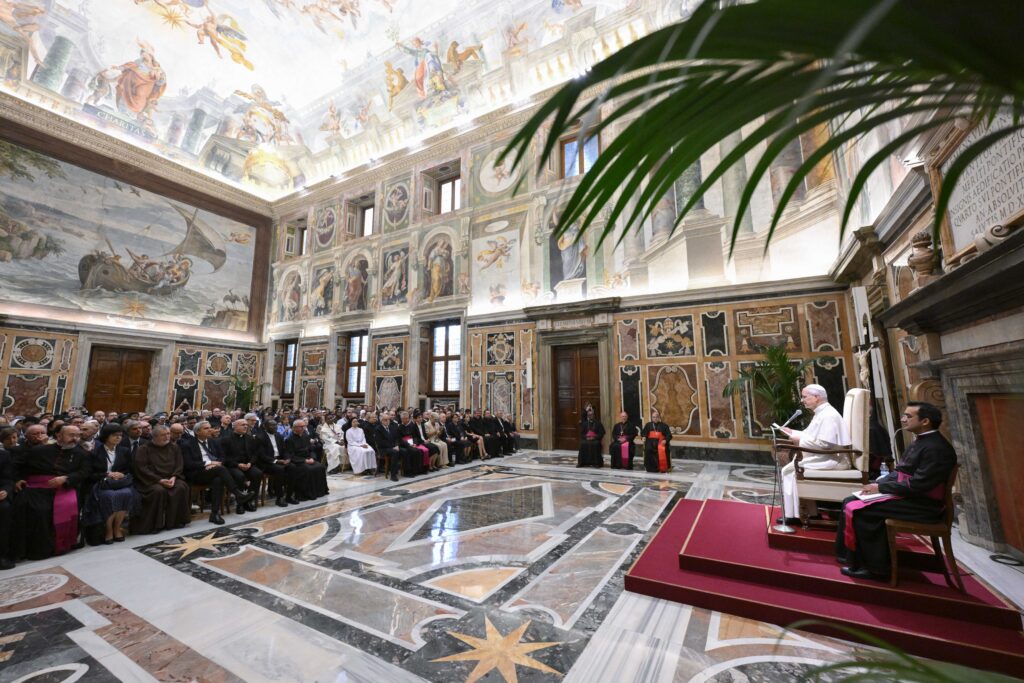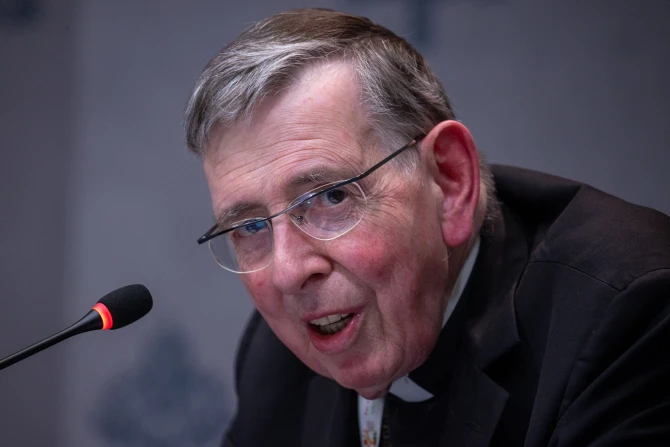
Three fraternal delegates — non-Catholic representatives of Christian churches participating in this year’s session of the Synod on Synodality — took center stage at Thursday’s Synod on Synodality press briefing held at the Vatican’s Holy See Press Office.
According to Cardinal Kurt Koch, prefect of the Dicastery for Promoting Christian Unity, the imperative for all Christian churches to journey, pray, and cooperate is Jesus’ own priestly prayer recorded in Chapter 17 of St. John’s Gospel: “So that they may all be one.”
“Jesus doesn’t command unity but he prays for it,” Koch told journalists on Thursday. “So if Jesus has prayed for unity, what can we do? We must do what Jesus did.”
In June, the Dicastery for Promoting Christian Unity released “The Bishop of Rome,” a book that examines the fruits of various ecumenical dialogues between the Catholic Church and other churches regarding the “Petrine ministry” — the role and ministry of the pope — over the last 30 years.
During the press conference, Metropolitan Job of Pisidia, the Eastern Orthodox co-president of the Joint International Commission for Theological Dialogue between the Catholic Church and the Orthodox Church, highlighted the significance of the “convergence” found in the Roman Catholic Church’s various bilateral dialogues with the Orthodox and other Christian churches surveyed in “The Bishop of Rome.”
“What strikes me in this book — and I advise you to read it — is to see the convergence among all these bilateral dialogues,” he shared with journalists. “This means that we are not just looking for an agreement or just some compromise with another church.”
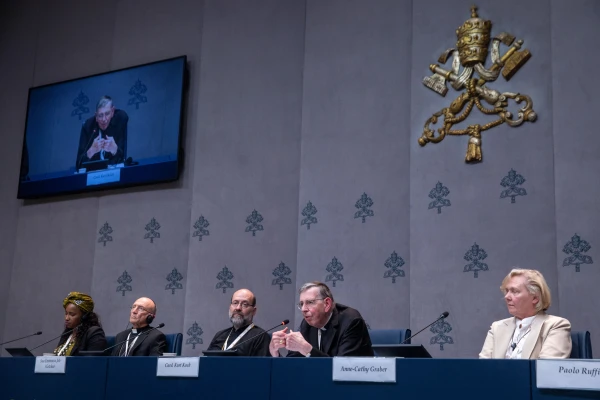
The metropolitan also stated that ecumenical dialogue is not solely aimed at reconciliation and fraternity among churches but has the potential to “also bear fruit in the internal [and] domestic life of every church.”
Speaking about “the great importance of relationality” among Christian churches, Anglican Bishop Martin Warner of Chichester, co-chair of the English-Welsh Anglican-Roman Catholic Committee, spoke about the “sense of family” that has developed between the Catholic Church and the Church of England, particularly during the reign of the late Queen Elizabeth II.
“She, I think, lived throughout the duration of five popes,” he said. “These [meetings] create a sense of a family which has a history and a past.”
Warner also commented that both Anglicans and Catholics view authority as a “gift.” He said the primacy of love and service — underscored in Pope John Paul II’s encyclical Ut Unum Sint — are the “solid foundations” on which both churches are built upon.
Anne-Cathy Graber, secretary for ecumenical relations of the Mennonite World Conference, told journalists that the Synod on Synodality has given the ecumenical movement a new “dynamism” but that more “visible signs” of Christian unity are needed.
“It’s true that sometimes there are no symbolic signs that the world can understand. What we are lacking is symbolic gestures of reconciliation,” she said.
Synod on Synodality delegates and participants will attend an ecumenical prayer service at the Vatican on Friday, Oct. 11.
This article was originally published on Catholic News Agency.