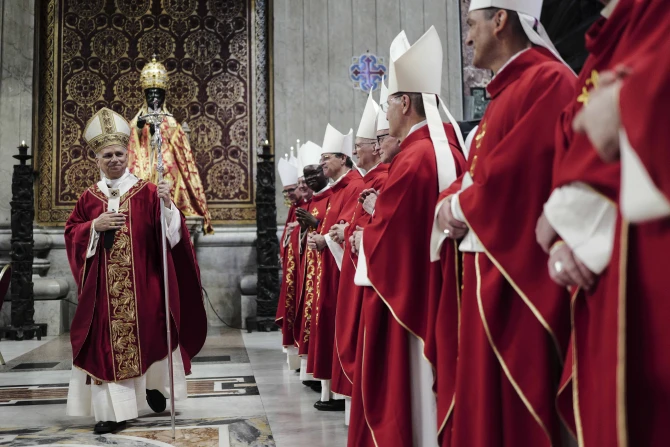
Pope Leo XIV warned new archbishops on Sunday against following “the same old pastoral plans without experiencing interior renewal and a willingness to respond to new challenges.”
FIND THE POPE’S BIOGRAPHY HERE
Speaking on the Solemnity of Peter and Paul — saints recognized by the Catholic Church as pillars of the faith and venerated as patrons of the city of Rome — the pope also called for maintaining ecclesial unity while respecting diversity.

“Our patron saints followed different paths, had different ideas and at times argued with one another with evangelical frankness. Yet this did not prevent them from … a living communion in the Spirit, a fruitful harmony in diversity,” the pope said.
During Mass at St. Peter’s Basilica, where he bestowed the pallium on 54 new metropolitan archbishops, including eight from the U.S., Leo urged them to “find new paths and new approaches to preaching the Gospel” rooted in the “problems and difficulties” arising from their communities of faith.
“The two apostles… inspire us by the example of their openness to change, to new events, encounters, and concrete situations in the life of their communities, and by their readiness to consider new approaches to evangelization in response to the problems and difficulties raised by our brothers and sisters in the faith.”
After the homily, deacons descended to the tomb of the Apostle Peter, located beneath the Altar of the Chair, to retrieve the palliums the pope had blessed.
Avoiding routine and ritualism
In his homily, the Pope praised the example of Sts. Peter and Paul, highlighting their “ecclesial communion and the vitality of faith.” He stressed the importance of learning to live communion as “unity within diversity — so that the various gifts, united in the one confession of faith, may advance the preaching of the Gospel.”
For Pope Leo, the path of ecclesial communion “is awakened by the inspiration of the Spirit, unites difference,s and builds bridges of unity thanks to the rich variety of charisms, gifts, and ministries.”
‘Turn our differences into a workshop of unity’
The pope called for fostering “fraternity” and urged his listeners to “make an effort, then, to turn our differences into a workshop of unity and communion, of fraternity and reconciliation, so that everyone in the Church, each with his or her personal history, may learn to walk side by side.”
“The whole Church needs fraternity, which must be present in all of our relationships, whether between lay people and priests, priests and bishops, bishops and the pope. Fraternity is also needed in pastoral care, ecumenical dialogue, and the friendly relations that the Church desires to maintain with the world,” the pope said.
He also invited reflection on whether the journey of our faith “retains its energy and vitality, and whether the flame of our relationship with the Lord still burns bright.”
“If we want to keep our identity as Christians from being reduced to a relic of the past, as Pope Francis often reminded us, it is important to move beyond a tired and stagnant faith. We need to ask ourselves: Who is Jesus Christ for us today? What place does he occupy in our lives and in the life of the Church?”
New paths and practices for the Gospel
Leo thus encouraged a process of discernment that arises from these questions, allowing faith and the Church “to be constantly renewed and to find new paths and new approaches to preaching the Gospel.”
“This, together with communion, must be our greatest desire.”
At the end of the celebration, the pontiff descended the stairs to the tomb of the Apostle Peter and prayed for a few moments before it, accompanied by Metropolitan Emmanuel of Chalcedon, head of the Delegation of the Ecumenical Patriarchate.
The Solemnity of Sts. Peter and Paul is especially important for ecumenism because the two saints are honored by all apostolic traditions, and the Ecumenical Patriarchate has sent a delegation to Rome for the feast annually since the 1960s.
Return to an ancient tradition
During the celebration, Pope Leo XIV revived the ancient tradition of personally imposing the pallium on new metropolitan archbishops.
This symbolic rite had been modified by Pope Francis in 2015, when he decided to present the pallium — a white wool band resembling a stole with six black silk crosses — to archbishops at the Vatican, while leaving it to the nuncio in each archbishop’s country to impose the pallium in a local ceremony.
At the time, Pope Francis explained that this change was meant to give greater prominence to local churches, to make the ceremony more pastoral and participatory, and to strengthen the bond between archbishops and their people, without weakening communion with Rome.