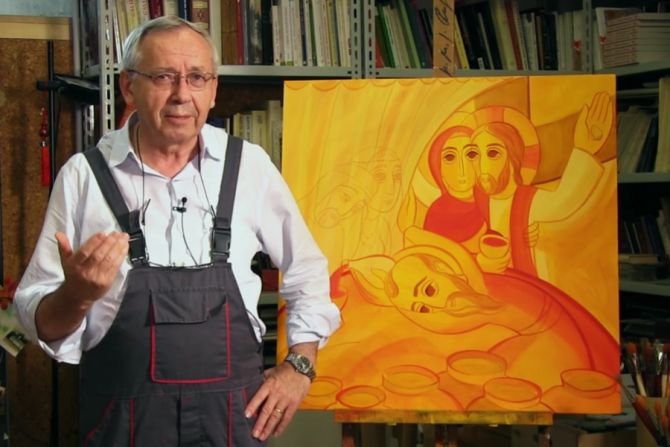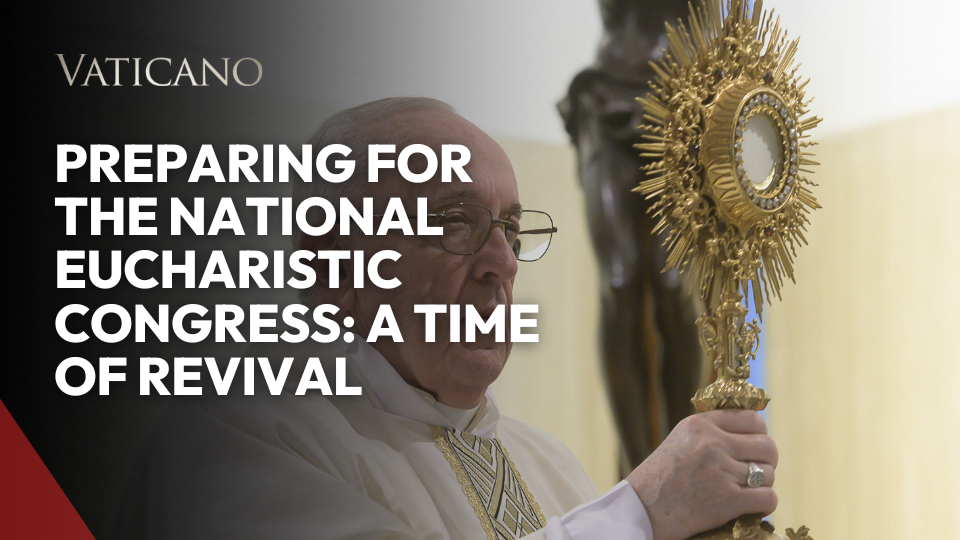
EWTN Vatican speaks with Fr. Michael Baggot about the Eucharistic revival and the importance of Eucharistic Adoration.
Fr. Michael Baggot contrasts the aspects of our ordinary daily lives with the experience of Eucharistic Adoration, saying, “In a world in which so many of our relationships are mediated through technology, I think one of the great antidotes to the disconnection we experience is Eucharistic Adoration, because we place ourselves in the presence of the Lord. And He is fully present to us, waiting for us to engage with Him and above all, waiting for us to receive His love, which requires receptivity. It requires an openness. It takes time for us to settle our senses and to focus on Him and to listen to Him. That, I think, is one of the great values of Eucharistic Adoration in our age as we have quality time to listen to the Lord and make ourselves more present to His real and full presence to us.”
With the National Eucharistic Congress just six months away, as many as 80,000 Catholics are expected to attend the event from July 17–21, 2024, in Indianapolis.
The congress is the climax of the bishops’ three-year National Eucharistic Revival initiative, which was launched in part because of a Pew Research poll that suggested only one-third of adult Catholics in the U.S. believe in the Church’s teaching on the Blessed Sacrament. The recent Pew Research Center study revealed that 69% of Catholics in the United States believe that the bread and wine used in Mass “are symbols of the body and blood of Jesus Christ.”
The problem is that this is not what the Catholic Church teaches about the Eucharist, and it conflicts with two thousand years of Catholic tradition and teaching.
Fr. Michael Baggot urges us on in the face of these poll studies, saying “I think that this troubling statistic about the low number of Catholics who attend Mass and yet fail to believe in the real presence of Christ in the Eucharist is an invitation and a challenge to all of us to catechize better, to instruct better through our teaching. In schools or in other settings, but also to instruct well through the way in which we celebrate the liturgy.”
He emphasizes, “A beautifully reverently celebrated liturgy is one of the greatest for, in terms of sharing with every generation, the beauty of the Eucharist, the presence of Christ.”
That is, “If a priest and those around him are acting as though they’re in the presence of God, then everyone else will begin to realize the great mystery and marvel that’s before us.”
“But,” if this isn’t the case, he says, “if we treat the Eucharist casually in our celebrations, then it’s natural that many people are going to be trained to think that this is just a social gathering. And not an actual encounter with the living God.”
The Church in Vatican II teaches that the Eucharist is “the source and summit of the Christian life.”
Fr. Michael Baggot explains the significance of this reality, the consequence of God’s real presence in the Eucharist. He says, “Jesus Christ, in his last days of earthly ministry gathers His beloved apostles together, and he gives them an amazing gift. He says to them during the meal, ‘This is My body. This is My blood.’ This is His farewell gift to us. Not just a nice gesture or a way of remembering someone who is lost to us, but a continuation of His presence. He wants to remain with us. He says, ‘I will be with you until the end of the world.’”
Adapted by Jacob Stein