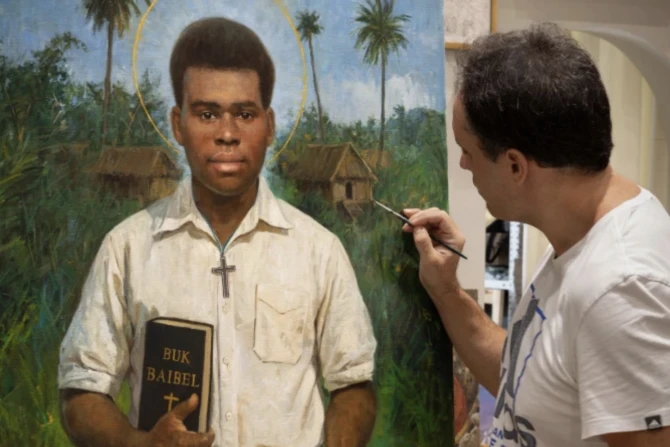
Malaga, Spain-born artist Raúl Berzosa has painted portraits of popes for the Vatican, and his works have graced the covers of booklets at Vatican ceremonies and even the Stations of the Cross at the Colosseum. However, as he himself confessed on X, none had ever hung on the façade of St. Peter’s Basilica.
That honor came this week with the portrait of St. Peter To Rot, which Berzosa painted for the saint’s canonization ceremony on Oct. 19. The Vatican commissioned the Catholic artist to paint the official portrait, which has been displayed since Oct. 17 on the façade of St. Peter’s Basilica. Berzosa considers the work to be a fruit of grace and the culmination of a life dedicated to reflecting the light of faith in art.
Peter To Rot, who was born in Papua New Guinea, served as a catechist and died a martyr for the faith in 1945. He was canonized on Oct. 19 along with six others.
In 1995, during his trip to Papua New Guinea, St. John Paul II described To Rot’s life as “a beacon shining bright, a signal fire leading you to hold aloft the noble ideals which inspired him: faith in God, love of family, service of neighbor, and unswerving courage in the face of trials and sacrifice.”
Berzosa, 46, renowned worldwide for his realistic style and religious themes, explained to ACI Prensa, CNA’s Spanish-language news partner, that with his work depicting the Papuan saint, he sought to convey the inner light of which the Polish pope spoke.
“If the portrait manages to convey some of Peter To Rot’s bright inner light and helps others strengthen their faith, then the work will have fulfilled its true function,” the Spanish painter said.
“I hope that the faithful see in his gaze not only a martyr but a man full of peace, love for his family, and fidelity to the Gospel,” he added.
For Berzosa, To Rot’s essential witness lies in the conviction that holiness “can be lived out in everyday life, even in the midst of suffering, as in his case.”
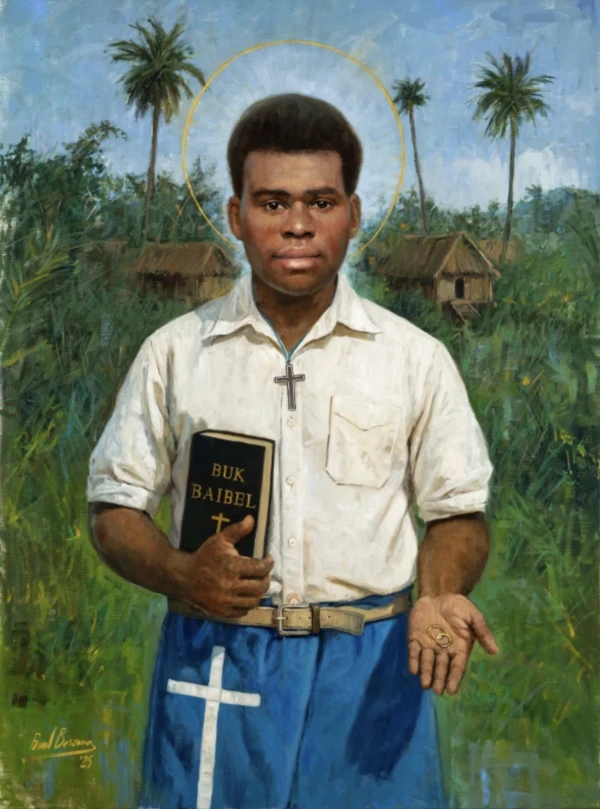
The artist said he wanted the lighting effects in the portrait “to emerge from within the face itself, something serene that engages the viewer and seeks to convey hope.” Berzosa also noted that the “light blue and green brushstrokes” create a warm atmosphere, with the color and the overall composition seeking to accompany “this luminous message.”
The challenges of painting the first Papuan saint
“The main challenge was to approach Peter To Rot’s image itself with respect and accuracy. To achieve this, I had some black and white photographs as well as a color portrait based on one of the photographs. All of this helped me create my painting,” he said.
In Berzosa’s portrait, To Rot is dressed in the traditional attire of local catechists: a white shirt and a type of blue wrap.
“When the Japanese threatened the catechists and prohibited any apostolic activity, the vast majority — out of fear — hid the cross. Peter To Rot was the only catechist who continued to proudly display the white cross that identified him as a catechist,” Berzosa noted.
“In one hand he holds a Bible and in the other [open hand he shows] two rings, a reference to his defense of marriage. A cross hangs from his neck,” the artist explained. To Rot wanted to die wearing that cross, which would later be key to identifying his mortal remains. Behind the figure of the saint, the countryside of his native land at the time can be seen.
For the most accurate depiction, the painter researched photographs, traditional clothing, and other local references.
“Throughout this work, I was assisted by Father Tomás Agustín Ravaioli, vice postulator of the cause,” Berzosa explained.
Portraying a martyr
The artist noted that the lives of martyrs, although often short, are “full of meaning, dedicated out of love and fidelity to the Lord.” He said he always seeks to convey the serenity of these witnesses to the Gospel in the most decisive moment of their lives.
“I try to understand that mixture of strength and peace of someone who gives his life for Christ,” he said.
“When I paint portraits of martyrs, there is a special respect for the person portrayed. Their witness transcends cultures and eras,” he noted.
This story was first published by ACI Prensa, CNA’s Spanish-language news partner. It has been translated and adapted by CNA.