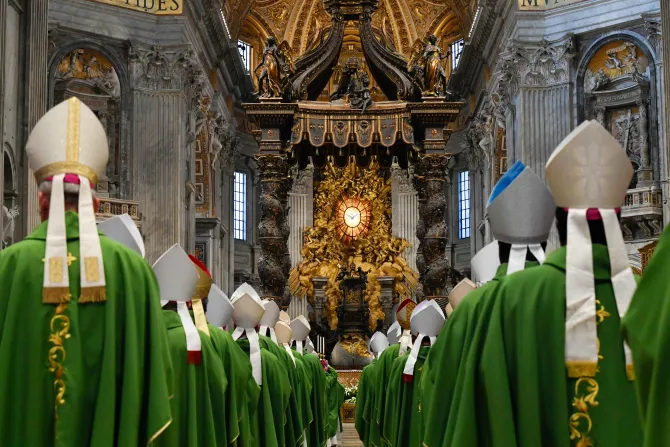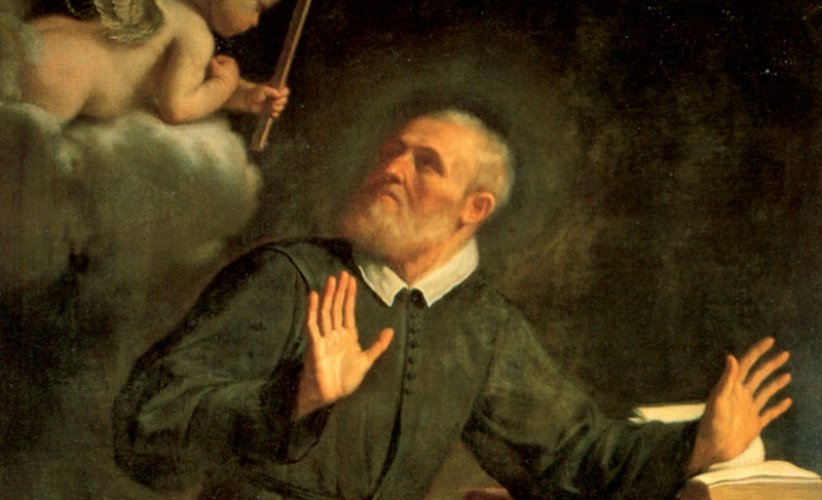
Today, the participants in the Synod are pilgrims to the catacombs of Rome. But why this choice? Why is the pilgrimage to the ancient Christian tombs so important? Of course, some of them are martyrs, even famous ones. But what gave rise to this idea in the popular Christian piety of Rome? It’s simple; it all stems from St. Philip Neri. Not that honoring the dead and especially celebrating the martyrs wasn’t done before, but the Florentine saint, one of the most Roman, made it a true ritual that we still follow today.
The earliest sources date back to the late 1500s when the canonization process of Philip began. Domenican Francesco Cardoni, who knew the saint, recalled how, in the early years of his presence in Rome (1533-1537), Philip used to pray in the catacomb of San Sebastiano on the Via Appia. He spent “ten years (…) in the grottoes of San Sebastiano, where he lived on bread and herb roots” (The first process for St. Philip Neri in the Vatican Latin Code 3798 and in other copies in the archives of the Oratory of Rome, edited by Giovanni Incisa della Rocchetta and Nello Vian, Vatican City, 1957, p. 133).
His biographers, especially Antonio Gallonio, wrote that he often paused to pray at the cemetery called San Callisto. In the canonization process, Father Germanico Fedeli, an Oratorian and a close friend of Father Philip, often recounted how the saint used to say that when he was young, he “often went alone at night to the Seven Churches, staying overnight in these Churches, and even in the cemetery of Callisto. When he found the churches closed, he would stay in the porticos of these churches to pray and sometimes read a book by moonlight.”
Many episodes in the saint’s life are connected to the catacombs, which were a place of inspiration and contemplation for him. Professor Fiocchi Nicolai of the Pontifical Institute of Christian Archaeology wrote about it in an article in L’Osservatore Romano in 2010. There are many spiritual anecdotes. For example, “the miraculous episode of the rib fracture, which, according to Gallonio’s testimony – the first to report it – took place near Capo di Bove (the tomb of Cecilia Metella) and was later arbitrarily relocated in 1651 to the Roman underground of Aringhi, in the catacombs, where the three devils would shake the tombstones to frighten St. Philip.
But, above all, what was Philip seeking in the catacombs? “The desire to draw spiritual nourishment from contact with these ancient testimonies and to recover from them the most genuine values of Christianity.”
In the mid-1500s, almost all the catacombs in Rome were inaccessible and in ruins, except for that of San Sebastiano. In a particular area of this cemetery, according to tradition, Philip would often retreat, and today it is called “the chamber of St. Philip.”
Philip combined his prayers in the catacombs with the practice of visiting the Seven Churches. From that time on, this practice began to spread. The first of these visits took place on Fat Thursday in 1552 when, for the first time, St. Philip Neri opposed the pagan celebrations of the Roman Carnival with devotion to the holiest places in Rome and meditation on the Passion.
At the time, the study of the first Christian cemeteries began. This was undertaken by “antiquarians interested in religious memories,” as well as by the ecclesiastical hierarchy who, in the fervent climate of the Catholic Reformation, saw the study and valorization of the earliest Christian monuments as a means to counter Protestant arguments. In particular, the painted images in the catacombs, which were being recovered at that time, appeared to provide, with the objectivity of an ancient monument, evidence to affirm the reality of the cult of the saints and sacred images among the very first Christian generations.
The path opened by St. Philip led to the attention of scholars like the Maltese Antonio Bosio, who effectively invented the new scientific discipline of Christian archaeology. His book “Roma Sotterranea” was published posthumously in 1632 by Oratorian Giovanni Severano, author of a book on the Seven Churches.
But cardinals also studied the catacombs. Cardinal Federico Borromeo explored various catacombs and curated a collection of copies of catacomb paintings. Federico Borromeo, who was close to the Oratory, probably possessed the most marked and authentic vocation for archaeological studies.
And St. Philip not only opened the doors to scholars but also paved the way for those who became lost. Here’s one of the many anecdotes: Abbot Giacomo Crescenzi and a group of friends got lost in the catacombs of the Giordani on the Via Salaria on December 10, 1598. Only prayers addressed to Father Philip (“some with words and some with their hearts”) miraculously helped them find their way out.
For those interested, these topics will also be discussed during the course on the History of Jubilees organized by the Gregorian University in Rome.