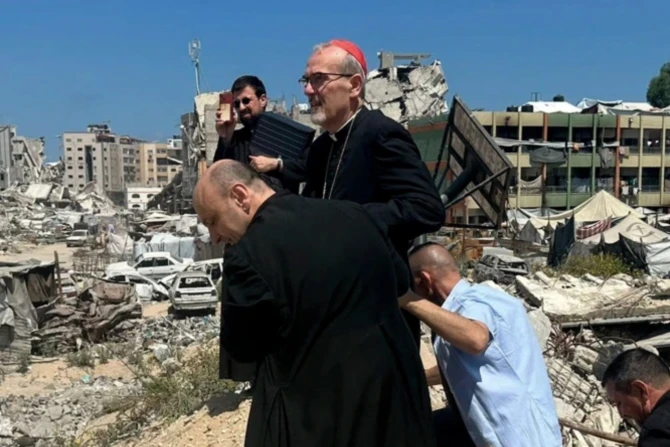
Cardinal Pierbattista Pizzaballa, the Latin patriarch of Jerusalem, called the Israel-Hamas ceasefire deal brokered by the U.S. a “first step” toward peace.
In a statement, the terrorist group Hamas agreed to release the remaining Israeli hostages, living and dead, in the first steps of a peace deal brokered by U.S. President Donald Trump.
Twenty living hostages and the bodies of 28 dead hostages are believed to remain in Gaza as the second anniversary of the Oct. 7, 2023, Hamas attack — the largest massacre of Jews since World War II — approaches.
Pizzaballa called the ceasefire deal “an important and long-awaited first step” in an Oct. 4 letter to the faithful.
The 20-point plan includes deradicalizing Gaza into a terror-free zone that doesn’t “pose a threat to its neighbors” and redeveloping Gaza for the people of Gaza, as well as an immediate ceasefire, the return of the hostages, and the return of nearly 2,000 Gazan prisoners.
“If both sides agree to this proposal, the war will immediately end,” the plan reads. “Israeli forces will withdraw to the agreed-upon line to prepare for a hostage release. During this time, all military operations, including aerial and artillery bombardment, will be suspended, and battle lines will remain frozen until conditions are met for the complete staged withdrawal.”
Delegations from the U.S., Israel, Hamas, and some Middle Eastern countries met on Monday in Egypt for peace talks.
“Nothing is entirely clear or definite yet; many questions remain unanswered, and much still needs to be defined,” Pizzaballa said. “We must not delude ourselves, but we are pleased that something new and positive is on the horizon.”
The first phase of the ceasefire would include the logistics of the hostage release, followed by a plan to create a Palestinian “technocratic, apolitical” leadership in Gaza that is not Hamas, according to U.S. Secretary of State Marco Rubio.
“We await the moment to rejoice for the families of the hostages, who will finally be able to embrace their loved ones,” Pizzaballa said. “We hope the same for Palestinian families, who will be able to embrace those returning from prison. We rejoice above all for the end of hostilities, which we hope will not be temporary and will bring relief to the inhabitants of Gaza.”
“We don’t know if this war will truly end, but we do know the conflict will continue because its root causes have yet to be addressed,” Pizzaballa said.
“The end of war does not necessarily mark the beginning of peace, but it is the first essential step toward building it,” Pizzaballa continued.
Pizzaballa reflected on hope for the Easter resurrection amid the war.
“Anger, resentment, distrust, hatred, and contempt too often dominate our discourse and pollute our hearts,” Pizzaballa said. “We risk becoming accustomed to suffering, but it need not be so. Every life lost, every wound inflicted, every hunger endured remains a scandal in God’s eyes.”
“The dominant narrative of recent years has been one of clash and reckoning, inevitably leading to the deeply painful reality of polarization,” Pizzaballa continued. “As a Church, reckoning does not belong to us, either as logic or as language. Jesus, our teacher and Lord, made love that becomes gift and forgiveness his life’s choice.”
“His wounds are not an incitement to revenge but a sign of the ability to suffer out of love,” he said.
This article was originally published by CNA.