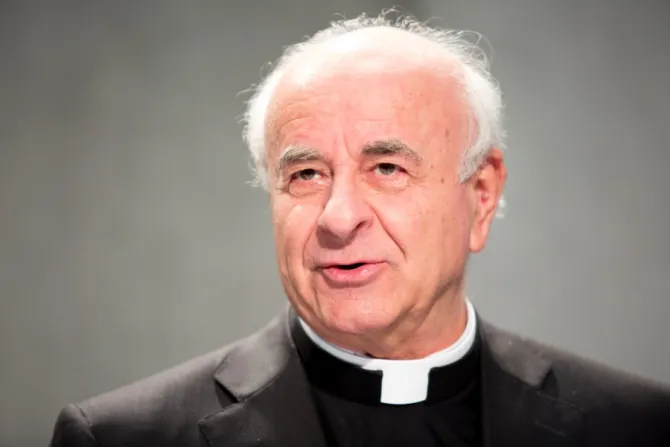
Archbishop Vincenzo Paglia, president of the Pontifical Academy for Life, has spoken in support of legalized medically assisted suicide, calling it “feasible” despite the clear teachings of the Catholic Church against it.
“Personally, I would not practice suicide assistance, but I understand that legal mediation may be the greatest common good concretely possible under the conditions we find ourselves in,” Paglia said in a speech on April 19 during the International Journalism Festival in Perugia, Italy.
The Italian archbishop’s remarks were part of a presentation that included a documentary about an Italian man who went to Switzerland to die by assisted suicide. A video of the discussion, in Italian, is available here.
The Italian news outlet Il Riformista published the text of Paglia’s speech on Saturday.
According to the Catechism of the Catholic Church, “intentional euthanasia, whatever its forms or motives, is murder” and “gravely contrary to the dignity of the human person and the respect due to the living God, his Creator” (CCC 2324).
More recently, in 2020, the Vatican’s Congregation for the Doctrine of the Faith affirmed that teaching in its letter Samaritanus bonus, “on the care of persons in the critical and terminal phases of life,” which was approved by Pope Francis.
“The uninfringeable value of life is a fundamental principle of the natural moral law and an essential foundation of the legal order,” the letter states. “We cannot directly choose to take the life of another, even if they request it.”
Earlier this year, during his general audience on Feb. 9, Pope Francis said the dying need palliative care, not euthanasia or assisted suicide, saying, “We must accompany people towards death, but not provoke death or facilitate assisted suicide.”
In his remarks on April 19, Archbishop Paglia emphasized that the Church is not a “dispenser of truth pills” when it comes to engaging with a pluralistic society on the most challenging moral issues of the day.
“Theological thought evolves in history, in dialogue with the Magisterium and the experience of the people of God (sensus fidei fidelium), in a dynamic of mutual enrichment,” Paglia said.
Paglia pointed to Pope Francis’ decision in 2018 to revise the Catechism of the Catholic Church to state that the death penalty is “inadmissible.”
“The contribution of Christians is made within the different cultures, neither above — as if they possessed an a priori given truth — nor below — as if believers were the bearers of a respectable opinion, but disengaged from history,” Paglia continued.
“Between believers and non-believers there is a relationship of mutual learning,” Paglia said.
“As believers, therefore, we ask the same questions that concern everyone, in the knowledge that we are in a pluralistic democratic society. In this case, about the end of (earthly) life, we find ourselves all facing a common question: How can we reach (together) the best way to articulate the good (ethical plane) and the just (legal plane), for each person and for society?”
Paglia criticized the expansion of laws in some countries to permit involuntary euthanasia. At the same time, he said it was “not to be ruled out” that legalized assisted suicide “is feasible in our society,” provided certain conditions spelled out by a 2019 Italian constitutional court ruling are met.
Specifically, he said, quoting from the court’s direction, “the person must be ‘kept alive by life-support treatment and suffering from an irreversible pathology, a source of physical or psychological suffering that he or she considers intolerable, but fully capable of making free and conscious decisions.’” The Italian House of Representatives has already approved such legislation, but not the Senate, he noted.
This is not the first time Paglia’s remarks on assisted suicide have stirred controversy. In 2019, answering a question about assisted suicide and whether a Catholic or a Catholic priest can be present at someone’s death by assisted suicide, Paglia told a small group of journalists that he would be willing to do so, because “the Lord never abandons anyone.”
“In this sense, to accompany, to hold the hand of someone who is dying, is, I think a great duty every believer should promote,” he said at the time, adding that believers should also provide a contrast to the culture of assisted suicide.
More recently, in August 2022, Paglia was sharply criticized by abortion opponents for referring in an Italian television interview to Law 194 — the 1978 law legalizing abortion in Italy — as a “pillar of society.” In a subsequent statement, the Pontifical Academy of Life said the comment was taken out of context.