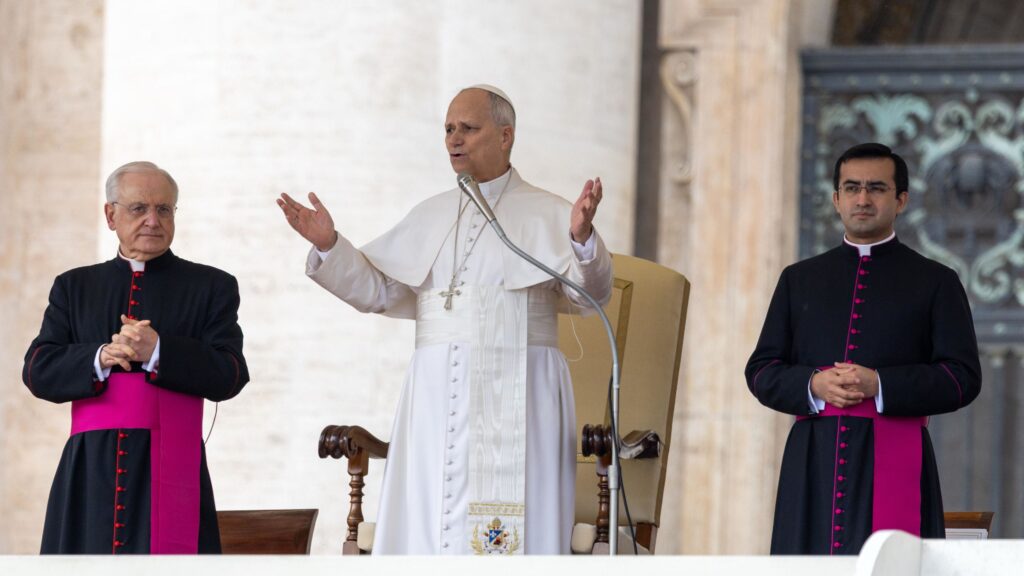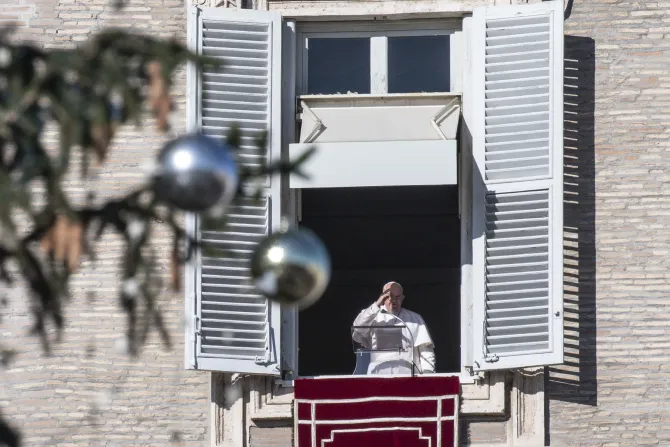
Pope Francis highlighted the importance of listening to God by embracing the example of John the Baptist, “the voice of one crying in the desert,” during his Angelus message on the second Sunday of Advent.
While the desert is “an empty place, where you do not communicate,” it was an important backdrop for John’s ministry as it represents a place of encounter where we can authentically “listen to God,” the pope said to the nearly 25,000 faithful gathered in St. Peter’s Square on Sunday, Dec. 10.
Noting that the image of the barren desert as a place of preaching may “seem like two contradictory images,” they are in fact reconciled through the figure of John the Baptist as his voice “is linked to the genuineness of his experience and the clarity of his heart.”
The pope also noted that the desert is a “place of silence and essentials, where someone cannot afford to dwell on useless things but needs to concentrate on what is indispensable in order to live.”
The desert does not hold a central place in the biblical context, he said, but it is an allegory for us today as a place of contemplation and encounter with God and provides an example for living a good life.
“To proceed on the journey of life, we need to be stripped of the ‘more,’ because to live well does not mean being filled with useless things, but being freed from the superfluous, to dig deeply within ourselves so as to hold on to what is truly important before God.”
“Only if, through silence and prayer, we make space for Jesus, who is the word of the Father, will we know how to be freed from the pollution of vain words and chatter,” Francis observed.
Following the recitation of the Angelus prayer, the Holy Father commemorated the anniversary of the signing of the United Nations Universal Declaration of Human Rights on Dec. 10, 1948.
Noting that the 30-article document was a watershed moment that ushered in new norms and a universalized set of fundamental rights, he warned that there was a risk of going “backwards.”
“The commitment to human rights is never finished! In this regard, I am close to all those who, without proclamations, in concrete everyday life, fight and pay personally to defend the rights of those who do not count,” the pope exclaimed.
The pope also took a moment to draw attention to a recent prisoner exchange between the governments of Armenia and Azerbaijan.
“I watch with great hope at this positive sign for relations between Armenia and Azerbaijan, for peace in the South Caucasus, and I encourage the parties and their leaders to conclude the peace treaty as soon as possible,” the pontiff said.
The prisoner exchange, which was announced by both governments on Thursday, Dec. 8, saw two Azerbaijani and 32 Armenian detainees exchanged and has been a major breakthrough in the relations between the two states since tensions flared up over the contested region of Nagorno-Karabakh earlier this year.
The pope ended his appeal by also imploring for peace as we enter into the Christmas season.
“We are moving towards Christmas: Will we be able, with God’s help, to take concrete steps towards peace? It’s not easy, we know. Certain conflicts have deep historical roots. But we also have the testimony of men and women who worked with wisdom and patience for peaceful coexistence.”
“Follow their example! Every effort should be made to address and remove the causes of conflicts. And in the meantime — speaking of human rights — civilians, hospitals, places of worship must be protected, hostages must be freed, and humanitarian aid guaranteed,” Francis emphasized.
This story was originally written for CNA.