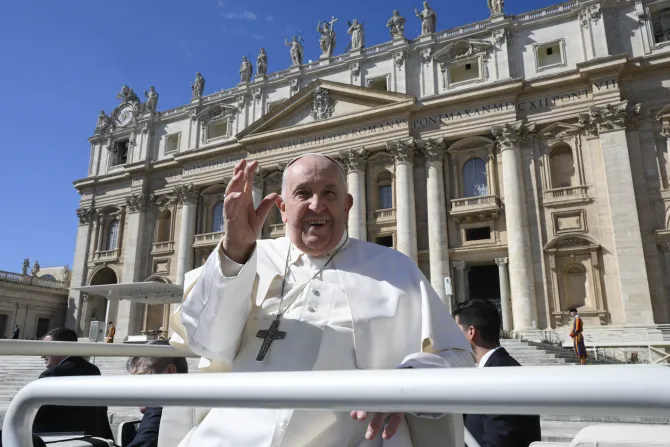
Pope Francis has centered his Lenten message for 2024 on the Book of Exodus, choosing “Through the Desert God Leads Us to Freedom” as its main theme to encourage the faithful that the season is a journey from bondage to spiritual renewal and freedom.
The pope framed this reflection on the departure of the Israelites from Egypt, a story that not only represents the journey from bondage to emancipation but also of revelation and spiritual freedom.
“When our God reveals himself, his message is always one of freedom,” the pope said.
The Holy Father went on to note that this process “is a demanding one” and that “it is not answered straight away. It has to mature as part of a journey.”
“We realize how true this is at those moments when we feel hopeless, wandering through life like a desert and lacking a promised land as our destination. Lent is the season of grace in which the desert can become once more — in the words of the prophet Hosea — the place of our first love,” the pope observed.
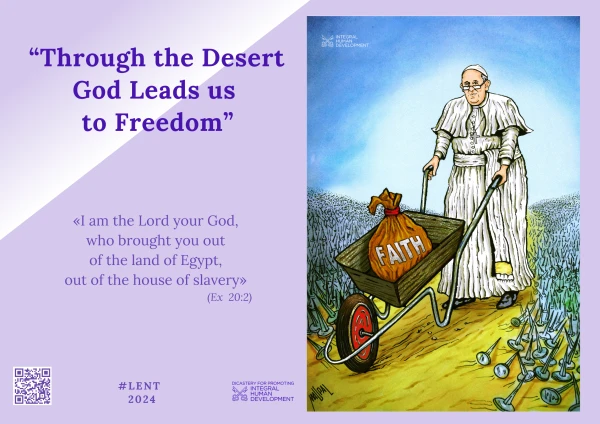
Pope Francis also underscored the centrality of the desert in the New Testament, observing that on the first Sunday of Lent, we are reminded that Jesus “was driven into the desert by the Spirit in order to be tempted in freedom.”
“The desert is the place where our freedom can mature in a personal decision not to fall back into slavery. In Lent, we find new criteria of justice and a community with which we can press forward on a road not yet taken,” the pope added.
Tying the season of Lent to the setting of the desert, the pope noted that the penitential season cannot be looked at just as an “abstract journey” but must, instead, be “concrete,” and this shift is predicated upon our capacity to “open our eyes to reality.”
For the pope, this reality is centered on the quest to mitigate the suffering and various forms of social and economic oppression that are ubiquitous today, much of which, he said, is caused by “a deficit of hope.”
“This ‘deficit of hope’ is not unlike the nostalgia for slavery that paralyzed Israel in the desert and prevented it from moving forward. An exodus can be interrupted: How else can we explain the fact that humanity has arrived at the threshold of universal fraternity and at levels of scientific, technical, cultural, and juridical development capable of guaranteeing dignity to all, yet gropes about in the darkness of inequality and conflict?”
During Lent 2024, the pope has encouraged the faithful to undertake an interior examination by asking: “Do we hear that cry? Does it trouble us? Does it move us?”
“Our Lenten journey will be concrete if, by listening once more to those two questions, we realize that even today we remain under the rule of Pharaoh. A rule that makes us weary and indifferent. A model of growth that divides and robs us of a future.”
“All too many things keep us apart from each other, denying the fraternity that, from the beginning, binds us to one another,” the pope continued.
The Lenten season, according to the pope, is a time that is characterized by personal struggle as we suffer from myriad temptations, but it is the recognition of this that calls us to “pause in prayer, in order to receive the word of God, to pause like the Samaritan in the presence of a wounded brother or sister.”
Highlighting the three pillars of Lent — prayer, almsgiving, and fasting — the pope noted that they are not disparate acts but form a symbiotic “movement of openness and self-emptying in which we cast out the idols that weigh us down, the attachments that imprison us.”
The pope closed his Lenten message by highlighting the communal aspect of the season, noting “the contemplative dimension of life that Lent helps us to rediscover will release new energies.”
“In the presence of God, we become brothers and sisters, more sensitive to one another: in place of threats and enemies, we discover companions and fellow travelers,” he added.
In line with this communal aspect, the pontiff related it to the Church’s “synodal form,” which the Church is “rediscovering and cultivating.”
“I invite every Christian community to do just this: to offer its members moments set aside to rethink their lifestyles, times to examine their presence in society, and the contribution they make to its betterment.”
This article was originally published on Catholic News Agency.