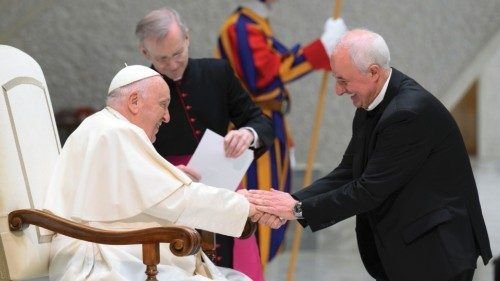
In an appointment that ideally follows that of the new prefect of the Doctrine of the Faith, Pope Francis appoints the auxiliary bishop of Rome elect Michele Di Tolve rector of the Roman Major Seminary, and gives him by decree the task of ‘strengthening relations between the realities of formation for the priesthood present in the territory of the diocese of Rome and coordinating their activities.’”
He will be ordained bishop next Sept. 2 in Milan, and, upon his arrival in Rome, Di Tolve will be charged with managing the formation of priests. As with the case with Archbishop Victor Manuel Fernandez, who was given the task by the Pope to “watch” rather than be guardian of doctrine in his new role as prefect of the Dicastery for the Doctrine of the Faith,Di Tolve will be given the task of creating new formation paths that are more in line with Pope Francis’s thinking.
With these two successive appointments, Pope Francis has changed not only how doctrinal matters are handled, but has also given a clear indication on how he wants formation to be.
Di Tolve’s appointment comes after a decree in which the pope recalled the promulgation of “In Ecclesiarum Comunione” on Jan. 6, 2023, which redefined the order of the Vicariate of Rome, and in which he recalled that on that same day he had assigned Bishop Baldassarre Reina to the post of vicegerent.
Now, in a decree, the Pope decided that “H.E. Msgr. Michele Di Tolve be entrusted with the task of strengthening relations between the realities of formation for the Priesthood present in the territory of the Diocese of Rome and of coordinating their activities, in agreement with H.E. Msgr. Baldassarre Reina, Vicegerent. In this context, I appoint H.E. Msgr. Michele Di Tolve Rector of the Pontifical Roman Major Seminary.” This appointment marks the end of the five-year term of Father Gabriele Faraghini, of the Little Brothers of the Jesus Caritas Community of Charles de Foucauld, as rector of the seminary.
Pope Francis discovered Di Tolve through the parishioners of Rho after his meeting with them last March 25. He had been pointed out by a cousin, who had heard the vociferous shouts of the boys around him, and had asked to bring him the parish priest of Rho. If Faraghini embodied the model of “suburban priest” that Pope Francis wanted, the newly appointed Bishop Di Tolve embodies the Pope’s model of youth ministry.
Di Tolve served as Milan Archdiocesan Seminary from 2014 to 2020. Previously, he was in charge of the diocesan Service for School Pastoral Care.
It is striking that two non-Roman auxiliary bishops have been called to manage the vicariate, such as Baldassare Reina, from Sicily, and Michele Di Tolve, from Lombardy; it is a sign that the Pope wants to make a clean break with the past.
The path of reform in the Vicariate of Rome that began with “In Ecclesiarum Comunione” last Jan. 6 comes to a close. However, before going into some of the details of the new decree, it is important to first understand it’s historical context. The last reform of the structure of the Vicariate of Rome was outlined by John Paul II in 1988, with the apostolic constitution “Ecclesia In Urbe”. In that case, too, the reform of the vicariate’s structure went directly to the reform of the Curia, which was promulgated in those very days.
While actually echoing in broad strokes the Constitution of John Paul II, Pope Francis’ reform, however, presented at the same time two general features of Pope Francis’ way of legislating: the use of councils or commissions; and, the referral of all councils and commissions directly to the power of the Pope himself.
It is clear that the Pope is Bishop of Rome, and the Pope’s Vicar for the diocese is his auxiliary. Pope Francis, however, has gone further by accompanying the Constitution with a decree that directly defined the areas of competence of auxiliary bishops. The pope no longer only appoints the areas of competence of the auxiliaries in Rome, but also decides their areas of competence within the government of the vicariate.
Pope Francis shows, in this way, a willingness to exercise greater personal control over everything that happens in the vicariate. With Monsignor Michele Di Tolve’s decree, a legacy in the formation of priests was also guaranteed. The Pontifical Roman Major Seminary is the seminary in Rome where the clergy of tomorrow are formed. But, the Pope also seems to be thinking of a more integrated reality with formation in the territory. It will be to be seen how Monsignor Di Tolve will fulfill his assignment.