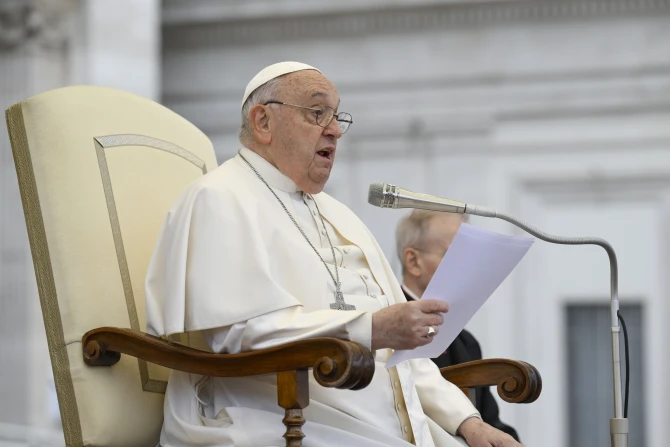
Pope Francis has published a letter addressed especially to priests in formation to promote the renewal of the study of Church history, emphasizing its importance in better interpreting reality.
At the beginning of the letter, presented Thursday at the Vatican Press Office, the Holy Father refers to the need to promote a “genuine sense of history” that takes into account the “historical dimension that is ours as human beings.”
“No one can truly know their deepest identity, or what they wish to be in the future, without attending to the bonds that link them to preceding generations,” the Holy Father says. The pontiff also points out that everyone, not only candidates for the priesthood, needs this renewal.
‘To love the Church as she truly exists’
In this context, the Holy Father states that we must abandon an “angelic” conception of the Church and embrace its “stains and wrinkles” in order to love the Church as it is.
In short, Pope Francis invites the faithful to see the real Church “in order to love the Church as she truly exists,” a Church that has learned “and continues to learn from her mistakes and failures.”
According to the Holy Father, this can “serve as a corrective to the misguided approach that would view reality only from a triumphalist defense of our function or role.”
Dangers of an ideological reading of history
In the letter Pope Francis criticizes the manipulation of history by ideologies that “destroy (or deconstruct) all differences so that they can reign unopposed.” These ideologies seek to lead young people to “spurn the spiritual and human riches inherited from past generations” and ignore everything that came before them, he says.
For the pope, this also leads to posing “false problems” and seeking “inadequate solutions,” especially in an era marked by a tendency “to dismiss the memory of the past or to invent one suited to the requirements of dominant ideologies.”
“Faced with the cancellation of past history or with clearly biased historical narratives, the work of historians, together with knowledge and dissemination of their work, can act as a curb on misrepresentations, partisan efforts at revisionism, and their use to justify” any number of evils, including wars and persecutions, the Holy Father indicated.
The pope thus points out that “we cannot come to grips with the past by hasty interpretations disconnected from their consequences” and that reality “is never a simple phenomenon reducible to naive and dangerous simplifications.”
The Holy Father warns against the efforts of those who act like “gods” who want to “cancel part of history and humanity.”
Human frailty and the spread of the Gospel
The Holy Father goes on to recognize “the human weakness of those to whom the Gospel has been entrusted” and exhorts the faithful to not ignore shortcomings and to “combat them assiduously” so that they do not hinder the spread of the Gospel.
The Holy Father reiterates that “forgiving does not mean forgetting,” and he encourages the Church “to initiate — and help initiate in society — sincere and effective paths of reconciliation and social peace.”
He also calls for avoiding the “merely chronological approach” to the history of the Church, which “would transform the history of the Church into a mere buttress for the history of theology or spirituality of past centuries.”
This story was first published by ACI Prensa, CNA’s Spanish-language news partner. It has been translated and adapted by CNA.