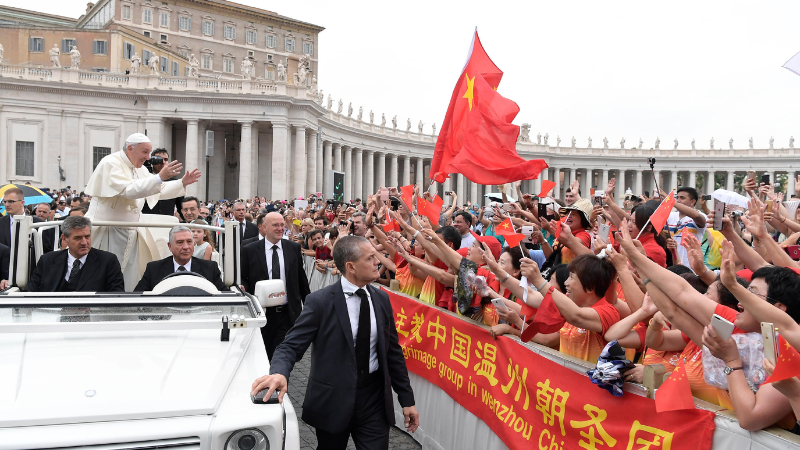
Pope Francis conveyed a “message of hope” to Chinese Catholics and expressed his desire to one day visit the Basilica of Holy Mary, the Help of Christians, in Shanghai, China, during an interview released on Friday.
In an interview at the Vatican with Father Pedro Chia, the director of the press office of the Chinese Province of the Society of Jesus, the pontiff said he would “really want to” conduct an apostolic visit to China to visit the shrine and meet with bishops and Catholics in the country.
“[The Chinese people] are indeed a faithful people who have gone through so much and remained faithful,” Francis said.
The pope added that the Chinese people are descendants of a “great people” and encouraged them not to “waste this heritage” but instead “pass it on with patience.” He further expressed a “message of hope” to the faithful in China.
“It seems tautological to send a message of hope to people who are masters of waiting,” Francis said. “The Chinese are masters of patience, masters of waiting. … It’s a very beautiful thing.”
The pope, who is a Jesuit, also provided advice to Jesuit clergy in China.
“Show the way to God through the spiritual exercises and discernment,” Francis said in his message to Chinese Jesuits. “… Walk with the poor [and with] those whose dignity has been violated in a mission of reconciliation and justice and … accompany young people in the creation of a hope-filled future and … take care of our common home.”
At the end of the interview, Francis bestowed a blessing on the Chinese people and prayed for the intercession of Our Lady of Sheshan.
The interview was conducted on May 24, the feast of Our Lady, Help of Christians, but not released until Aug. 9.
No pope has ever visited China, but Francis was the first pope to visit Mongolia, which borders China, in September 2023.
In 2018, the Vatican signed a confidential agreement with the CCP that would require the regime to consult with the Holy See about the appointment of bishops. That deal was renewed in 2020 and again in 2022.
According to a recent Pew study, the number of Christians in China has leveled after increasing in the 1980s and 1990s, which some observers attribute to a “crackdown” by the communist regime.
Nina Shea, senior fellow and director of the Center for Religious Freedom at the Hudson Institute, told CNA that the declining numbers of China’s Christians are “no surprise.”
“They correlate with Xi’s [Jiping’s] crackdown on Christianity, his so-called ‘Sinicization’ campaign,” she said. For the past five years, “the state has strictly banned all children from any exposure to religion, churches have been blanketed with facial-recognition surveillance and linked to social credit scores.”
During that time, Bibles have been restricted and censored, Beijing has detained Christian bishops and pastors, and their sermons have been censored to “be on Xi’s ‘thought,’” Shea said.
On critics and the future of the Church
During the interview with Chia, Francis also commented on criticism he has faced during his papacy.
“Critics are always helpful,” the pope said. “Even if they are not constructive, they are always helpful because they make one reflect on one’s actions.”
“Well, many times you know that you have to wait, to endure and often correct oneself because behind some resistances there can be good criticism,” Francis continued. “And sometimes also with pain, because the resistances, as they happen at these moments, are not only against me personally, they are against the Church.”
The pontiff also referenced difficulties faced by St. Ignatius of Loyola, who founded the Jesuits.
“The difficulties and resistances that St. Ignatius faced at the beginning were conflicts with people who looked inward and lost their missionary spirit,” he said.
The pope also urged Catholics to avoid worldliness and clericalism when reflecting on the future of the Church. He noted that 20th-century Jesuit theologian Father Henri de Lubac warned that worldliness was “the worst evil that can befall the Church” and “even worse than the time of the concubinary popes.”
“Some say it will be a smaller, more reduced Church,” the pontiff said. “I think the Church must be careful not to fall into the plague of clericalism and the plague of spiritual worldliness.”
When asked whether he had any words of advice for the person who succeeds him as pope, Francis gave a simple response: “Pray … because the Lord speaks in the prayer.”
This article was originally published on Catholic News Agency.