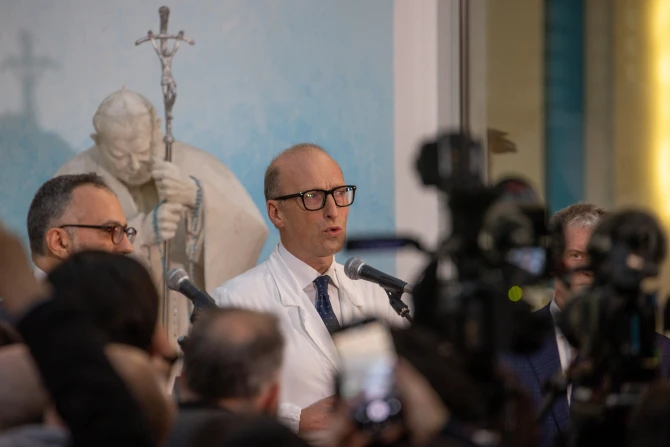
The head of the medical team that treated Pope Francis during the 38 days he spent at Rome’s Gemelli Polyclinic Hospital, Dr. Sergio Alfieri, revealed that one of the most critical moments of his hospitalization was when they had to choose between continuing the therapy or letting the pope die.
“We had to choose whether to stop and let him go, or push it and try every drug and therapy possible, running the extremely high risk of damaging other organs,” he said in an interview with the Italian newspaper Il Corriere della Sera.
In the interview, Alfieri described in detail the doctors’ response to the respiratory crisis suffered by the pope on Feb. 28.
According to the medical report published that day, Pope Francis suffered an isolated attack of bronchospasm, a severe coughing fit that suddenly worsened his clinical condition, after days of moderate optimism at the Vatican.
Although the pope never lost consciousness and cooperated with the specialists’ therapeutic maneuvers, the alarms went off, and doctors opted to place him on a noninvasive mechanical ventilation mask to help him breathe.
‘I saw tears in the eyes of some people who were close to him’
“For the first time, I saw tears in the eyes of some people who were close to him. People who, I’ve come to understand during this period of hospitalization, truly love him, like a father. We were all aware that the situation had worsened further and there was a risk that he might not make it,” Alfieri explained.
However, despite the risk of causing irreversible kidney and bone marrow damage due to the medical treatment he underwent, they decided to act. “We really thought we wouldn’t make it,” he said.
It was a difficult decision, as Alfieri recounted, ultimately supported by the decision of the pope himself, who, through his personal health assistant, Massimiliano Strappetti, his personal nurse at the Vatican, gave a clear order: “‘Try everything, let’s not give up.’ And no one gave up.”
In the end, Pope Francis responded to the treatment. However, after his recovery, there was another moment of intense concern.
While eating, the pope suffered an episode of vomiting, and the gastric juices ended up entering his lungs.
“We were just coming out of the toughest period, and while eating, Pope Francis vomited and inhaled it. That was the second truly critical moment because, in these cases, if you don’t act quickly, there’s a risk of sudden death, in addition to complications in the lungs, which were already the most compromised organs,” Alfieri related.
He might not survive the night
The doctor explained that, despite the seriousness of the situation, Pope Francis was always fully aware, “even when his condition worsened.”
“He was aware, like us, that he might not survive the night,” the doctor stated.
He added: “We saw the man who was suffering. However, from the first day he asked us to tell him the truth and wanted us to tell the truth about his condition.”
In this regard, the director of the medical-surgical department at Gemelli Polyclinic Hospital expressed the desire for transparency that prompted the Vatican to report on Pope Francis’ health.
“We communicated the medical information to the secretaries, and they added other information that the pope later approved. Nothing has ever been modified or omitted,” he noted.
The power of prayer
In the interview, Alfieri also highlighted the pope’s incredible strength, both physical and mental: “In the past, when we spoke, I would ask him how he managed to keep up this pace, and he always replied, ‘I have a method and rules.’ Beyond a very strong heart, he has incredible resources.”
In addition to the pope’s stamina, the Gemelli medical coordinator added that the prayers offered by faithful around the world in recent days also contributed to his recovery.
“There is a scientific publication that says prayer strengthens the sick. In this case, the whole world began to pray. I can say that twice the situation was lost, and then it happened like a miracle. Of course, he was a very cooperative patient. He underwent all the therapies without ever complaining,” he stated.
This story was first published by ACI Prensa, CNA’s Spanish-language news partner. It has been translated and adapted by CNA.