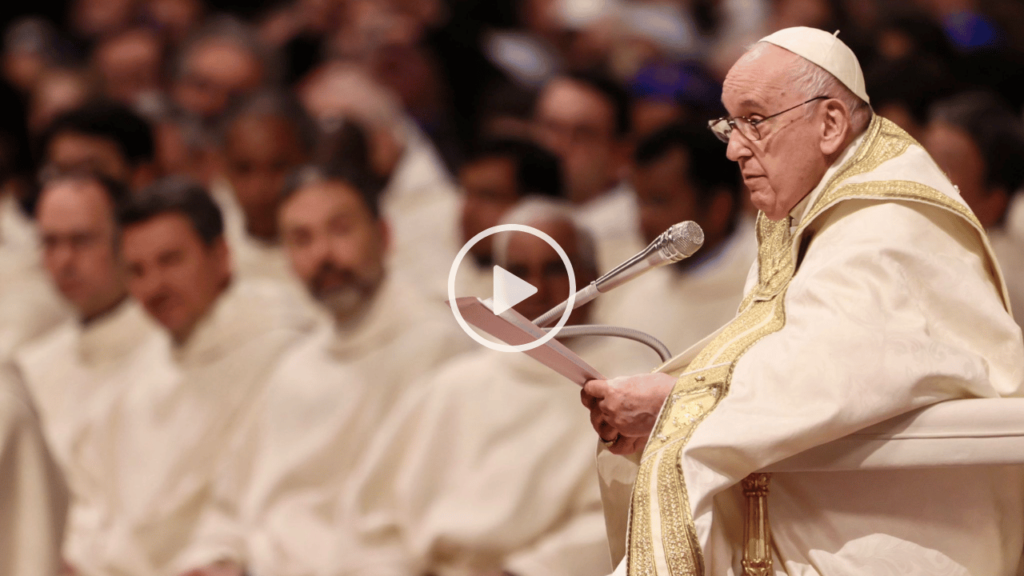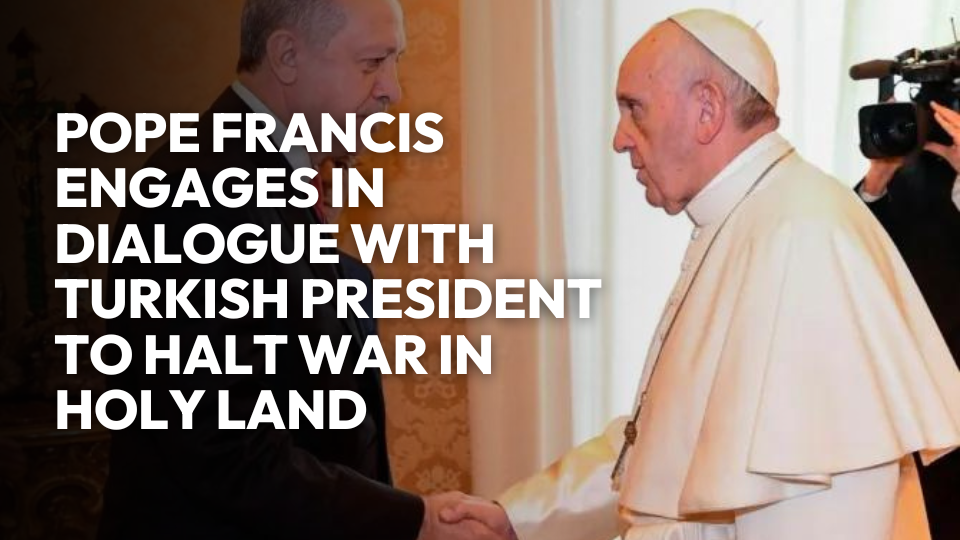
The Vatican confirmed that on Thursday, October 26, Pope Francis received a phone call from Turkey’s President, Recep Tayyip Erdoğan. The leaders discussed the escalating tensions in the Holy Land arising from the ongoing conflict between Israel and the Islamic organization Hamas, which governs the Gaza Strip.
Matteo Bruni, the director of the Holy See Press Office, conveyed in an email that the morning conversation, initiated by Erdoğan, predominantly centered on the “grave situation in the Holy Land.”
“Pope Francis communicated his deep concern for the unfolding events and emphasized the Holy See’s longstanding position. He expressed hope for a resolution that encompasses a two-state solution and a special designation for the city of Jerusalem,” Bruni remarked.
Simultaneously, the Presidency of the Republic of Turkey, in a statement on their social media account, highlighted the conversation’s focus on “the conflict between Israel and Palestine and the mounting human rights violations in the region.”
The Turkish Presidency, while refraining from condemning the October 7 civilian casualties and abductions by Hamas in Israel, labeled the ongoing events in Gaza, where over 5,000 have died from Israeli airstrikes, as a “massacre.” Israeli Prime Minister Benjamin Netanyahu has meanwhile signaled preparations for a potential ground invasion of the Strip.
In a recent address to the Turkish Parliament on October 25, President Erdoğan articulated a distinction, stating, “Hamas is not a terrorist organization; it represents a group fighting for liberation, steadfastly defending its territory and citizens.”
Concurrently, European Union leaders have convened in Brussels, Belgium. Their agenda includes discussions aimed at establishing a unified stance and advocating for a “humanitarian pause.” This move seeks to address the immediate needs of Gaza’s 2 million inhabitants, who, in addition to enduring airstrikes, grapple with the repercussions of the Israeli blockade, resulting in shortages of essential supplies including water, medicines, and food.
The Evolution of the Two-State Vision
The Vatican champions the vision of two states—one Israeli and one Palestinian—drawing its stance from the United Nations’ General Assembly Resolution 181, passed in 1947, which subsequently saw the birth of the State of Israel.
Nevertheless, the ensuing partition of the then British Mandate of Palestine and the proclamation of Israel were met with resistance from Arab nations. This discord culminated in three wars and birthed Hamas in 1987, the Palestinian Islamist faction that assumed control of Gaza in 2007.
Pertaining to Jerusalem, Resolution 181 envisioned a unique international administration overseen by the United Nations. This proposal aimed to safeguard the “sacred spiritual and religious interests” of the triad of major religious denominations—Judaism, Christianity, and Islam—all of whom venerate locations within the city.
However, the scenario transformed post the 1967 war when Israel reasserted its dominion over Jerusalem, declaring it their capital. This move intensified tensions, especially with Muslim-majority nations like Iran, suspected of bankrolling Hamas.