Each time that a Catholic makes the sign of the cross, it is a reminder that God is a communion of love, Pope Francis said Sunday.
Speaking on the solemnity of the Most Holy Trinity, the pope highlighted how the simple gesture that Catholics are taught as children is a sign of the central mystery of Christian faith.
“By tracing the cross on our body, we remind ourselves how much God loved us, to the point of giving his life for us; and we repeat to ourselves that his love envelops us completely, from top to bottom, from left to right, like an embrace that never abandons us,” Pope Francis said June 4.
“Yes, brothers and sisters, our God is a communion of love: This is how Jesus revealed him to us,” he added.
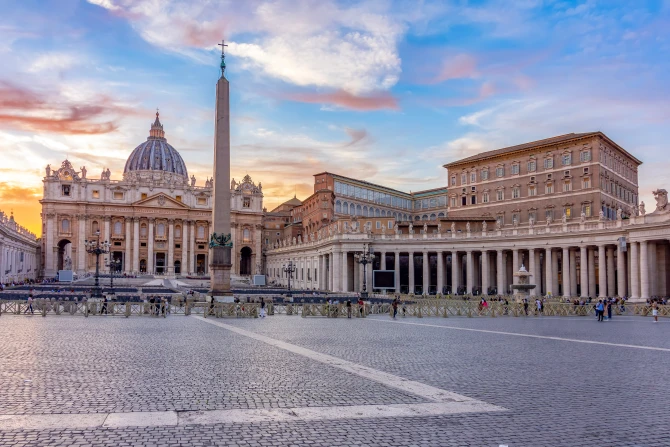
Pope Francis invited the crowd gathered in St. Peter’s Square to make the sign of the cross together.
“God is love. God is Father, Son, and Holy Spirit, and he gave his life for us, so we make the sign of the cross,” he said.
The pope spoke on Trinity Sunday, a solemnity celebrated on the Sunday following Pentecost that dates to before the 10th century.
The tradition of making the sign of the cross dates back much further. St. Basil (329–379) wrote that the Apostles “taught us to mark with the sign of the cross those who put their hope in the Lord.”
In his Angelus address, the pope reflected on a conversation between Jesus and Nicodemus recorded in the Gospel of John 3:16–18. Pope Francis noted how Jesus “revealed the heart of the mystery to him, saying that God loved humanity so much that he sent his Son into the world.”
Pope Francis pointed out that one way to picture the Holy Trinity is to think of “the image of a family gathered around the table, where life is shared.”
“But it is not only an image; it is reality,” he said. “It is reality because the Holy Spirit, the Spirit that the Father poured into our hearts through Jesus (cf. Gal 4:6), makes us savor God’s presence: a presence that is close, compassionate, and tender. The Holy Spirit does with us what Jesus does with Nicodemus: He introduces us to the mystery of new birth — the birth of faith, of the Christian life — he reveals the heart of the Father to us, and he makes us sharers in the very life of God.”
“The invitation he extends to us, we might say, is to sit at the table with God to share in his love. This is what happens at every Mass, at the altar of the eucharistic table, where Jesus offers himself to the Father and offers himself for us.”
At the end of the Angelus prayer, Pope Francis prayed for the victims of a train crash in India that killed more than 280 people.
“I am close to the wounded and their families. May our heavenly Father welcome the souls of the deceased into his kingdom,” he said.
This article was originally posted on CNA (Catholic News Agency)