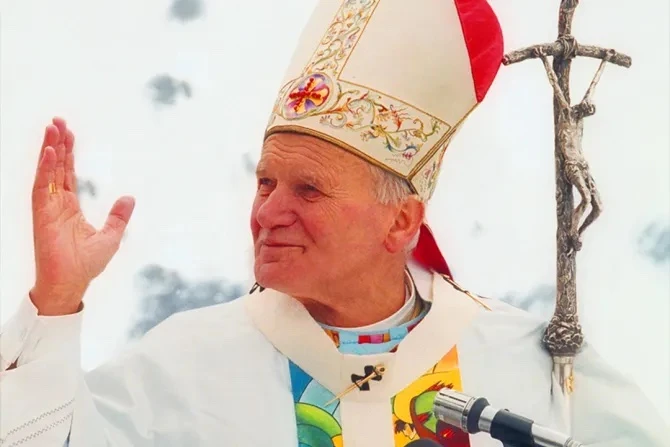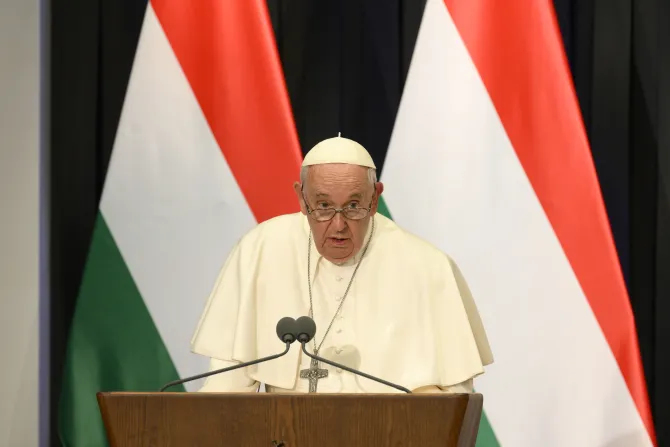
Speaking to Hungarian civil authorities in Budapest, “a city of bridges,” Pope Francis on Friday challenged the nations of Europe to recapture a spirit of fraternal unity and pursue “creative efforts for peace.”
“In the postwar period, Europe, together with the United Nations, embodied the noble hope that, by working together for a closer bond between nations, further conflicts could be avoided,” the pope said April 28 at the start of his three-day visit to the Hungarian capital.
“In the world in which we presently live, however, that passionate quest of a politics of community and the strengthening of multilateral relations seems a wistful memory from a distant past,” the Holy Father lamented.
“We seem to be witnessing the sorry sunset of that choral dream of peace, as the soloists of war now take over,” he said. “More and more, enthusiasm for building a peaceful and stable community of nations seems to be cooling, as zones of influence are marked out, differences accentuated, nationalism is on the rise, and ever harsher judgments and language are used in confronting others.”
Before his address, delivered in a former Carmelite monastery in Budapest’s Castle District, Pope Francis met with Hungary’s President Katalin Novák and Prime Minister Viktor Orbán, whose conservative policies, many of which aim to preserve and strengthen the nation’s Christian identity, have placed Hungary’s government at odds with more liberal members of the European Union.
In his remarks, the pope made no direct reference to the ongoing war in Ukraine, Hungary’s neighbor to the northeast. Instead, he spoke broadly of an urgent need to “generate forms of diplomacy capable of pursuing unity, not aggravating differences.”
Pope Francis placed Hungary, a historically Christian nation with a rich tradition of statesmanship, and Budapest itself, forged 150 years ago out of three separate cities, at the center of this leadership challenge.
“I think of a Europe that is not hostage to its parts, neither falling prey to self-referential forms of populism nor resorting to a fluid, if not vapid, ‘supranationalism’ that loses sight of the life of its peoples,” the pope said. “This is the baneful path taken by those forms of ‘ideological colonization’ that would cancel differences, as in the case of the so-called gender theory, or that would place before the reality of life reductive concepts of freedom, for example by vaunting as progress a senseless ‘right to abortion,’ which is always a tragic defeat.”
The Holy Father offered a different vision for Europe’s future. “How much better it would be to build a Europe centered on the human person and on its peoples, with effective policies for natality and the family — policies that are pursued attentively in this country — a Europe whose different nations would form a single family that protects the growth and uniqueness of each of its members,” he said.
In a sense, the pope said, the city of Budapest symbolizes that vision.
“The most famous bridge in Budapest, the chain bridge,” the pope noted, “helps us to envision that kind of Europe, since it is composed of many great and diverse links that derive their solidity and strength from being joined together. In this regard, the Christian faith can be a resource, and Hungary can act as a ‘bridge builder’ by drawing upon its specific ecumenical character. Here, different confessions live together without friction, cooperating respectfully and constructively.”
Yet Hungary must also confront internal challenges to its historical character as a welcoming nation, the pope emphasized, alluding to efforts by Orbán and his party to curtail the flow of refugees from the Middle East and Africa.
Hungary has welcomed some 1.5 million war refugees from Ukraine since Russia invaded the country more than a year ago, and the country has been a global leader in assisting persecuted Christian communities in Syria, Lebanon, and other parts of the world. While praising those efforts, Pope Francis also evoked the fraternal spirit of the country’s first king, St. Stephen, noting that the 11th-century monarch advised his son, St. Emeric, that those who brought different languages and customs to Hungary “adorn the country.”
“The issue of acceptance and welcome is a heated one in our time, and is surely complex,” the pope acknowledged.
“Nonetheless, for those who are Christians, our basic attitude cannot differ from that which St. Stephen recommended to his son, having learned it from Jesus, who identified himself with the stranger needing to be welcomed,” he continued.
“When we think of Christ present in so many of our brothers and sisters who flee in desperation from conflicts, poverty and climate change, we feel bound to confront the problem without excuses and delay. It needs to be confronted together, as a community, not least because, in the present situation, its effects will be felt, sooner or later, by all of us,” he said.
Later on Friday, the pope was scheduled to meet with clergy and pastoral workers in St. Stephen’s Co-Cathedral in Budapest. His weekend schedule includes private meetings with his fellow Jesuits and with children from the Blessed László Batthyány-Strattmann Institute for the Blind. He is also set to meet with the poor and refugees at St. Elizabeth Hungary Church and with young adults at the Budapest Sports Arena.
This article was originally published on Catholic News Agency