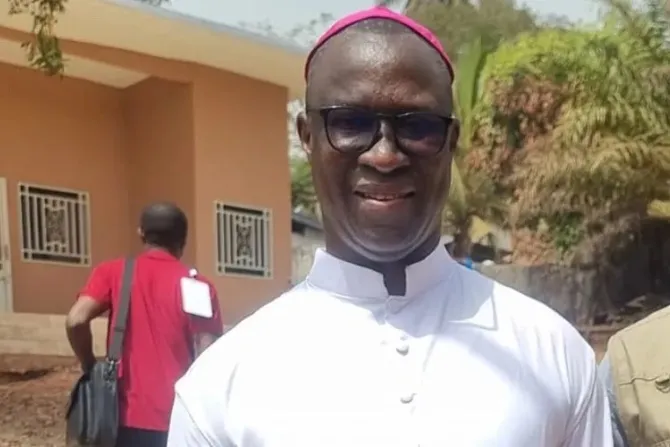
Father Juan Miguel Ferrer Grenesche, a Spanish priest and an expert in liturgy and popular piety, explained in anticipation of Pope Francis’ upcoming visit to Corsica on his 47th apostolic journey that the pontiff “has highly valued popular piety” throughout his life.
Popular piety, in this sense, means the piety characteristic of a people, often manifested in public expressions of faith.
On Dec. 15, the pope will visit the city of Ajaccio, the capital of the French island, to close a conference on popular religiosity in the Mediterranean in which Ferrer will participate, speaking about processions and popular faith in Spain.
In an interview with ACI Prensa, CNA’s Spanish-language news partner, Ferrer explained how he believes the pope will approach his participation in this conference, since “in Latin America he has greatly valued popular piety,” especially with his participation in the meetings of the Latin American and Caribbean Bishops’ Council (CELAM, by its Spanish acronym).
After the Second Vatican Council, the priest explained, the Latin American bishops decided at a conference held in Medellín, Colombia, in 1968 to distance themselves in some way from popular religiosity, considering that it was “too contaminated by pagan elements, superstitions, witchcraft, and other things.”
This reluctance changed at the conference held in Puebla, Mexico, in 1979, Ferrer explained, noting that “if care is taken, there are many elements that can be helpful and complement the great contribution of the liturgy, which the council said did not exhaust the spiritual life of the Church.”
Pope Francis was consecrated as a bishop in 1992 and six years later he became archbishop of Buenos Aires. In 2001, St. John Paul II made him a cardinal. In that capacity, he participated in the CELAM conference held in Aparecida, Brazil, in 2007.
“As cardinal of Buenos Aires he played a key role in the final document, because in it popular religiosity is clearly seen as an element that expresses the inculturation of Christianity in the masses of people on the entire continent,” Ferrer explained.
Pope Francis “wants the Church to present what remains of popular religiosity as a platform for encounter, as an Areopagus for evangelization,” the Spanish priest summed up.
Popular piety, ‘last lifeline’ for many
Regarding the content of the conference that Pope Francis will close, the Spanish priest explained that, in a secularized society, popular piety is for many people “the last lifeline to connect with transcendence and not to completely break with the Christian religious tradition.”
He also commented that the Church likes to talk more about “popular piety” than “popular religiosity” because understood in this latter sense it can be considered “excessively aseptic or disconnected from Christian sources or roots.”
In evangelization, popular piety also allows us to reach those who don’t know the depth and richness of formal liturgy and through “a cultural adaptation” is able to “preserve the connection between the human heart’s thirst for God and the sources of revelation: the word of God, the life of Christ, the sacraments, the Church itself.”
Preserving the religious sense of life
Ferrer also pointed out that “where there is a strong popular religiosity, the religious sense of life is preserved,” despite sins, “doctrinal lapses,” neglect, or laziness.
In this context, it’s possible that “someone who has a religious sense of life can receive the Christian message more easily. On the contrary, where all manifestations of popular religiosity or popular piety have been eliminated, we could say that people’s souls have dried up.”
In this regard, the expert pointed out that psychologist Victor Frankl discovered that even more pathologies “arise from the repression of the religious instinct” than from the repression of the sexual instinct, as his teacher, Sigmund Freud, maintained.
“In societies where people’s souls have dried up, where everything has to be rational, where everything has to be empirical, where there is no room for the religious or the transcendent, then phenomena of crises, we might say, arise and sowing the Gospel becomes very difficult,” the priest observed.
Ferrer also explained that popular piety, expressed through processions, with their statues, music, etc., attracts many people of different ages in whom different emotions are awakened.
However, “for a Catholic Christian that’s not enough, but it’s also true that if we then add to the mixture with skill and pastoral art, with presence, liturgical celebration and formation, it becomes a source of volunteers for any task in the parishes or, in the dioceses, a source of vocations for our religious communities and for our seminaries.”
Popular piety in Corsica
When asked about the particularities of popular piety in Corsica, Ferrer said that Corsica “has a strong tradition of confraternities and brotherhoods [that typically sponsor and organize processions],” with influences from Italy and southern France, “coming very much from the Dominicans and Franciscans who preached and looked after these areas of the Mediterranean.”
Over the years, “people took it up as something very much theirs and very much their own, and in addition, much of the singing has been preserved, which is very important in Corsica” and is characterized by being “very peculiar, nasal, very striking.”
This story was first published by ACI Prensa, CNA’s Spanish-language news partner. It has been translated and adapted by CNA.