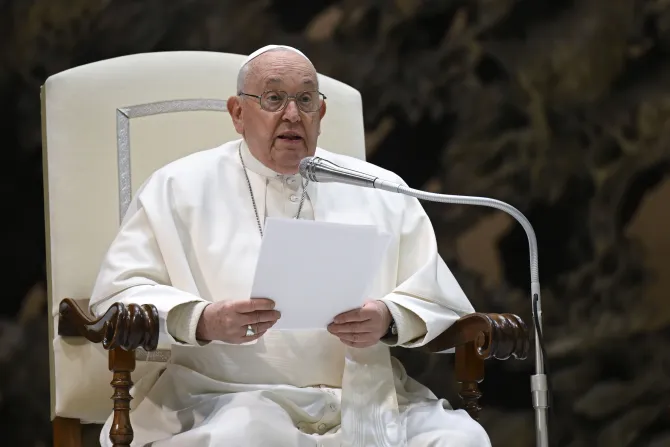
Pope Francis amended the Vatican’s financial regulations on Tuesday, enshrining a spending limit into law that requires Vatican offices to get permission before making large purchases.
The pope published two apostolic letters — which the Holy Father issued motu proprio (“on his own impulse”) — on Jan. 16 that make changes to some of Francis’ former financial reform laws from June 2020, updating them to align with the 2021 apostolic constitution Praedicate Evangelium, the pope’s signature reform of the organization and structure of the Roman Curia.
The first motu proprio, titled “On the Limits and Modalities of Ordinary Administration,” requires Vatican offices to get approval from the Secretariat of the Economy for purchases over 2% of their total annual operating budget. The motu proprio adds that purchases under 150,000 euros do not require approval.
The Secretariat for the Economy oversees the financial aspects of both the Roman Curia and the Vatican City State administration, including a review of financial reports. The secretariat was established by Pope Francis in 2014 as part of his financial reform of the Vatican.
The law grants the Secretariat for the Economy 30 days to notify the Vatican offices whether the request has been approved, adding that “the lack of response is equivalent to the granting of the request.”
The second motu proprio consists of more than 90 articles and includes Vatican regulations on procurements, or the process of acquiring and purchasing goods and services.
Pope Francis wrote in his introduction to the second motu proprio that he was updating regulations in light of “the experience gained in recent years” to allow for a “more effective application” of Vatican financial reforms with the goal of “continuing on the path undertaken to promote transparency, control, and competition in the procedures for the awarding of public contracts.”
The amended regulations include a provision that the sustainable use of internal funds, transparency in the procurement process, and equal treatment among bidders all take place “in accordance with the principles of the social doctrine of the Church, the canonical order of the Holy See and Vatican City State, and the encyclical letter Laudato Si’,” codifying compliance with Pope Francis’ landmark environmental encyclical into the law.
Pope Francis signed the motu proprio on procurements on Nov. 27, 2023, in St. Peter’s Basilica and the letter on extraordinary spending more recently on Jan. 6 from the Vatican.
This article was originally published on CNA.