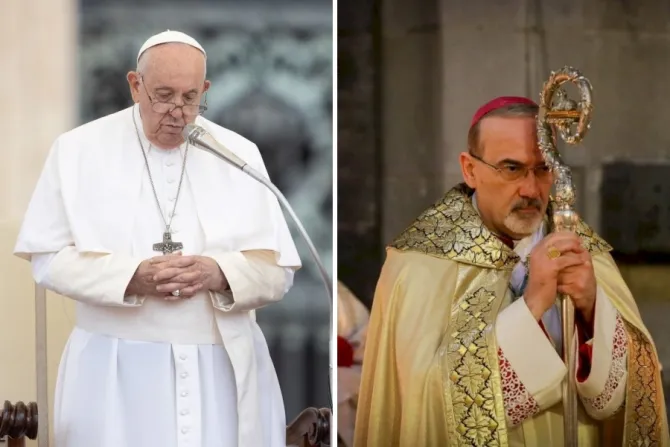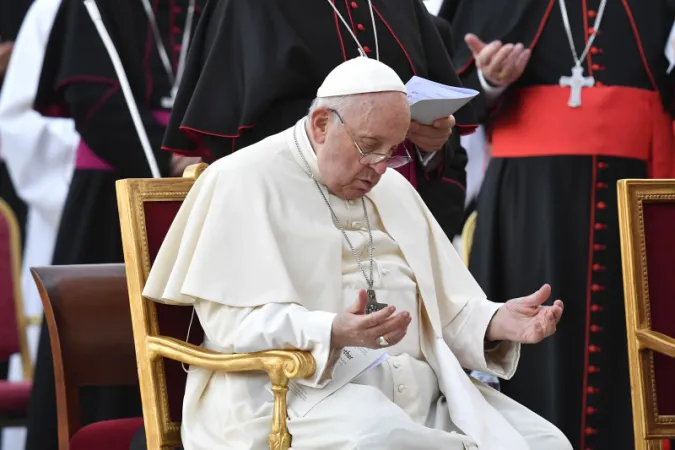
This Thursday, November 30, Pope Francis received members of the International Theological Commission at the Vatican, where he reminded them that the Church is “female” and a “bride.” The organism was established by Paul VI within the then Congregation for the Doctrine of the Faith in 1969 (it was a proposal of the first assembly of the Synod of Bishops) to assist it in examining the most important doctrinal issues.
Due to suffering from a lung inflammation that impedes his normal breathing, the Pontiff handed over his speech. However, he also offered some impromptu words.
The Pope criticized the scant presence of women in the Commission. “We must progress on this! Women have a different capacity for theological reflection than we men. At the next meeting of the nine Cardinals, we will reflect on the female dimension of the Church.”
“The Church is female,” Francis reiterated, “and if we do not understand what a woman is, what the theology of a woman is, we will never understand what the Church is. One of our great sins has been masculinizing the Church. And this is not resolved through ministerial means, that’s another thing. It is resolved through the mystical, the real way.”
“This,” the Pope concluded, “is a task I ask of you, please. Demasculinize the Church.”
“I’ve spoken too much, and it has hurt,” admitted the Pope, referring to the lung inflammation he is suffering from these days.
Below is the speech delivered by the Pontiff to the attendees.
Dear brothers and sisters, good morning!
I greet Cardinal Fernández and welcome all of you, expressing my gratitude for your valuable work. Today we are called to dedicate ourselves with all the energy of heart and mind to a “missionary conversion of the Church” (Evangelii gaudium, 30). It responds to Jesus’ call to evangelize, embraced by Vatican Council II, which still guides our ecclesial journey: there the Holy Spirit let his voice be heard for our times. The Council stated its purpose by affirming that “it ardently desires, by proclaiming the Gospel to every creature, to enlighten all men with the light of Christ” (Lumen gentium, 1). And, as your Commission has noted, “the implementation of a synodal Church is an indispensable prerequisite for a new missionary impetus that involves the entire People of God” (Synodality in the life and mission of the Church, 9): a missionary impetus that knows how to communicate the beauty of the faith. Coming then to your more specific task, in the Letter addressed to the new Prefect of the Dicastery for the Doctrine of the Faith I emphasized that today “we need a thought that knows how to convincingly present a God who loves, who forgives, who saves, who liberates, who promotes people and calls them to fraternal service” (July 1, 2023). You are called to take on this need in a qualified way, through the proposal of an evangelizing theology, which promotes dialogue with the world of culture. And it is essential that you theologians do it in tune with the People of God, I would say “from below”, that is, with a privileged look for the poor and the simple, and at the same time staying “on your knees”, because theology is born on your knees, in the adoration of God. I know that you are deepening two current challenges: the anthropological question and the ecological theme. But your work also sees you committed to proposing an updated and incisive reflection on the permanent topicality of the Trinitarian and Christological faith confessed by the Council of Nicea, which we are about to commemorate 1700 years after its celebration, coinciding with the Jubilee called for the year 2025. I would then like to share with you three reasons that make the rediscovery of Nicea so promising. The first is a spiritual reason. At Nicea, faith in Jesus, the only Son of the Father, was professed: He who became man for us and for our salvation is “God from God, light from light.” It is not only the light of an unthinkable knowledge, but it is light that illuminates existence with the love of the Father. Yes, there is a light that guides us on the way and dispels darkness, and this light, which dwells in our lives, is springing and eternal: how to testify to it, if not with a luminous life, with a joy that radiates? Even for your ministry of theologians, Jesus’ invitation applies to “not light a lamp to put it under the bushel, but on the lampstand, so that it may give light to all those who are in the house” (cf. Mt 5:15). It is up to theologians to spread new and surprising flashes of the eternal light of Christ in the house of the Church and in the darkness of the world. A second reason is the synodal one. At Nicea, the first ecumenical Council was celebrated, in which the Church was able to express its nature, its faith, its mission, to be, as the last Council affirms, “the sign and instrument of intimate union with God and of the unity of all mankind” (Lumen gentium, 1). Synodality is the way, the way to translate into attitudes of communion and into processes of participation the Trinitarian dynamic with which God, through Christ and in the breath of the Holy Spirit, comes to meet humanity. Theologians are entrusted with the great responsibility of unleashing the richness of this wonderful “humanizing energy.” You yourselves participate in the works of the Commission coming from various parts of the world, bringing with you the gifts and riches, the questions and sufferings of your Churches and your peoples. Be witnesses, in your collegiate work and in the sharing of your ecclesial and cultural peculiarities, of a Church that walks according to the harmony of the Spirit, rooted in the Word of God and in the living Tradition, and that accompanies with love and discernment the cultural and social processes of humanity in the complex transition we are experiencing. Do not be satisfied with what has already been acquired: keep your heart and mind open to God’s semper magis. And finally, an ecumenical reason. How can we not recall the extraordinary relevance of this anniversary for the journey towards the full unity of Christians? Not only, in fact, does the Symbol of Nicea unite the disciples of Jesus, but precisely in 2025, providentially, the date of the celebration of Easter will coincide for all Christian denominations. How beautiful it would be if it marked the concrete beginning of an always common celebration of Easter! Brothers and sisters, let us carry this dream in our hearts and invoke the creativity of the Spirit, so that the light of the Gospel and of communion may shine more brightly.
I renew my thanks for your service and bless you, asking you to pray for me.