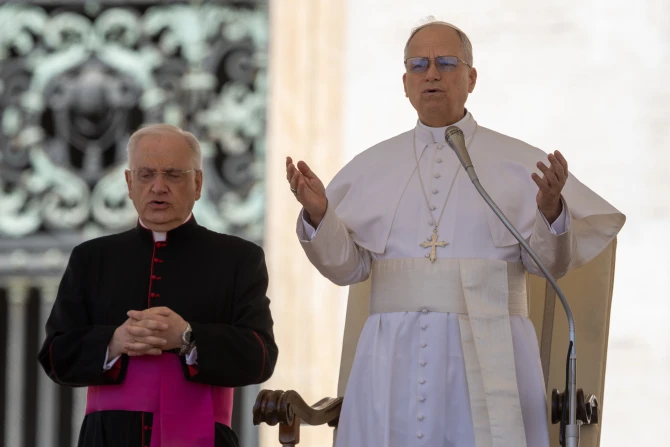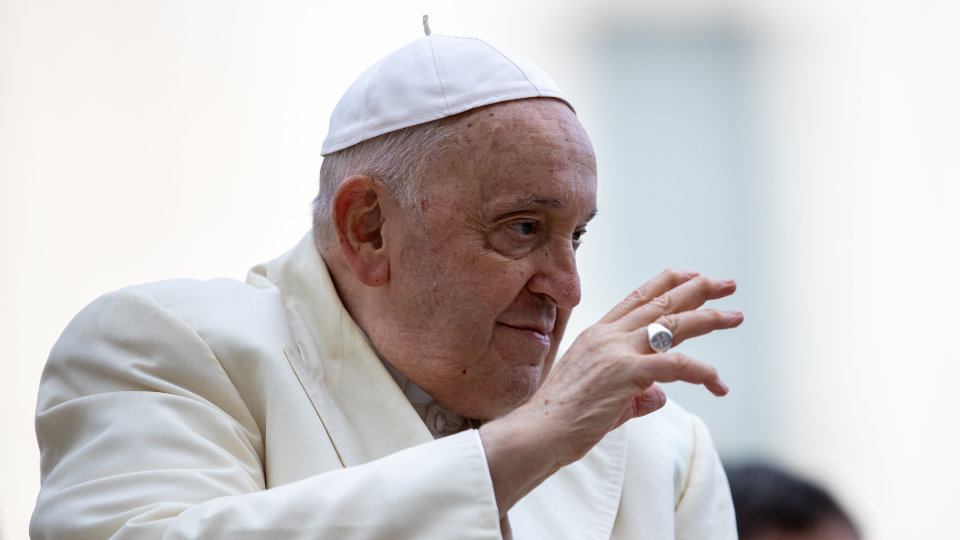
During his weekly general audience in St. Peter’s Square on Wednesday, Pope Francis highlighted the universal nature of the Church’s mission to proclaim the Gospel, arguing that it is a call for everyone and that no one is excluded.
The Holy Father’s Nov. 22 catechesis was a continuation of last week’s lesson where he focused on the joy in proclaiming the Gospel, noting that without joy there is no credible witness to the Gospel message.
The pope on Wednesday quoted his 2013 apostolic exhortation Evangelii Gaudium (“the Joy of the Gospel”), stressing that Christians “have the duty to proclaim the Gospel without excluding anyone.”
“Instead of seeming to impose new obligations, they should appear as people who wish to share their joy, who point to a horizon of beauty and who invite others to a delicious banquet,” the pope said, quoting the exhortation. “It is not by proselytizing that the Church grows, but ‘by attraction’,” he quoted further.
“Brothers, sisters, let us feel that we are at the service of the universal destination of the Gospel; and let us distinguish ourselves for our capacity to come out of ourselves, to overcome every limit,” the pope said.
“Christians meet on the parvis more than in the sacristy, and go ‘to the streets and lanes of the city’,” the pope said. “They must be open and expansive, ‘extrovert’, and this character of theirs comes from Jesus, who makes his presence in the world a continuous journey, aimed at reaching out to everyone, even learning from some of his encounters.”
The pope also spoke about the role discernment plays in this process, noting that “the Bible shows us that when God calls a person and makes a pact with some of them, the criterion is always this: Elect someone to reach many others.”
But Francis warned against the temptation to conflate the notion of being the elected with having a sense of superiority.
“Perhaps the greatest temptation is to consider the call received as a privilege. Please no, the call is not a privilege, ever. We cannot say that we are privileged compared to others, no. The call is for a service. And God chooses one to love everyone, to reach everyone,” the pope instructed.
In speaking about the universality of the mission of the Church, the pope went on to warn that the Church is universal both in its mission and in its very structure. He argued that we must “prevent the temptation to identify Christianity with a culture, with an ethnicity, with a system.”
“Thus, however, it loses its truly Catholic nature, that is, for all, universal: it is not a small group of first-class elect. Let us not forget: God chooses someone to love everyone. This horizon of universality. The Gospel is not just for me, it is for everyone, let’s not forget that.”
At the end of the general audience, during his personal address to Italian pilgrims, the pope repeated his request for prayers for those who are suffering as a result of the ongoing wars in Ukraine and Palestine.
“Let us not forget to persevere in prayer for those who suffer from wars in many parts of the world, especially for the dear people of Ukraine, the tormented Ukraine, and of Israel and Palestine.”
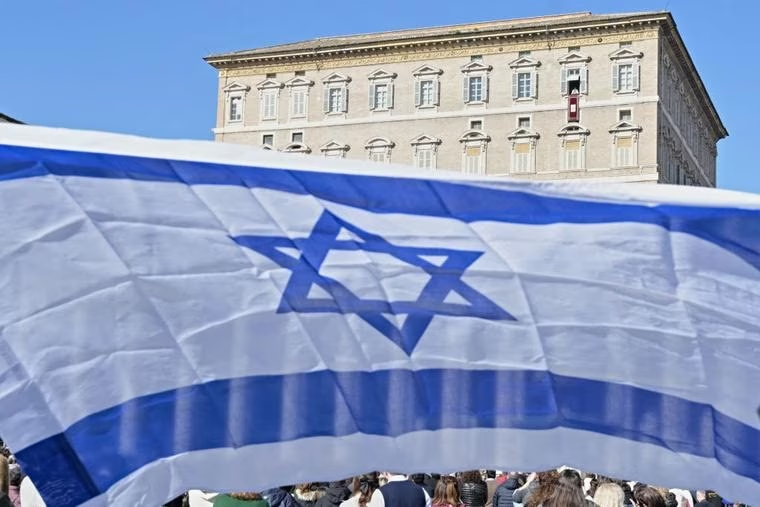
The pope also announced that prior to the morning’s general audience, he had received two delegations from the Holy Land. One was a delegation from Palestine, composed of family members of Palestinian prisoners being held in Israel; the other was made up of the relatives of the Israeli hostages taken by Hamas at the onset of the Israel-Hamas war in early October.
“They suffer a lot and I heard how they both suffer: wars do this, but here we have gone beyond wars, this is not waging war, this is terrorism,” the pope said.
“Please, let’s move forward for peace, pray for peace, pray a lot for peace. May the Lord put his hand there, may the Lord help us to solve the problems and not move forward with the passions that ultimately kill everyone. We pray for the Palestinian people, we pray for the Israeli people, for peace to come.”
This article was originally published on Catholic News Agency.