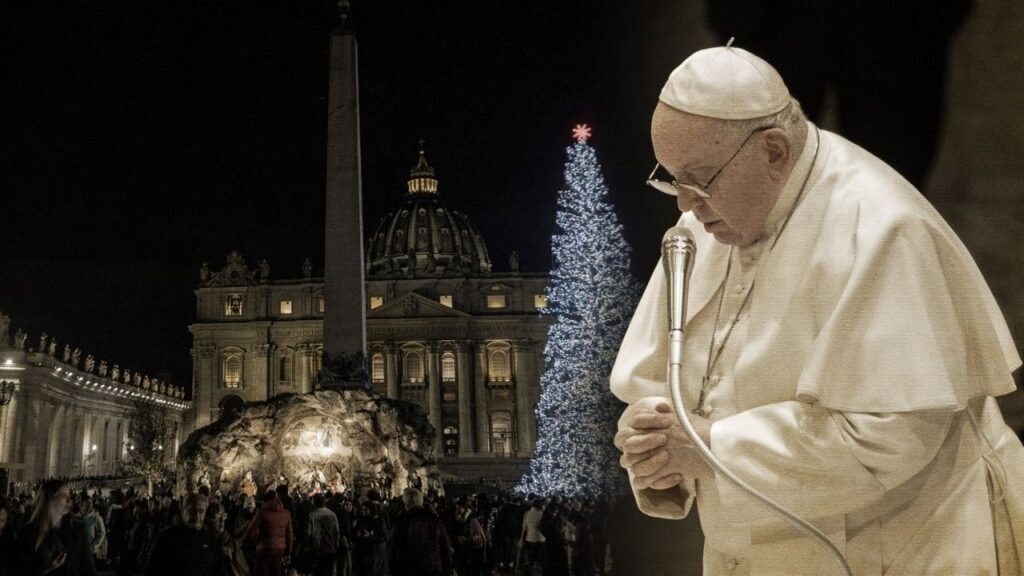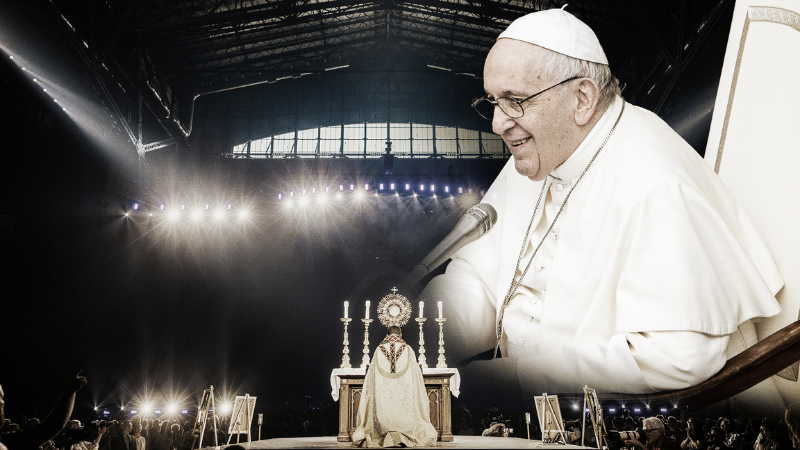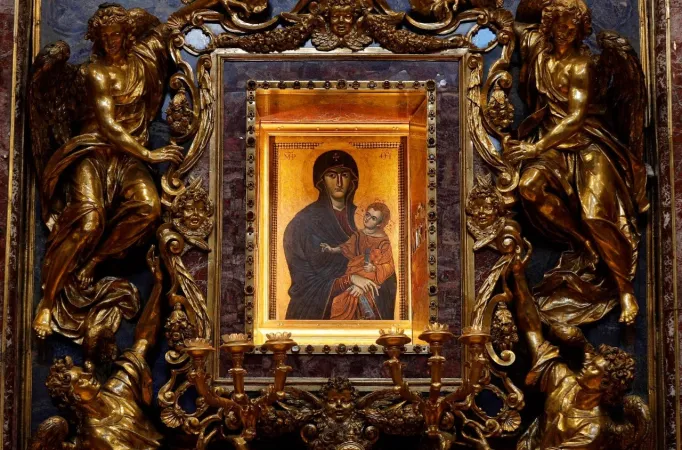
Marking the Feast of the Immaculate Conception in a ceremonial gesture, Pope Francis is set to honor the icon of Maria Salus Populi Romani with a Golden Rose.
This significant event will unfold at the Basilica of Santa Maria Maggiore, a site steeped in history where Saint Ignatius of Loyola conducted his inaugural Mass. Pope Francis, who has consistently paid tribute to this icon since his first day as pontiff, will extend this tradition with the presentation of the Golden Rose.
The solemn ceremony is scheduled for Friday, December 8, 2023, at 3:30 PM in the Papal Basilica, complementing the tribute to the Statue of the Immaculate at Piazza di Spagna.The Basilica’s statement reminds us that “the Golden Rose has ancient roots and symbolizes the papal blessing. The tradition of bestowing the Golden Rose dates back to the Middle Ages and, over the centuries, has been gifted to monasteries, shrines, sovereigns, and prominent figures in recognition of their commitment to faith and the common good.”
The Basilica explains that “with the gift of the Rose to the Salus, Pope Francis emphasizes the spiritual importance and profound significance this icon holds in the life of the Catholic Church, being also the oldest Marian shrine in the West dedicated to the Mother of God.”
Not the first time
This is not the first time the Salus Populi Romani has received a golden rose. The first, as the basilica recalls, was donated in 1551 by Pope Julius III, who was deeply devoted to the Marian icon housed in the Basilica and had celebrated his first Mass on the altar of the Nativity. In 1613, Pope Paul V donated the Golden Rose on the occasion of the translation of the revered Icon into a newly erected chapel.
However, “the Basilica has no trace of the two aforementioned Golden Roses donated by the two Pontiffs, probably lost during the Napoleonic invasion of the Papal States (Treaty of Tolentino 1797).”
Archbishop Rolandas Makrickas, Extraordinary Commissioner of the Basilica, has stated that “the gift of the Golden Rose is a historic gesture that visibly expresses Pope Francis’s profound bond with the Mother of God, venerated in this sanctuary under the title of Salus Populi Romani. The people of God can be further strengthened in their spiritual and devotional bond to the Blessed Virgin Mary. To the Salus, we ask for the gift of peace for the whole world.”
Pope Francis and the Golden Rose
Pope Francis brought a golden rose to the shrine of Fatima in 2017, the third for the shrine following those donated by Paul VI and Benedict XVI. Generally, in recent years, the golden rose has been brought as a sign of Marian devotion to various shrines: Aparecida, Luján, Guadalupe, Loreto, Czestochowa, Roio, Our Lady of Cabeza (Spain), Our Lady of Socorro de Valencia (Venezuela), Our Lady of Charity del Cobre (Cuba), Our Lady of Guadalupe (Mexico). Pope Francis also left one on the tomb of Don Primo Mazzolari, an influential Italian Roman Catholic priest and writer known for his advocacy for social justice and his outspoken views on controversial issues within the Church.
What is the Golden Rose
However, the meaning of the Golden Rose is older and different. It used to be conferred on individuals, not sanctuaries.
Before Avignon, the golden rose was blessed during the statio of the Fourth Sunday of Lent, held at Roman Basilica of Santa Croce in Gerusalemme.
Upon returning from Avignon, the golden rose began to be blessed in the Lateran Palace, and the Sala dei Paramenti was designated as the place for the blessing from the mid-15th century.
Among the more than 180 recipients of the golden rose are a series of personalities and stories. Monsignor Stefano Sanchirico, official of the Apostolic Vatican Archive and expert in papal ceremonial, shares: “The first rose delivered outside Rome was given to Fulcone d’Angers, who had hosted Urban II (1088-1099). The roses given to the Doges of Venice were considered not as a gift to the person, but to the Republic. The one that Benedict XI sent in 1304 to the Dominican convent in Perugia was soon sold to meet the needs of the poor.”
Henry VIII of England received two: the first from Julius II, the other from Leo X. Those donated by Martin V to the Vatican basilica and by Clement VII to the Confraternity of the Gonfalone will be part of the loot of the Landsknechts in the sack of Rome of 1527. In 1462, Pius II gave it to Thomas Palaiologos, brother of Constantine XI, the last emperor of Constantinople, who on May 29, 1453, had found death on the walls of the city, now fallen into Turkish hands.”
Sixtus IV wanted to send to his city of Savona not a golden rose, but an oak branch, alluding to his surname and coat of arms. Alexander VI, instead, granted it to Cesare Borgia. Paul VI donated the golden rose to the Vatican basilica for the translation of the holy Popes named Leo in 1608. Many golden roses were then sent to cathedrals where the Popes had previously been bishops: Innocent XII to Naples, Urban VIII to Spoleto, Benedict XIV to Bologna.
Moreover, Pius IX sent it to Maria Adelaide of Savoy, consort of Victor Amadeus II, while Leo XIII gave it to Mary Caldwell, the only commoner to have received it, for her merits in founding the Catholic University of Washington. The last Italian queen to receive it was Queen Elena of Montenegro, wife of Victor Emmanuel III of Savoy, in 1937, from Pius XI.