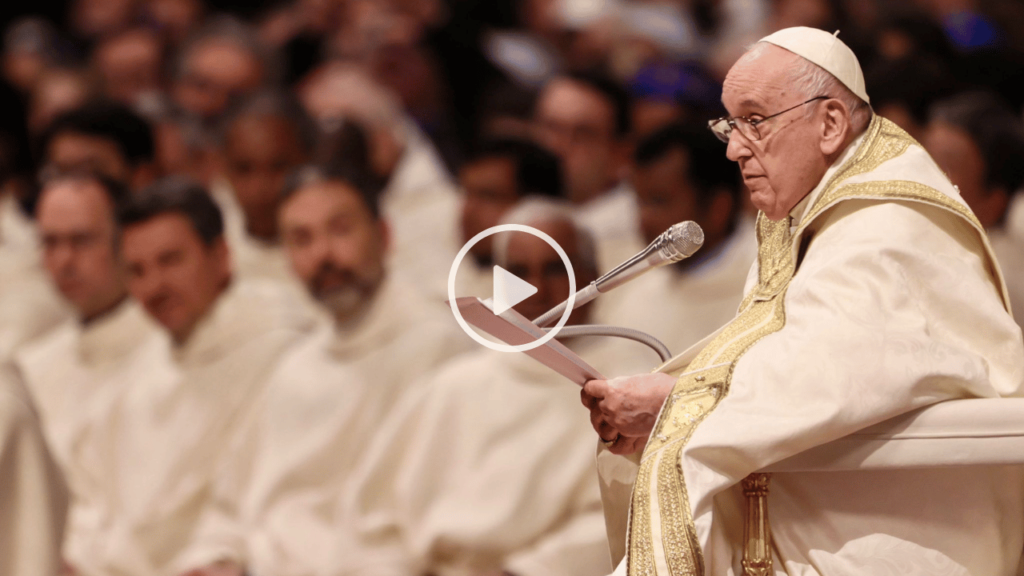
Archbishop Paul Richard Gallagher, Secretary for Relations with States within the Holy See’s Secretariat of State, defends Pope Francis’ public gestures to end the conflict in Ukraine and assures that the Pontiff does not propose an “empty pacifism.”
This affirmation was made by the Prelate during the presentation in Rome of the volume of the geopolitical magazine Limes titled “Ukrainian Lessons,” which took place on Thursday, July 13.
The Archbishop aimed to clarify the position adopted by the Holy Father regarding the war in Ukraine and “the interpretation that has been given to his words and gestures.” He explained that it is not simply “rhetoric of peace,” but a courageous “prophecy of peace.” He also emphasized that Pope Francis “does not want to resign himself to war and persists in believing in peace, inviting everyone to be weavers and courageous creative artisans of peace.”
He also expressed regret that the Ukrainian people, as well as the governmental authorities of that nation and religious representatives, have reacted to certain statements by the Holy Father “with deep disappointment.”
He assured that “the words and public gestures of the Pope are facts, and their interpretation can be done freely and discreetly,” but he highlighted that “interpreting them as ‘acts of empty pacifism’ does not do justice to the vision and intentions of the Holy Father.” Monsignor Gallagher emphasized, “What moves the Holy Father is nothing other than the will to make dialogue and peace possible, inspired by the principle that the Church should not use the language of politics, but the language of Jesus.”
He further explained that the Holy See does not intend to “turn a blind eye” to the war crimes committed by the Russian army and authorities, while also recalling that the Pontiff clearly distinguishes between the aggressor and the aggressed country, which has also faced criticism in the past.
On the other hand, he emphasized the need to put an end to “the idea that there is nothing to be done, that there is no place for words, for creative dialogue and diplomacy, that we must resign ourselves and accept the continuation of fierce combat that sows death and destruction.” He stressed that this war “must be stopped as soon as possible.”
Pope Francis has repeatedly expressed his great concern for Ukraine, which has been suffering from the invasion and attacks by the Russian army since February 24, 2022.
It has become customary for the Holy Father to request prayers for the “martyred Ukrainian people” during general audiences or on Sundays after the Angelus.
He has also sent Cardinal Krajewski on six occasions to bring the closeness of the Pontiff, along with food and medicine, to the victims of the conflict. Furthermore, on June 6, the peace mission of Italian Cardinal Matteo Zuppi, sent by Pope Francis to Kiev, the capital of Ukraine, concluded.