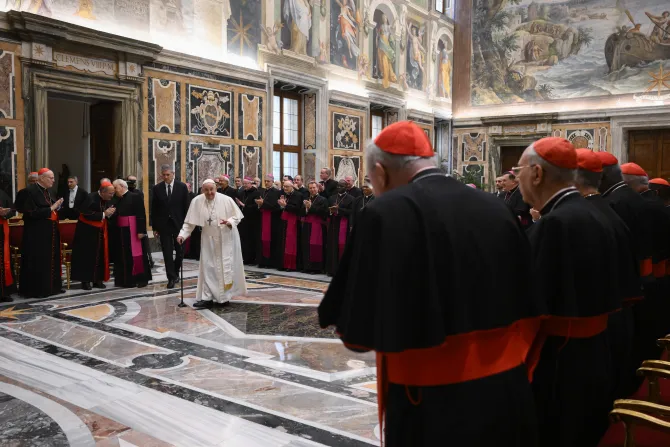
Pope Francis met with members of the Vatican’s Dicastery for Divine Worship and the Discipline of the Sacraments on Thursday morning to discuss the importance of liturgical reform as a core feature of the broader “renewal of the Church.”
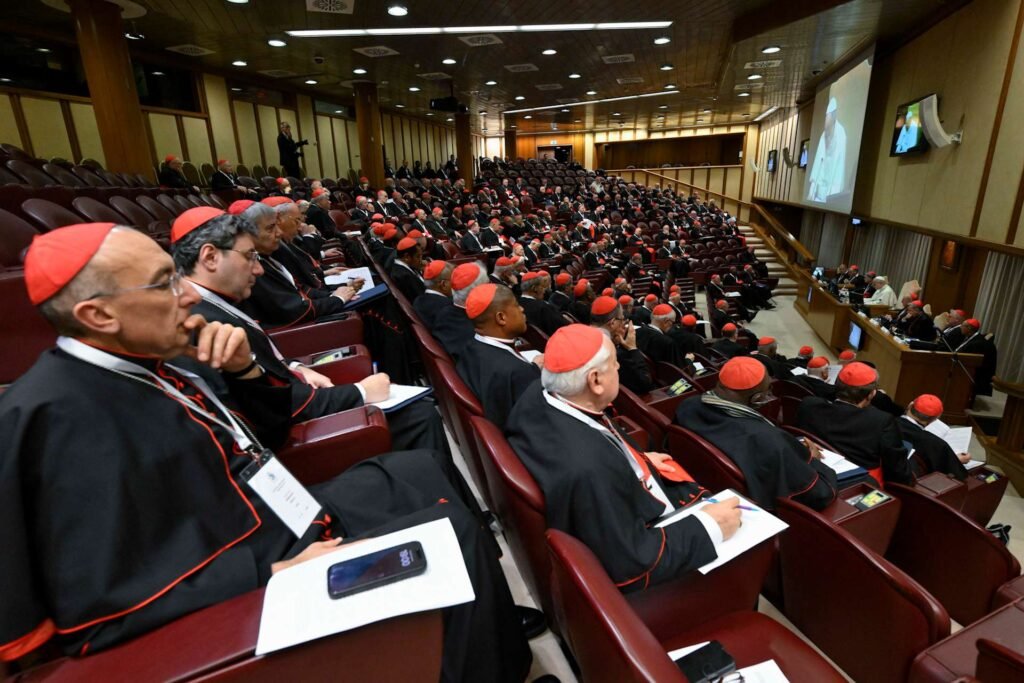
The address comes as the dicastery is meeting for its annual plenary assembly, which is addressing the “liturgical formation from Sacrosanctum Concilium to Desiderio Desideravi” for ordained ministers as well as “liturgical training courses for the people of God.”
The meeting will also seek to “provide bishops with practical suggestions for developing pastoral projects in their dioceses with the aim of putting into practice the reflections of the papal document,” a Feb. 5 press release from the dicastery stated.
Recalling that it has been 60 years since the promulgation of the Second Vatican Council’s seminal document on the liturgy, Sacrosanctum Concilium, the pope stressed in his Feb. 8 address that liturgical reform underscored the council fathers’ objective of renewing the Church’s “fundamental dimensions” such as “spiritual, pastoral, ecumenical, and missionary” work.
“Without liturgical reform there is no reform of the Church,” the pope said.
“A church that does not feel the passion for spiritual growth, that does not try to speak in an understandable way to the men and women of his time, that does not feel pain for the division between Christians, who does not tremble with the anxiety of announcing Christ to the people, is a sick Church, and these are the symptoms,” the Holy Father emphasized in his address.
The pope qualified these remarks by saying “we can only make such a statement by understanding what the liturgy is in its theological sense.”
Speaking specifically on the theme of the assembly’s 2024 meeting, the pope noted that their work must focus on making formation more accessible so it is not a “specialization for a few experts, but of an interior disposition of all the people of God.”
“This naturally does not exclude that there is a priority in the training of those who, by virtue of the sacrament of orders, are called to be mystagogues, that is, to take each other by the hand and accompany the faithful in the knowledge of the holy mysteries,” Francis continued.
The Holy Father also noted that liturgical formation is predicated upon a love for Christ by highlighting the theological representation of the Church as Christ’s bride, saying: “Every instance of reform of the Church is always a question of spousal fidelity.”
“The Church is a woman, the Church is a mother, the Church has its figure in Mary and the Church-woman.”
The pope added that the Church “is more than Peter … everything cannot be reduced to ministeriality. The woman in herself has a very great symbol in the Church as a woman, without reducing her to ministeriality.”
“This is why I said that every instance of reform of the Church is always a question of spousal fidelity, because she [the Church] is a woman.”
The pope also reflected on the centrality of the liturgy in our lives, saying that “it is the place for excellence in which to encounter the living Christ,” which “continually animates and renews baptismal life.”
The pope also said that it is his desire that the dicastery undertakes this work in collaboration with the Dicastery for Culture and Education, the Dicastery for the Clergy, and the Dicastery for Institutes of Consecrated Life and Societies of Apostolic Life to reflect “the spirit of synodal collaboration.”
This article was originally published by the Catholic News Agency