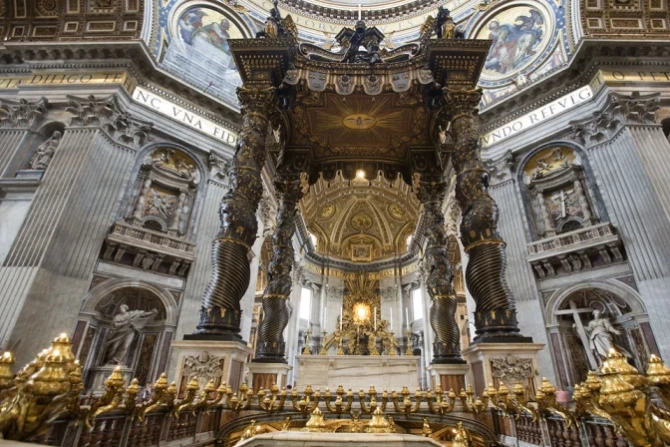
Pope Leo XIV has issued a new decree revising the financial and administrative norms governing the basilicas of St. Peter and St. Mary Major, bringing both institutions under the ordinary oversight of the Vatican’s Council for the Economy, in the latest act of fine-tuning of economic reforms undertaken by his predecessor Pope Francis.
The pope writes that the Holy See’s economic and financial reform requires “periodic reevaluation and redefinition” of the applicable regulatory framework.
The letter motu proprio, dated Sept. 29, 2025, was promulgated this month when it was posted in the San Damaso Courtyard of the Vatican’s Apostolic Palace. It has not previously been reported by the media.
The decree abrogates two earlier such decrees concerning the Fabric of St. Peter’s and the Chapter of St. Mary Major. Under the updated provisions, both the Fabbrica — which oversees the care, maintenance, and artistic patrimony of St. Peter’s Basilica — and the Chapter of St. Mary Major are now subject to the same forms of oversight established for other entities listed under the statutes of the Council for the Economy and in Praedicate Evangelium, the 2022 apostolic constitution that reorganized the Roman Curia.
To ensure what Pope Leo calls an “immediate and structured transition,” the Secretariat for the Economy will coordinate implementation along with a consultative group to help resolve questions or issues that might arise. The law will eventually be published in the Acta Apostolicae Sedis, the official gazette of the Holy See.
In October, Pope Leo XIV issued the decree Coniuncta Cura, a major financial reform that ended the Vatican Bank’s exclusive role in managing Holy See investments and allowed APSA and other accredited intermediaries to handle funds when advantageous. The change, which reverses a 2022 centralization under Pope Francis, aims to diversify management, improve returns, and strengthen the Holy See’s long-term financial sustainability amid rising operational costs.
This article was originally published by CNA.