COMMENTARY: John Paul explicitly attributed his survival of the shooting to the intercession of Our Lady of Fatima.
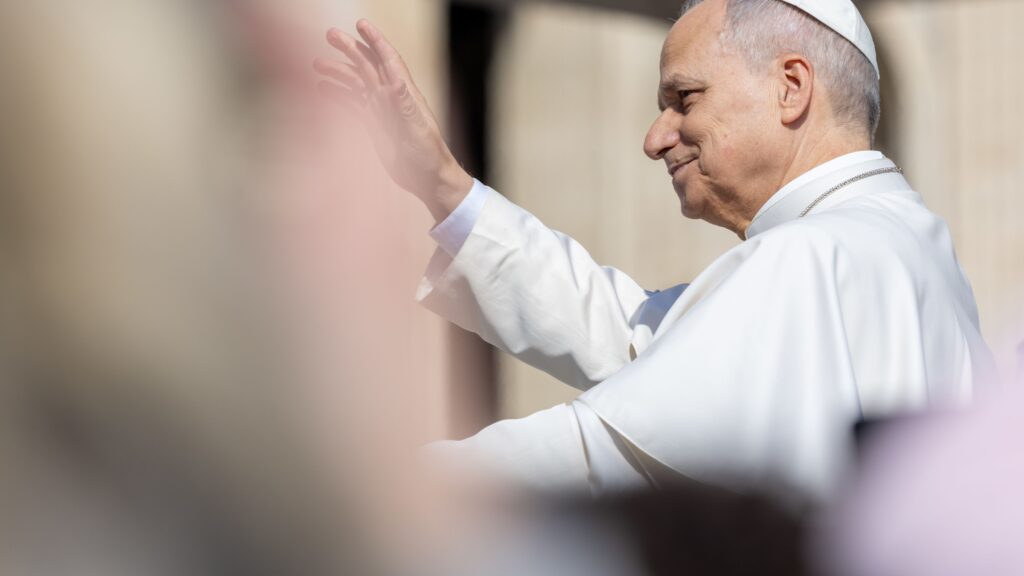
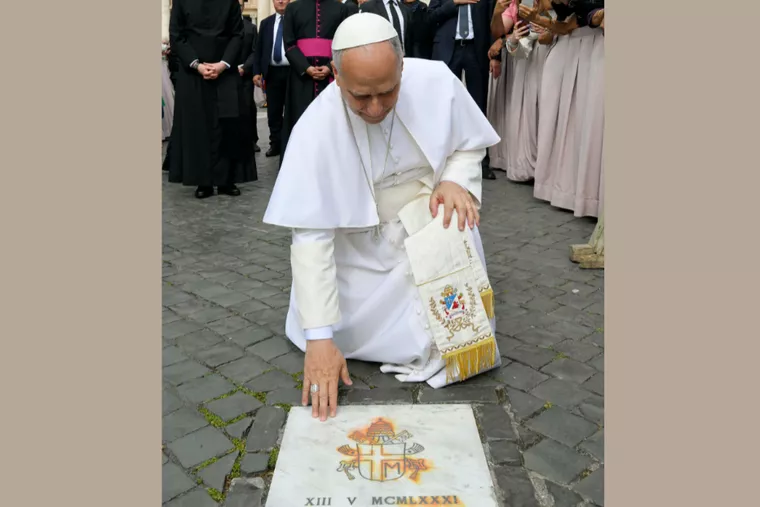
There was a touching moment — literally — in St. Peter’s Square on Wednesday, the feast of Our Lady of Fatima. While touring the square before his general audience, Pope Leo XIV walked to the spot where Pope St. John Paul II was shot 45 years earlier, on May 13, 1981. For decades, the spot was marked by a single cobblestone painted red. Today, it is now marked by an elegant marble plaque with John Paul’s coat of arms and the date of the assassination attempt. Pope Leo stopped for a brief moment of prayer, and then knelt down to touch the spot.
It was a welcome moment of remembrance and tribute — and another sign of Leo’s desire for reconciliation with those who felt that Pope Francis had downplayed the significance of the Polish Pope.
Given that the Wednesday general audience fell on the feast of Our Lady of Fatima, and that the May 13 feast is inextricably linked to John Paul, it was to be expected that the Holy Father would mention the anniversary — as Pope Francis did in his general audience on May 12, 2021, the eve of the 40th anniversary.
John Paul explicitly attributed his survival of the shooting to the intercession of Our Lady of Fatima. He went three times to the Portuguese shrine in thanksgiving — on the first anniversary (1982), the 10th anniversary (1991) and for the Great Jubilee (2000).
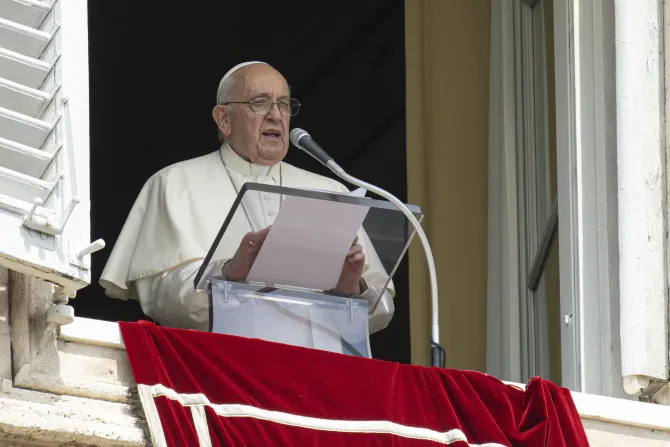
“Today we remember the memorial of Our Lady of Fatima,” Pope Leo said in the English portion of his audience address. “On this day, 45 years ago, an attempt was made on the life of Pope John Paul II, and for these reasons, I dedicated my catechesis today to the Blessed Virgin Mary.”
The decision to pray at the memorial plaque was an added gesture.
Ties to John Paul II
Pope Leo’s election and inaugural Mass last year received special pious attention in Poland, where they are very attentive to feast days and anniversaries. He was elected on May 8 — the feast of St. Stanislaus in Poland, the martyr-bishop who is the patron saint of Kraków, and whose relics lie upon the altar of Wawel Cathedral. Leo’s inaugural Mass was on May 18, John Paul’s birthday.
In Italy, May 8 is also associated with the Supplica (translated “supplication”) to Our Lady of Pompeii, which Pope Leo himself noted when he first appeared on the balcony of St. Peter’s Basilica after his election. Pope Leo marked the anniversary of his election by making a pilgrimage to the Our Lady of the Rosary of Pompeii shrine.
It was also the 150th anniversary of the laying of the cornerstone of the magnificent shrine church, which Pope Leo noted, although it was John Paul II who featured it more prominently in his preaching. Pope Leo mentioned his Polish predecessor and his teaching on the Rosary six times in his homily, recalling that John Paul had declared 2002-2003 as a special Year of the Rosary, and had visited Pompeii to mark its conclusion.
“Next year will mark a quarter of a century since then, [and John Paul] wished to place it in a special way under the gaze of Our Lady of Pompeii,” Leo said on his visit to Pompeii.
Leo XIV also referred to John Paul’s 2002 apostolic letter on the Rosary, Rosarium Virginis Mariae, in which he introduced the Luminous Mysteries. The Holy Father added that his namesake, Leo XIII, had published 12 encyclicals on the Rosary.
The contrast between Pope Leo’s emphasis on John Paul II during this occasion and Pope Francis’ acknowledgement of their shared predecessor is significant; for example, Francis mentioned John Paul only in passing when canonizing him in 2014. The canonization fell on the 75th birthday of Cardinal Stanislaw Dziwisz, John Paul’s longtime secretary, but the late pontiff made no public mention of it, nor did he mention Poland, despite the immense throng of Poles present. A wound was opened that day, which never fully healed.
Leo is healing it now.
On May 13, 1981, John Paul had intended to announce during the general audience the founding of what would become the John Paul II Institute for Marriage and Family, an intellectual center for his distinctive personalist theology of marriage, including the theology of the body. The assassination attempt prevented that formal announcement, so it was delayed to Oct. 7, 1981, feast of Our Lady of the Rosary — the same date on which John Paul would conclude the Year of the Rosary at Pompeii in 2003.
The dismantling of the John Paul II Institute in Rome by Pope Francis cut into the same wound opened at the canonization. In 2017, the institute, while still keeping John Paul’s name, was redirected — complete with new statutes and leadership — to follow the teaching of Amoris Laetitia, which not a few scholars argued was at odds with John Paul’s own teaching on civil-divorce-and-remarriage.
In his first weeks as Pope, Leo replaced the controversial Archbishop Vicenzo Paglia as head of the institute — he was already 80 years old — and restored the earlier custom of naming the Vicar for Rome as the grand chancellor. Whether restoration of the original mission will follow remains to be seen.
Those most inspired by John Paul II certainly welcome the kind words and gestures Pope Leo has for him and hope that some concrete restorations — the John Paul II Institute, for example — might follow. Pope Leo has made continuity with his several predecessors a dominant theme; on Thursday’s visit to La Sapienza university, he spoke of popes from St. Paul VI preaching against war to the ecological vision of Francis in Laudato Si. It is evident that Leo considers setting one pope against another is neither good for the unity of the Church, nor the Petrine office itself.
The May 13 gesture and May 8 homily weren’t moments of solemn teaching or governance, but were highly visible indications of a new disposition toward John Paul, and those who were his ardent admirers.
This article was originally published by NCRegister.