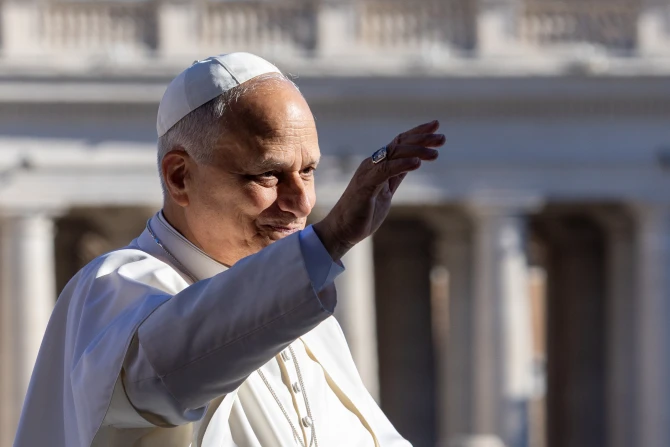
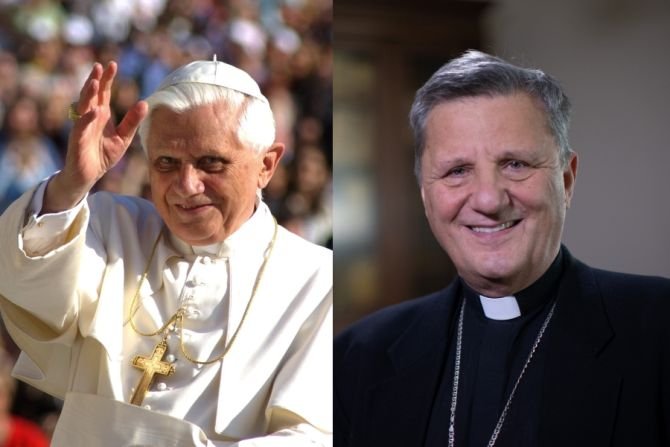
Bishop Diego Sarrió Cucarella hopes the pastoral visit will lead to ‘hearts opening to peace, a renewed commitment to coexistence, and a living witness to God’s glory through fraternity and mutual understanding.’
Editor’s Note: This is the fifth in a series of articles based on the author’s recent reporting trip across Africa. Previous articles looked at the Catholic Church’s presence in Cameroon, Togo and Kenya.
The Spanish-born prelate in charge of Algeria’s vast Laghouat-Ghardaïa diocese, Bishop Diego Sarrió Cucarella of the Missionaries of Africa is looking ahead to Pope Leo XIV’s upcoming pastoral visit to the North African nation.
In reference to the motto of the Pope’s visit in April, As-Salam Alaykum (“Peace be with you”), the bishop told the Register:
“The best result of this visit would be precisely this: hearts opening to peace, a renewed commitment to coexistence, and a living witness to God’s glory through fraternity and mutual understanding.”
Bishop Sarrió, 54, was named by Pope Francis in January 2025 to lead the Diocese of Laghouat-Ghardaïa, a huge territory across southern Algeria comparable in geographical scale to California, Oregon, Idaho, Montana, Wyoming, Utah, and Nevada combined.

About 2,240 Catholics live in this immense desert region, where they are served by 14 priests (including the bishop), 19 religious sisters, and five religious brothers. They care for the small Catholic communities while living in friendship with the wider population.
A scholar of Christian-Muslim relations, Bishop Sarrió received a Ph.D. in religious and theological studies from Georgetown University. He was president of the Pontifical Institute for Arabic and Islamic Studies (PISAI) in Rome for six years after serving as academic dean for four. Among the clergy who blessed Bishop Sarrió at his St. Peter’s Basilica episcopal ordination was then-Cardinal Robert Prevost, now Pope Leo XIV. The Pope will be making his first pastoral trip to Africa, which kicks off in Algeria April 13-15.

Bishop Sarrió took time out of his busy schedule to respond to questions from the Register.
Your episcopal motto is beautifully literal: “I will make a way in the desert” (Isaiah 43:19).
When I first read the words of the Prophet Isaiah, I was struck by how God speaks into difficult situations, just as he did for the Israelites in exile. He promises to open a path in the desert — just as he parted the Red Sea —reminding us that even in the most challenging places, God can bring new life and hope.
The word “way” resonates with many layers of meaning for me. It reflects the call of the Jubilee Year 2025 to see our lives as a pilgrimage of hope. It also recalls the early followers of Jesus, described as “the Way” in the Acts of the Apostles (Acts 9:2; 19:9), and points to Christ himself, who said, “I am the Way, the Truth, and the Life” (John 14:6). It also evokes the vocation of the Church in Laghouat: walking alongside the people of Algeria, living out our mission as the salt of the earth, and accompanying the thousands of migrants who pass through our diocese in search of a better life.
There is a profound beauty in the desert itself. It is a place of silence, simplicity, and clarity, where the essentials of life become visible, where the horizon stretches wide, and where God can be encountered — in creation and in the journey of our own hearts. In the desert, we learn patience, endurance, and trust. Even in apparent emptiness, God can make a way.
Pope Leo XIV will visit Algeria on April 13-15. What could be the best result of this visit?
The Holy Father is coming to Algeria to meet the people and their leaders, to encourage our Church in its mission of fraternal presence among a predominantly Muslim population, and to remind us of our shared heritage with St. Augustine, a native son whose example can guide our common journey.
He comes as an apostle of peace. The greeting As-Salam Alaykum (“Peace be with you”), the motto of his visit, is both the welcome that all in Algeria offer him and the blessing he brings to us — just as the Risen Jesus greeted his apostles.

These words invite us to overcome tensions or unrest — whether rooted in past conflicts or present misunderstandings — and to open our hearts to reconciliation, harmony, and a sincere desire for peace, the true path to glorifying God.
The best result of this visit would be precisely this: hearts opening to peace, a renewed commitment to coexistence, and a living witness to God’s glory through fraternity and mutual understanding.
Do you know if and when the Holy Father visited Algeria before he was elected Pope?
It seems he came twice during his 12 years as Superior General of the Augustinian Order. He visited his confreres in Annaba, as well as the Augustinian Missionary Sisters in Algiers — two of whom are among the 19 Blessed Martyrs of Algeria.
Tell us about an encounter you had with the Holy Father.
As it happens, he was among the bishops who laid hands on me at my episcopal ordination, which took place at St. Peter’s Basilica on March 19, 2025. Shortly afterward, while vesting for the Easter Vigil at St. Peter’s, we exchanged a few words. I was still in Rome, awaiting my visa to travel to Algeria.
I had another opportunity to meet him — this time already as Peter’s Successor — in September 2025, during the seminar organized each year in Rome by the Dicastery for Evangelization and the Dicastery for Bishops for newly appointed bishops. I very much look forward to meeting him again, this time in Algeria.
Pope Francis was dedicated to interfaith dialogue, especially between Catholics and Muslims, a field you have studied and taught. How did Pope Francis advance collaboration between these two great faiths?
I had the privilege of seeing Pope Francis during his final public appearance on Easter Sunday, and I was also able to attend his funeral Mass. Each of us may have a particular aspect of his teaching that resonates most deeply. For me, it is undoubtedly the theme of fraternity. This idea runs through his writings, speeches, and symbolic gestures, and it lies at the heart of his efforts to foster Christian-Muslim dialogue, perhaps most clearly expressed in the Document on Human Fraternity for World Peace and Living Together.
At its core, the document presents a vision of fraternity in diversity. Religious communities are called to cultivate dialogue, collaborate concretely, and promote mutual understanding. Pope Francis emphasized that this invitation is not directed only to Christians and Muslims, but to all people.
He expressed this vision beautifully during his address on the esplanade of the Hassan Tower in Rabat on March 30, 2019, when he said that authentic dialogue entails “encountering and accepting others in their distinctive religious beliefs and enriching one another through our diversity, in a relationship marked by good will and by the pursuit of ways we can work together. Understood in this way, creating bridges between people — from the point of view of interreligious dialogue — calls for a spirit of mutual regard, friendship and indeed fraternity.”
In this way, Pope Francis advanced collaboration between Catholics and Muslims not only through historic meetings and major documents, but by offering a spiritual vision: fraternity as a lived reality, embodied in concrete relationships, nurtured through dialogue, and oriented toward the common good.
You were a pastor in Oman before being named to lead the Laghouat diocese. Can you describe a few similarities and differences between the Church in Oman and the Church in Algeria?
My appointment as Bishop of Laghouat was announced while I was serving in a parish in Muscat [capital of Oman]. After a decade in Rome at the Pontifical Institute for Arabic and Islamic Studies, I requested a sabbatical to experience firsthand the life of the Church in another part of the Islamic world.
Oman is part of the Apostolic Vicariate of Southern Arabia, which includes the United Arab Emirates (UAE), and Yemen. The Catholic community there is composed entirely of guest workers, primarily from India and the Philippines, with smaller groups from other countries. From my very first day, I was struck by their warmth and devotion — people who had left home and family yet lived their faith with remarkable joy and commitment. When the news of my episcopal appointment was shared with the parish, the joy and encouragement I received were deeply moving. I felt both gratitude and a renewed sense of mission.

Coming from Oman to the Algerian Sahara, the contrast was striking. Here, the Church is much smaller, scattered across vast distances, and often invisible to the wider society. Yet, despite these differences, both communities share a common thread: the importance of presence, listening, and walking alongside people in their daily lives. In Oman, I witnessed faith expressed in lively gatherings, songs, and cultural celebrations. In Algeria, it is quieter, but equally profound, expressed through small acts of service, enduring relationships, and steadfast hope.
What have you learned in your first year as bishop?
I’ve learned the value of presence and attentive listening. In a diocese as vast as ours, with communities scattered across long distances, accompaniment matters more than programs or plans. I am deeply grateful to priests, religious, and laypeople who serve in my diocese, whose faith, generosity, and patience have taught me so much.

If I think of an achievement from this first year, it would be helping to strengthen the sense of community and shared mission across the diocese, and reminding everyone that small gestures of service, care, and attention can truly make a difference in people’s lives.
Before becoming bishop, you led the PISAI. Where does your interest in the Islamic world come from?
My first real encounter with Islam came during my formative years, when I lived for two years in Khartoum, Sudan, between 1995 and 1997, before the country’s division. I worked in a parish on the outskirts of the city, serving Christians from the South who had fled north because of the war. That experience quickly taught me that Muslims, like Christians, are capable of both the best and the worst, helping me avoid idealizations.
After my priestly ordination, I spent two years in Algeria, continuing to meet Muslims in a context very different from Khartoum. It was a positive experience, marked by friendship and mutual respect, and it inspired a deep desire to understand their religious tradition and the faith that sustains them.
This was followed by several years of study and work in Egypt, Italy, Tunisia, and the United States. In 2014, after completing my doctorate, I was appointed professor at PISAI. Accepting the role was not easy, as I had hoped to return to the Maghreb. My consolation in Rome was knowing that many PISAI students were preparing to live and witness their Christian faith in contact with Muslims in North Africa and beyond, which made me feel that I, too, was contributing to this unique mission of the Church.
When did you first think about becoming a priest? Please share a bit about your upbringing and your vocation journey. What attracted you to the Missionaries of Africa?
I was born in Gandía, a town on Spain’s Mediterranean coast about 40 miles south of Valencia, the youngest of four children. My faith journey began largely at school rather than in the parish. I attended Jesuit schools in Gandía and later in Valencia, and it was there that my preparation for the sacraments and my formation in faith truly took root. Looking back, my vocation unfolded slowly and quietly, but with a steadily growing sense of direction.
As a child, I was fascinated by the stories of Jesuit missionaries who visited during their vacations, sharing their experiences in India, Chad, Brazil, and beyond. I remember reading missionary magazines that offered glimpses of life and ministry far from home. I was particularly inspired by a Jesuit uncle who spent many years in mission work in Africa; his example planted seeds that took time to grow.

It was during my preparation for Confirmation and in my final years of high school that those seeds began to sprout. I gradually came to understand my own calling more clearly. When I discovered the Missionaries of Africa — the White Fathers — I felt an immediate attraction. Their love for Africa, their commitment to international and multicultural community life, and their vision of faith lived in service across borders spoke to me. I sensed that this path could unite my faith with my desire to serve.
Looking at the bishops who preceded you, all were Missionaries of Africa. What makes the charism of your order particularly relevant in North Africa today, besides the fact that your founder Cardinal Charles Lavigerie was Archbishop of Algiers and later also of Carthage?
When the Apostolic Vicariate of Ghardaïa in the Sahara was elevated to a diocese in 1955, Georges Mercier became the first to bear the title “Bishop of Laghouat.” He was later among the approximately 40 bishops who signed the Pact of the Catacombs in 1965, just days before the close of the Second Vatican Council. That gesture of evangelical simplicity and solidarity with the poor remains a powerful inspiration.
The history of the diocese reaches back even further. Before becoming a vicariate, Ghardaïa was an Apostolic Prefecture, established in 1901. Its first prefect, Msgr. Charles Guérin, was a friend and confidant of St. Charles de Foucauld. And even earlier, this vast territory formed part of the Apostolic Prefecture of the Sahara and the Sudan, erected in 1868 at the request of Charles Lavigerie, archbishop of Algiers and founder of the Missionaries of Africa.
In short, the Diocese of Laghouat has been closely linked to the White Fathers from the very beginning. I feel part of that long missionary lineage and conscious of the responsibility of carrying forward a precious legacy. At the same time, many other religious congregations have also served, and continue to serve, in the diocese.
As for our charism, its relevance in North Africa today goes beyond historical continuity. The Missionaries of Africa were founded not primarily to serve European settlers, but for apostolic presence among local populations, especially Muslims. That original vision remains central. Our vocation is rooted in encounter, intercultural life, dialogue, and humble service. In a region marked by religious and cultural diversity, this approach is not just meaningful — it is essential.
This article was originally published by NCRegister.