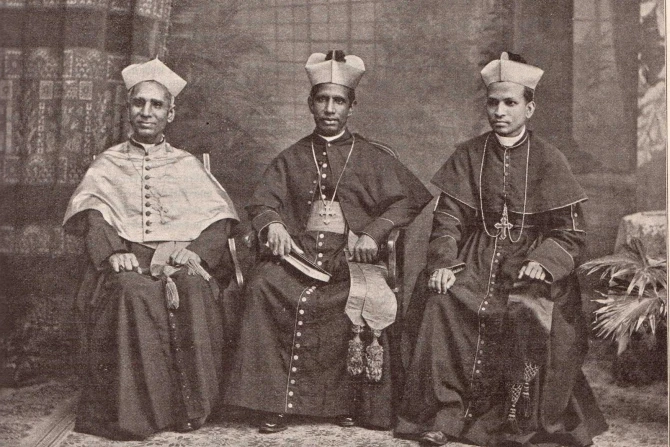
Pope Leo XIV authorized the Dicastery for the Causes of Saints to promulgate the decrees recognizing three new venerables, including two missionaries and an Indian bishop.
FIND THE POPE’S BIOGRAPHY HERE
In his first audience since beginning his pontificate with the prefect of the Vatican dicastery, Cardinal Marcello Semeraro, the Holy Father approved the “offering of life” of the Servant of God Alejandro Labaka Ugarte of the Order of Friars Minor Capuchin.
Alejandro Labaka, a bishop martyred in the Ecuadorian jungle
Labaka was born on April 19, 1920, in Beizama, Spain. After being expelled from communist China, this Capuchin missionary arrived in Ecuador, where he served as titular bishop of Pomaria and apostolic vicar of Aguarico.
Labaka dedicated himself to evangelizing in the Amazon rainforest of Ecuador until he gave his life on July 21, 1987, in the Tigüino region of the country after being struck by spears from the Tagaeri, a tribe threatened by oil exploitation in the area, which the prelate opposed.
Inés Arango, a missionary dedicated to the Huaorani people
Dying in the same incident with Labaka, Inés Arango Velásquez, a missionary of the Capuchin Tertiaries of the Holy Family, was declared venerable by Leo XIV on May 22.
This religious sister, born in Medellín, Colombia, on April 6, 1937, had been in Aguarico for 10 years, dedicated to the apostolate among the Huaorani Indigenous people.
On July 11, 2017, the Vatican published Pope Francis’ motu proprio Maiorem Hac Dilectionem in which he established that “offering one’s life” knowing that death will surely follow is a new path to beatification for a member of the faithful.
The offering of one’s life is one of the paths to beatification along with heroic virtue and martyrdom.
Matthew Makil, Indian bishop
Leo XIV also approved the heroic virtues of the Servant of God Matthew Makil, founder of the Congregation of the Sisters of the Visitation of the Blessed Virgin Mary.
He was born on March 27, 1851, in Manjoor, India, and died on Jan. 26, 1914, in Kottayam, also in India. He was also titular bishop of Tralles and the first apostolic vicar of Kottayam.
After being declared venerable, a miracle performed through his intercession must be approved for beatification, the first step toward possible canonization.
This story was first published by ACI Prensa, CNA’s Spanish-language news partner. It has been translated and adapted by CNA.