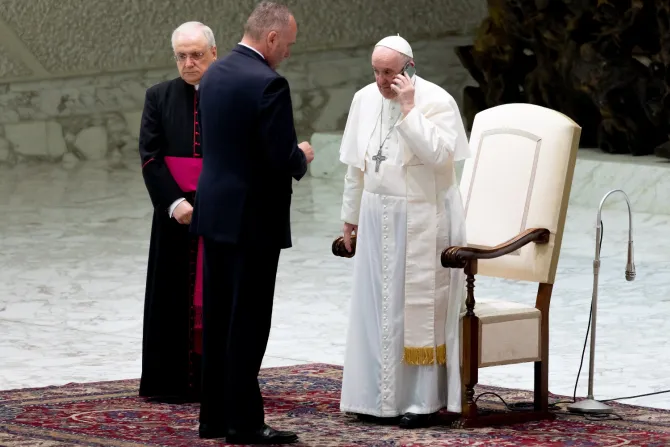
Pope Leo XIV is expected to move into the official papal residence, an apartment on the top floor of the Apostolic Palace, departing from the living arrangements used by Pope Francis for 12 years.
The papal apartment, which is a series of rooms wrapping around the Vatican’s Sixtus V Courtyard, was the traditional home of pontiffs for over a century before Pope Francis eschewed those living quarters for a suite in the Vatican’s guesthouse, the Casa Santa Marta.
Pope Francis explained his decision as “a need to live my life with others” in a 2013 interview. The late pope said the papal apartment is “old, tastefully decorated and large, but not luxurious.”
Francis’ choice of living space was commonly interpreted as a sign of his simplicity and rejection of papal pomp, though U.S. Jesuit Father James Martin said Leo’s expected move into the papal apartment was a prudent decision.
Martin called it understandable that Leo might move back into the Apostolic Palace, given the busy and crowded nature of the Vatican guesthouse compared with the privacy of the papal apartment.
“Leo’s move should not be taken as a sign either of a critique of Pope Francis (whom he has praised repeatedly and whose legacy he formally told the cardinals he wishes to continue) or as him not living ‘simply,’” the author wrote on X.
Pope Francis lived in a second-floor bedroom with a sitting room attached but would go frequently to the Apostolic Palace for meetings and audiences. Toward the end of his pontificate, he would also receive visitors in various meeting rooms of the guesthouse.
According to people who have been there, the Santa Marta guesthouse posed significant security challenges, and when the pope made it his official residence after his 2013 election, a section of the second floor was closed to guests for security.
The quarters in the Apostolic Palace include a chapel, bedroom and bathroom, papal study, office for the pope’s secretary, a living room, dining room, kitchen, and library for meetings. Since John Paul II’s pontificate, which ended in illness, the apartment has also included an outfitted medical suite that was later expanded to include dental equipment. There is also a roof garden and rooms for housekeeping staff.
The Apostolic Palace is a large building situated just to the northeast of St. Peter’s Basilica, inside Vatican City. One corner of the building overlooks St. Peter’s Square.
Besides the papal apartment, the Apostolic Palace — also sometimes called the Palace of Sixtus V for the pope who had most of it built — contains Vatican offices, the Vatican library, and some of the rooms now part of the Vatican Museums.
Several of the windows of the papal apartment overlook St. Peter’s Square, including the window at which recent popes, including Pope Francis, would appear weekly on Sundays and holy days to pray the Angelus or Regina Caeli and give a brief reflection. On May 11, Pope Leo sang the Regina Caeli from the central loggia of St. Peter’s Basilica for the first time.
Following recent convention, the papal apartment will likely undergo some renovations and customization prior to Leo’s move-in. Since his election, the pope has been continuing to sleep in the Vatican apartment he used as prefect of the Dicastery for Bishops, which is in the Palazzo Sant’Uffizio, the building that also houses the offices of the Dicastery for the Doctrine of the Faith.
This article was originally published on Catholic News Agency.