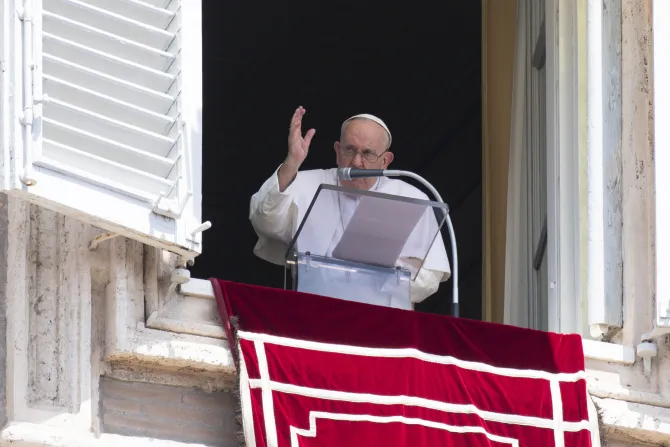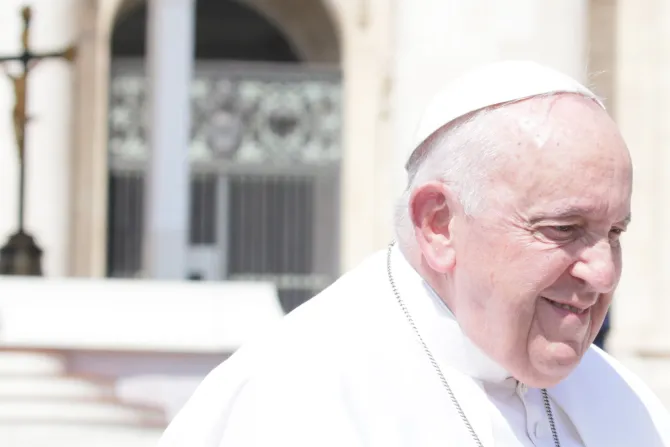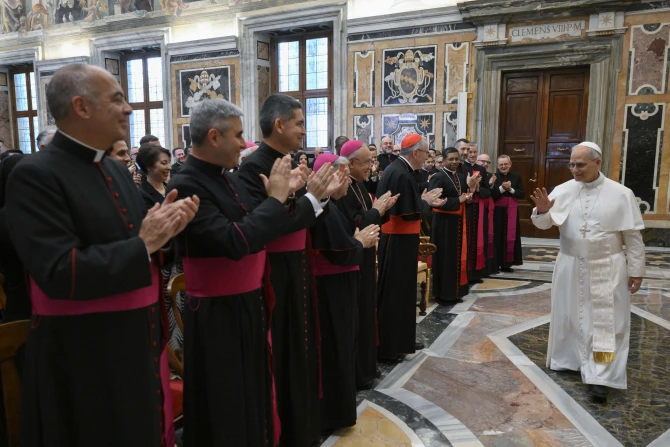
In his audience with members of the Vatican Secretariat of State on Thursday, Pope Leo XIV thanked them for their support in the first month of his pontificate.
FIND THE POPE’S BIOGRAPHY HERE
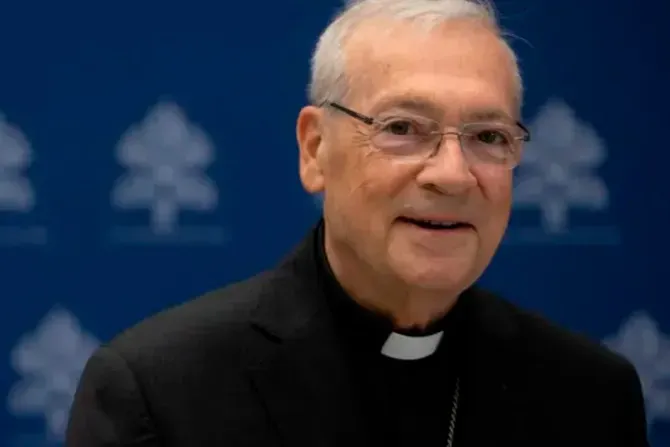
Among those present was Cardinal Pietro Parolin, Vatican secretary of state, who introduced the meeting with a brief address. Also participating was Archbishop Edgar Peña Parra, substitute for general affairs of the Secretariat of State.
Archbishop Paul Richard Gallagher, secretary of relations with states within the Secretariat of State, did not participate in the audience because he is in Cuba for the 90th anniversary of relations between that Caribbean country and the Holy See.
At the outset of his speech, Pope Leo thanked the Secretariat of State for assisting him in the “first steps” of his pontificate and for “carrying forward the mission” entrusted to him.
“It comforts me to know that I am not alone and that I can share the responsibility of my universal ministry with you,” he said.
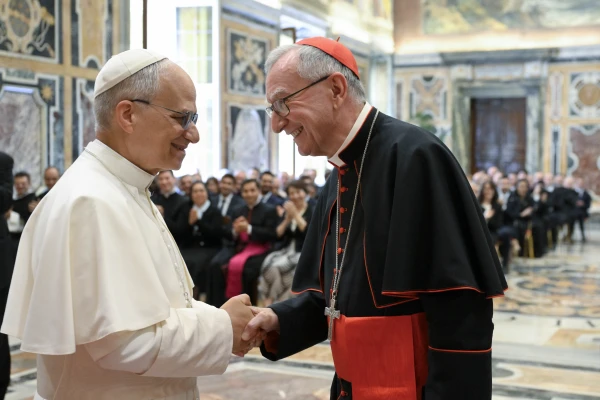
Then, extemporaneously, he said that “it is evident that the pope cannot continue alone and that it is very necessary to be able to count on the collaboration of many in the Holy See” and especially with the Secretariat of State.
He also recalled the beginnings of this institution, which date back to the end of the 15th century, and its evolution over the years, highlighting that currently almost half of the Secretariat of State is made up of laypeople and more than 50 women.
For the pope, this development reflects “the face of the Church: We share together the questions, difficulties, challenges, and hopes of the people of God present throughout the world,” always expressing “two essential dimensions: incarnation and catholicity.”
“We are incarnated in time and history, because if God has chosen the path of humanity and the languages of humanity, the Church is also called to follow this path, so that the joy of the Gospel may reach all and be mediated in today’s cultures and languages,” he emphasized.
He also reflected on the “Catholic” and universal perspective, which allows for the appreciation of different cultures and sensibilities, serving as “a driving force committed to forging communion between the Church of Rome and the local Churches” as well as with the international community.
For the Holy Father, these two dimensions “have become increasingly constitutive of the Curia’s work,” marking a path that has guided the reform of the Roman Curia carried out by St. Paul VI.
The pope also explained that incarnation “refers to the concreteness of reality and to the specific and particular themes addressed by the various bodies of the Curia.”
On the other hand, he emphasized the Church’s universal character, recalling that “the mystery of the Church’s multiform unity demands a work of synthesis that can assist the pope’s action.” This bond of unity, he explained, is carried out by the Secretariat of State.
Pope Leo XIV cited Praedicate Evangelium, Pope Francis’ apostolic constitution on the Roman Curia and its service to the Church in the world.
“I know that these tasks are very demanding and, at times, may not be fully understood. Therefore, I wish to express my closeness to you and, above all, my deep gratitude,” he said.
The pope also expressed his gratitude for their “hidden work” in the service of the Church and for “the evangelical spirit that inspires it” while asking them that this place “not be contaminated by ambitions or antagonisms.”
“Be, instead, a true community of faith and charity, of brothers and sisters and sons and daughters of the pope,” who give their all generously for the good of the Church, the pope urged.
After entrusting them to the intercession of the Virgin Mary, he thanked them for their prayers for their ministry and imparted his blessing.
SIGN UP FOR OUR NEWSLETTER HERE
This story was first published by ACI Prensa, CNA’s Spanish-language news partner. It has been translated and adapted by CNA.