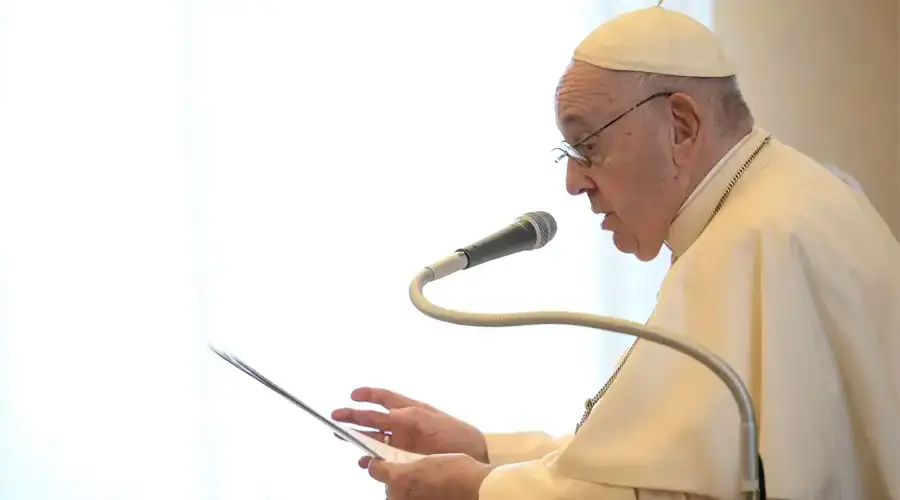
Pope Leo XIV during an address at the Vatican on Thursday called for the “prudent” evaluation of supernatural phenomena to avoid falling into superstition.
“To avoid falling into superstitious illusion, it is necessary to evaluate such events prudently, through humble discernment and in accordance with the teachings of the Church,” the Holy Father said to participants in a Nov. 13 meeting organized by the Dicastery for the Causes of Saints that reflected on the relationship between mystical phenomena and holiness of life.
The conference focused on the theme “Mysticism, Mystical Phenomena, and Holiness.” Upon receiving the participants at the Vatican, the pope noted that, through constant commitment, the magisterium, theology, and spiritual writers have provided “criteria for distinguishing authentic spiritual phenomena, which can occur in an atmosphere of prayer and a sincere search for God, from manifestations that may be deceptive.”
For the pope, mysticism and spiritual phenomena are “one of the most beautiful dimensions of the experience of faith,” and he expressed his gratitude for the participants’ collaboration in shedding light on certain aspects that require discernment.
The mystical life: Intimate union with God
“Through theological reflection as well as preaching and catechesis, the Church has recognized for centuries that at the heart of the mystical life lies the awareness of the intimate union of love with God,” the pope noted.
The pontiff explained that mysticism is therefore characterized “as an experience that transcends mere rational knowledge, not through the merit of the one who experiences it, but through a spiritual gift, which can manifest itself in diverse ways, even with opposing phenomena, such as luminous visions or dense darkness, afflictions, or ecstasies.” However, he continued, these exceptional events “are secondary and not essential with respect to mysticism and holiness itself.”
The Holy Father said they can be “signs” of holiness insofar as they are “unique charisms,” although the true goal is and always remains “communion with God.”
“Extraordinary phenomena that may connote mystical experience are not indispensable conditions for recognizing the holiness of a member of the faithful,” he emphasized.
Leo pointed out that, if they are present, “they strengthen their virtues not as individual privileges, but insofar as they are ordered to the edification of the whole Church, the mystical body of Christ.”
Maintaining ‘balance’
“What matters most and what must be emphasized in the examination of candidates for sainthood is their full and constant conformity with the will of God, revealed in Scripture and in the living apostolic tradition,” he said. For this reason, he urged the Dicastery for the Causes of Saints to maintain “balance.”
He added: “Just as causes for canonization should not be promoted solely in the presence of exceptional phenomena, neither should those same phenomena [be looked upon negatively] if they characterize the lives of the servants of God.”
“At the heart of discernment regarding a member of the faithful is listening to their reputation for holiness and examining their perfect virtue, as expressions of ecclesial communion and intimate union with God,” the pope noted.
At another meeting held this week at the Pontifical Urban University, the prefect of the Dicastery for the Doctrine of the Faith, Cardinal Victor Manuel Fernández, gave a presentation on the dicastery’s norms on the discernment of supernatural phenomena, which were approved last year. The prelate addressed the complexity and challenges the Church faces in recognizing these types of manifestations.
The cardinal noted that, despite approximately 3,500 cases of beatification and canonization in the last 50 years, only three or four declarations of phenomena of supernatural origin have been issued, underscoring the difficulty of obtaining official recognition of this kind.
“It is difficult to recognize them,” he stated, according to Vatican News.
This story was first published by ACI Prensa, CNA’s Spanish-language news partner. It has been translated and adapted by CNA.