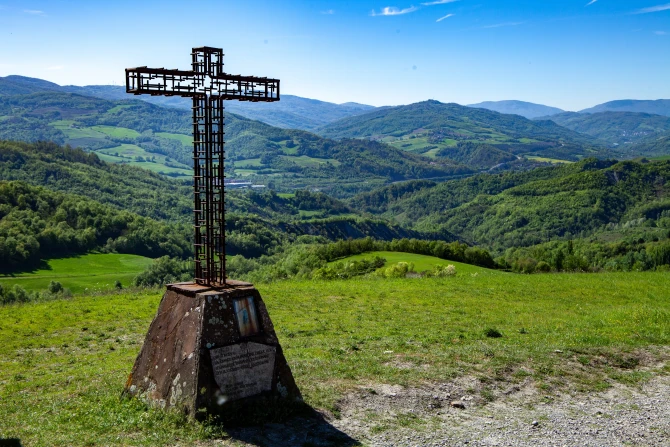
Father Ubaldo Marchioni was praying the rosary with a fearful congregation in the Church of Santa Maria Assunta outside Bologna, Italy, when Nazi soldiers broke down the door on Sept. 29, 1944, and shot him in the head.
The remaining 197 people who had taken refuge in the church were forced outside to the cemetery and massacred, including 52 children. The killings marked the first day of what is now known as the Marzabotto Massacre, a large civilian massacre in which Waffen-SS units murdered at least 770 civilians between Sept. 29 and Oct. 5, 1944, including children, women, and the elderly in retaliation for local support of Italian resistance fighters.
Marchioni, a diocesan priest ordained only two years earlier, was 26 years old.
On Nov. 21, Pope Leo XIV formally recognized Marchioni as a martyr killed “in hatred for the faith,” along with another Italian priest murdered in the same wave of violence, Father Nicola Capelli.
Capelli, who took the religious name Martino of Our Lady of Sorrows when he professed vows with the Priests of the Sacred Heart of Jesus in 1930, had long dreamed of serving as a missionary in China. Under obedience, he remained in Italy. When news spread of the attacks near Marzabotto, he rushed to the area to administer the last rites.
He was arrested on Sept. 29, 1944, the same day Marchioni was killed, and held for two days. On Oct. 1, SS troops executed him along with 44 other prisoners. Witnesses said he raised his hand to give his fellow prisoners a final blessing before they were shot. He was 32.
With the pope’s decree, both priests can now be beatified.
4 Catholics advance on the path to sainthood
During an audience with Cardinal Marcello Semeraro, prefect of the Dicastery for the Causes of Saints, Pope Leo also approved decrees recognizing the heroic virtues of four other Catholics, declaring them venerable: Australian doctor and nun Mary Glowrey (1887–1957), Brazilian consecrated laywoman Maria de Lourdes Guarda (1926–1996), Italian Archbishop Enrico Bartoletti (1916–1976), and Italian priest Gaspare Goggi (1877–1908).
Glowrey, later known as Sister Mary of the Sacred Heart, left Australia in 1920 to serve as a doctor and missionary in India. She treated hundreds of poor patients daily, learned local languages, and founded what became the Catholic Hospital Association. Pope Benedict XIV granted her special permission to perform medical work “in bonum animarum,” making her the first nun, doctor, and missionary, according to the Vatican Dicastery for the Causes of Saints.
De Lourdes Guarda, a member of the Secular Institute Caritas Christi in Brazil, spent decades paralyzed and bedridden after a sudden illness at age 21. She offered her suffering in prayer and became a national leader in promoting dignity and rights for people with disabilities, even as her health deteriorated from kidney disease, gangrene, and eventually cancer.
Bartoletti, later archbishop of Lucca and secretary-general of the Italian bishops’ conference, was a biblical scholar who openly opposed the Nazi persecution of Jews and collaborated with Jewish relief groups during the war. After Pope Pius XII named him a bishop, Bartoletti contributed to the Second Vatican Council and guided the Italian Church through major social reforms.
Goggi, a priest of the Little Work of Divine Providence founded by St. Luigi Orione, served as the first rector of the Church of Sant’Anna inside Vatican City. Known for his devotion to parishioners and his reputation for holiness, he was often sought out for confession. He suffered a severe physical and mental decline in his final months and died in 1908 at age 31.
Each of the four new venerables will require two miracles attributed to their intercession to be canonized as saints.
This article was originally published by CNA.