Spanish painter Raúl Berzosa, who has been commissioned for a number of philatelic works by the Vatican, said that while AI can be a useful tool for ideas or composition, it is a soulless creation.
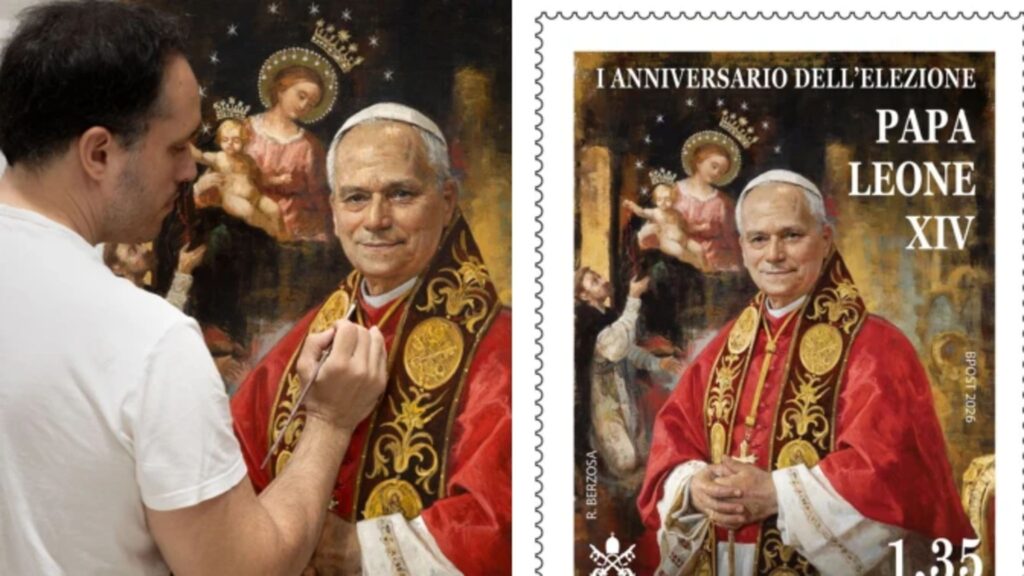
On May 8, the Vatican issued a commemorative stamp marking the first anniversary of the election of Pope Leo XIV.
The stamp, issued by the Vatican City Postal and Philatelic Service, features a portrait of the Holy Father set against an image of Our Lady of the Rosary of Pompeii, whose feast the Church celebrates on May 8. In the portrait, the Blessed Virgin looks down toward Pope Leo “as a sign of maternal protection,” Raúl Berzosa, the artist, explained.
In a statement to ACI Prensa, the Spanish-language sister service of EWTN News, Berzosa reflected on this work and also delved into the creative implications of artificial intelligence.
This new philatelic series marks another collaboration between Berzosa, who is from Málaga, Spain, and the Vatican, notable among which are his painting created for the commemorative stamp marking Pope Francis’ 80th birthday in 2016 and the stamp dedicated to the golden jubilee of the pontiffʼs priestly ordination, produced in 2019.
Berzosa’s work includes the stamps for Easter released by the Vatican Philatelic Office in 2020, 2022, and 2024. In addition is the recent stamp dedicated to the composer Giovanni Pierluigi da Palestrina, issued during the pontificate of Leo XIV.
The latest stamp will be priced at 1.35 euros ($1.59) and will have a limited print run of 45,000 copies. The stamps were printed by Bpost (Belgium) using four-color offset lithography.
AI ‘doesn’t live what it depicts’
“I believe that sacred art is not merely the final result we see; it‘s the product of reflection. The time and effort invested are what give it the artist’s personal imprint,” Berzosa noted when asked about the value and appropriateness of AI-generated Catholic imagery.
“I’ve seen AI-generated images that are very beautiful or striking, yet they convey the sensation of being images seen before. AI, of course, does not feel or experience what it depicts. The artist, by contrast, leaves something of himself in every work,” he pointed out.
The Spanish painter noted that we are witnessing “a flood” of AI-generated images and videos, some in fact created using the works of human artists. “I have seen my own paintings ‘come to life and move,’ and seeing them gave me a bittersweet feeling,” Berzosa shared.
“From what I’ve seen, AI typically generates whatever grabs the most attention: perfect faces, highly dramatic lighting, or visually stunning scenes, yet they all tend to look alike,” he commented.
The artist also noted that throughout centuries of Christian art history, “an infinite number of distinct artworks and styles” have emerged, something that today “stands in contrast to images created with AI.”
‘Human discernment remains fundamental’
Berzosa explained that religious images “are not merely decorative” but also serve as “a tool for evangelization.” This has been the historical function of images within Catholicism: to help the faithful draw closer to God and to the message of the Gospel.
“With AI, there is a risk of creating images that are overly artificial or hollow, where the sacred is transformed almost into fantastical imagery. I believe that, here and now, human discernment remains fundamental,” he noted.
“Technology can help, but human sensibility is needed to know which image is appropriate,” he added.
However, Berzosa clarified that AI can serve as a complementary tool for artists. “I don’t believe that technology is the enemy of art,” he said. “I think that artists have always used new tools,” he remarked.
“Often, viewing images — works of art as well as images created by AI — can be beneficial when seeking ideas; they can help in studying lighting or preparing compositions before beginning a work,” he noted.
The greatest obstacle, he continued, arises when technology completely supplants human skill and talent, the artist’s unique vision: “AI can create viable images, but ones that require subsequent interpretation by the artist. When used well, AI can be an important complement, a tool of its time,” he noted.
This story was first published by ACI Prensa, the Spanish-language sister service of EWTN News. It has been translated and adapted by EWTN News English.