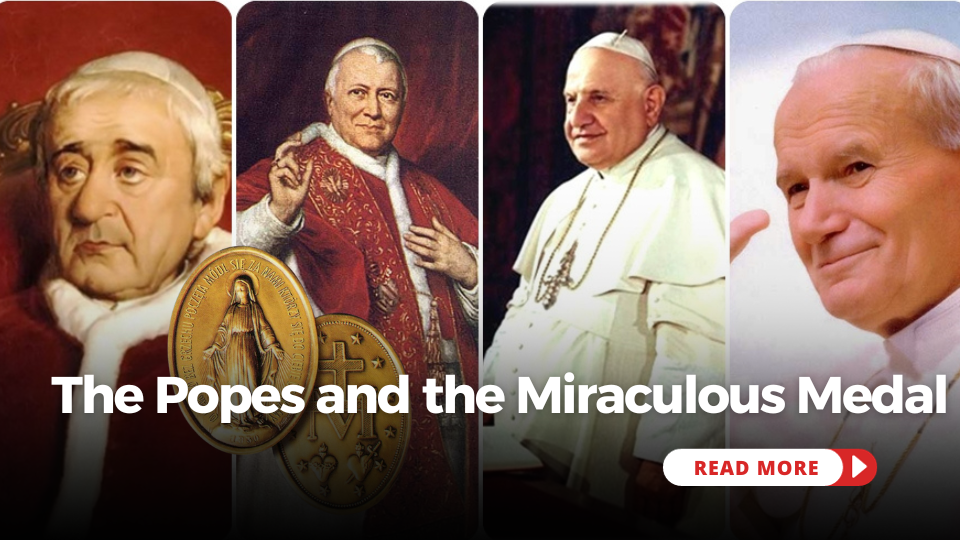
The Miraculous Medal, a symbol of Marian devotion, has been notably cherished and promoted by various Popes throughout history. This medal, originally conceived through a Marian apparition to St. Catherine Labouré, has played a significant role in the Roman Catholic Church, transcending beyond a mere devotional object to become an emblem of papal advocacy for Mary’s intercession.
Pope Gregory XVI was instrumental in authorizing the minting of the medal for the entire Church. He personally placed it on his study table, alongside a crucifix, and often gifted it to his many visitors, signifying its importance.
Pope Blessed Pius IX, recognizing the medal’s significance, approved the Archconfraternity of the Miraculous Medal at the Parish of San Ginés in Madrid in February 1845. He was a strong proponent of the medal, seeing it as a precursor to the dogma of the Immaculate Conception, and later approved the establishment of the Association of Daughters of Mary, with the Miraculous Medal as its emblem.
Pope Leo XIII, known for granting numerous privileges to the medal, institutionalized the feast of the Miraculous Medal on November 27 in 1894, granting indulgences and emphasizing its spiritual significance.
Pope St. Pius X approved the Association of the Miraculous Medal on June 8, 1909, further cementing its place in Catholic devotion.
Pope Benedict XV enriched the veneration of the Miraculous Medal with special privileges, including indulgences for wearing the medal.
Pope Pius XI granted indulgences for reciting the invocation associated with the medal and expressed great enthusiasm for the image of the Miraculous Virgin holding the globe, titling her “Queen of Missions and Queen of the World.”
Pope Venerable Pius XII, recognizing the significance of the medal and its visionary, St. Catherine Labouré, canonized her, indirectly affirming the authenticity of the Miraculous Medal.
Pope St. John XXIII, a devout follower, promoted the recognition of Our Lady of the Globe (the Miraculous Virgin) as the Queen of Missions. His devotion continued during his tenure as Nuncio in Paris, where he frequently prayed at the altar of Our Lady in Rue du Bac.
Pope St. Paul VI enriched the worship of the Miraculous Virgin, granting new indulgences to those who participate in her honor or wear the sacred medal.
Pope St. John Paul II, known for his deep Marian devotion, visited the chapel of the apparitions in Paris on May 31, 1980, offering prayers at the altar of the Miraculous Virgin and at the tomb of St. Catherine Labouré.
Saint Catherine Labouré: The Visionary Behind the Miraculous Medal
Born on May 2, 1806, in Fain-les-Moutiers, France, Catherine Labouré, who lost her mother at a young age, took over household responsibilities. Rejecting multiple marriage proposals, she was determined to pursue a religious life, overcoming her father’s opposition. She moved to Paris and later joined the Daughters of Charity.
Catherine experienced frequent visions of Christ and the Virgin Mary during her novitiate. On the night of July 18, 1830, she was guided by a child to the chapel, where the Virgin Mary revealed a mission for her, predicting great suffering. On November 27, Mary appeared again, presenting the design for a medal that would bring graces to those who wore it, instructing Catherine to promote its creation.
Initially dismissed as delusional, Catherine finally received the Archbishop’s approval in 1832 to mint the medal, later known as the “Miraculous Medal” due to the wonders it performed. She spent 46 years at the Enghien hospice, quietly serving the elderly and poor without revealing her visionary experiences until the end of her life.
One notable night between July 18 and 19, 1830, amidst France’s revolutionary tensions, Catherine conversed with the Virgin Mary for over two hours in the chapel. This encounter led to several more visions in the same year. The most significant was on November 27, where Mary appeared with a globe and rays of light, symbolizing her role as an intercessor. A voice instructed Catherine to create a medal based on this vision, leading to the first 1,500 pieces being minted in 1832.
The Miraculous Medal notably led to the conversion of Jewish man Alfonso Ratisbonne in 1842. Inspired by the Paris apparitions, the Association of the Daughters of Mary Immaculate was founded. Catherine lived a life of humility and silence, serving at the Enghien hospice in Paris for 46 years. Her body was exhumed later and showed remarkable preservation.
Her remains rest in the chapel where she received her visions, with her feast day celebrated on November 28 by the Vincentian Families.
DOCTRINAL RICHNESS
The Miraculous Medal is not just a testament to Marian devotion; it embodies the richness of Mary’s role in the Catholic faith. This emblematic medal reveals deep doctrinal significance, representing various aspects of the Virgin Mary’s divine role and her impact even beyond religious realms, notably influencing the design of the European flag.
The Virgin Mary, depicted crushing the head of the infernal serpent and encircled by golden letters, is presented as the Immaculate Conception. The rays emanating from her fingers symbolize her power as the mediator of all graces bestowed by God through her. The presence of the letter ‘M’ alongside the Cross signifies her role as Co-Redemptrix. The intertwined images of the Sacred Heart of Jesus and Mary’s Immaculate Heart, beyond symbolizing Christ’s love for humanity and Mary’s maternal love, encapsulate the devotion to the Sacred Hearts. Finally, the twelve stars surrounding her portray her as the Queen, a reference to the biblical description in the Book of Revelation.
THE FLAG OF EUROPE
Interestingly, the Miraculous Medal’s influence extended beyond religious iconography to the realms of politics and culture, notably inspiring the design of the European flag. In 1950, the Council of Europe held a competition to design a common flag. Artist Arsène Heitz from Strasbourg, influenced by the story of the Rue de Bac apparitions in Paris, incorporated the symbols of the crown of twelve stars on a blue background, representing the mystery of the Immaculate Conception. This design was officially adopted by the Council on the day of the Immaculate Conception in 1955.
The adoption of these symbols in the European flag signifies the Virgin Mary’s foresight in the idea of the re-Christianization of Europe, and by extension, America, which received Christian faith from European immigrants centuries ago.