As the Church and the world prays for Pope Leo XIV this week, we turn to St. Bernardine of Siena, known as “the Apostle of Italy” and for his intercession for those with lung and respiratory issues.
As Pope Leo XIV undergoes lung surgery and recovers at Gemelli Hospital this week in Rome, the faithful can turn to the intercession of a 15th-century Franciscan friar who is the patron saint of lung diseases and respiratory illnesses.
St. Bernardine of Siena, known as “the Apostle of Italy” for his efforts to revive the countryʼs Catholic faith in the 1400s, was known to have overcome a weak voice and severe respiratory/throat issues early in his life, while also caring for plague victims and the hospitalized.
Born to upper-class parents in the Italian republic of Siena during 1380, Bernardine Albizeschi soon suffered misfortune when he lost his mother at the age of 3 and his father four years later. His aunt Diana cared for him afterward, teaching him to seek consolation and security by trusting in God.
Even at a young age, Bernardine demonstrated a remarkable concern for the poor as an outgrowth of his love for God. Having become accustomed to fasting, he preferred at times to go without any food in order to help someone in greater need. From the ages of 11 to 17 he focused on his studies, developing the eloquence and dedication that would serve his future work as an evangelist.
Before becoming a preacher, however, Bernardine spent several years ministering to the sick and dying. He enrolled in a religious association that served at a hospital in the town of Scala and applied himself to this work from 1397 to 1400.
During that time, a severe plague broke out in Siena, causing a crisis that would eventually lead to the young man taking charge of the entire hospital. Inside its walls, up to 20 people were dying each day from an illness that also killed many of the hospital workers. The staff was decimated and new victims were coming in constantly.
Bernardine persuaded 12 young men to help him continue the work of the hospital, which he took over for a period of four months. Although the plague did not infect him, the exhausting work left him weak and he contracted a different sickness that kept him in bed for four months.
After recovering, he spent over a year caring for his aunt Bartholomaea before her death. Then the 22-year-old Bernardine moved to a small house outside the city, where he began to discern Godʼs will for his future through prayer and fasting.
He eventually chose to join the Franciscans of the Strict Observance in 1403, embracing an austere life focused on poverty and humility. During this time, while praying before a crucifix, Bernardine heard Christ say to him: “My son, behold me hanging upon a cross. If you love me, or desire to imitate me, be also fastened naked to your cross and follow me. Thus you will assuredly find me.”
After Bernardine was ordained a priest, his superiors commissioned him to preach as a missionary to the Italians who were falling away from their Catholic faith. The Dominican evangelist St. Vincent Ferrer, just before leaving Italy, preached a sermon in which he predicted that one of his listeners would continue his work among the Italians — a prophecy Bernardine heard in person and went on to fulfill.
Bernardineʼs personal devotion to God, which amazed even the strict Franciscans, made his preaching extremely effective. He moved his hearers to abandon their vices, turn back to God, and make peace with one another. He promoted devotion to the name of Jesus as a simple and effective means of recalling Godʼs love at all times.
When other priests consulted him for advice, Bernardine gave them a simple rule: “In all your actions, seek in the first place the kingdom of God and his glory. Direct all you do purely to his honor. Persevere in brotherly charity, and practice first all that you desire to teach others.”
“By this means,” he said, “the Holy Spirit will be your master and will give you such wisdom and such a tongue that no adversary will be able to stand against you.”
Bernardineʼs own life attested to this source of strength in the face of trials. He patiently suffered an accusation of heresy — which Pope Martin V judged to be false — and refused to abandon his bold preaching when a nobleman threatened him with death.
But Bernardine was also widely admired throughout Italy, and he was offered the office of a bishop on three occasions. Each time, however, he turned down the position, choosing to fulfill the prediction of St. Vincent Ferrer through his missionary work. Bernardine preached throughout most of Italy several times over, and even managed to reconcile members of its warring political factions.
Later in his life, Bernardine served for five years as the vicar general for his Franciscan order and revived the practice of its strict rule of life. Then in 1444, 40 years after he first entered religious life, Bernardine became sick while traveling. He continued to preach, but soon lost his strength and his voice.
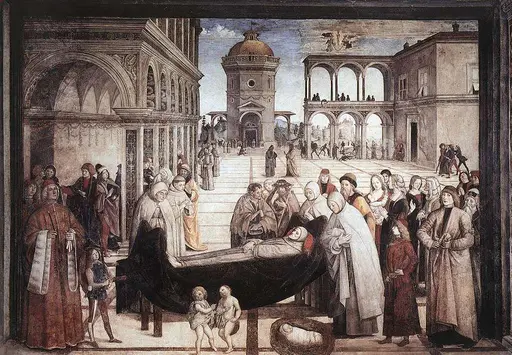
He died on May 20, 1444, and only six years later, in 1450, Pope Nicholas V canonized him a saint.
Follow the Live Updates of Pope Leo’s Health and Preparations for Surgery available at EWTN News.
This article was originally published by EWTN News English.
This story was first published on May 15, 2011, and was updated Oct. 13, 2026.